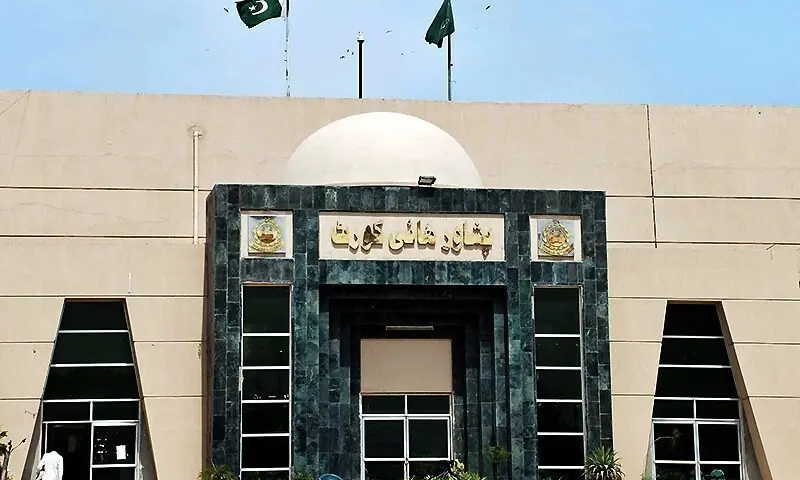

PESHAWAR: The Peshawar High Court has declared the calls for lawyer strikes illegal and unconstitutional and directed all courts in the province to proceed with cases without adjournment on account of strike.
A bench consisting of Justice Syed Arshad Ali and Justice Wiqar Ahmad, after discussing the matter in detail, ruled: “Consequently, all courts across Khyber Pakhtunkhwa shall refrain from adjourning cases merely because lawyers are on strike and shall proceed with judicial business uninterrupted.”
“Where counsel fails to appear, appropriate legal and procedural measures may be adopted to ensure the orderly conduct of proceedings,” the bench ruled, directing the additional registrar (Judicial) of the high court to circulate this judgement to all courts of the province for strict compliance and guidance.
The bench gave its findings in a 43-page detailed verdict on multiple petitions filed by senior lawyers Shabbir Hussain Gigyani and Ali Azim Afridi, challenging the suspension of their practicing licenses by the Pakistan Bar Council and KP Bar Council, respectively.
Directs courts not to adjourn cases on that account
Through a short order on Oct 15, the bench accepted their pleas and declared suspension of their licences illegal and unconstitutional. It has now released its detailed judgement authored by Justice Syed Arshad Ali.
“In view of the foregoing discussion, it is abundantly clear that any strike notices or directives issued by a Bar Association, calling upon advocates to abstain from appearing in courts, are without legal authority, constitutionally impermissible, and void of any binding force. The case law discussed earlier uniformly affirms that strikes or boycotts by lawyers, which obstruct access to courts, violate professional ethics and cannot be condoned under any circumstances,” it said.
The bench declared that any bar-issued strike directive seeking to restrain advocates from performing their professional duties on grounds of protest or association was illegal, ultra vires, and unenforceable; the constitutional mandate to ensure fair trial, protection under the law, and uninterrupted legal representation must prevail as the highest guiding principle, and the duty of an advocate to their client stands supreme over all such extraneous directives.
“To protest within the limits of law is a recognised right and may be exercised through dignified means such as wearing black armbands, displaying banners, or convening peaceful assemblies. But halting the functioning of courts, thereby jeopardising thousands of pending claims and draining public resources, is neither lawful nor tolerable,” it observed.
Expressing concern over the waste of public funds due to strikes, the bench observed that as a routine occurrence before it as well as hundreds of civil, criminal, family and special courts across the province, thousands of cases stood adjourned solely on account of strikes called by lawyers.
It added that such adjournments not only amounted to an abuse of the process of law and obstructed the constitutional guarantees of access to justice but also inflicted a staggering financial burden upon the exchequer.
The court pointed out that according to the high court’s Statement of Budget for 2024-25, the daily operational cost of the Peshawar High Court and its benches was around Rs14.986 million, while the daily expenditure of the sessions courts throughout the province totalled Rs19.628 million and that of civil courts in the province Rs23.041 million.
It added that the cumulative direct operational cost of the judicial machinery that went to waste on every day of strike exceeded Rs57 million, exclusive of the substantial development budget.
“These figures do not account for the cascading losses borne by other institutions compelled to remain operational despite the paralysis of court work: the advocate general’s office at the principal seat and benches, hundreds of prosecutors across the province, district attorneys and law officers attached to every court, police personnel deployed for court security in more than thirty-five districts, and hundreds of official witnesses who travel daily to depose but are turned back unheard. Above all, the litigant public, many of whom journey from far-flung areas at considerable personal expense, arrive only to learn that their matters will not proceed,” it observed.
The bench ruled that the human cost of such disruption was immeasurable; the financial cost was shocking, and the systemic cost was alarming.
“In an era where judiciaries across the world are transitioning toward digital systems and AI enabled models for efficient justice delivery, the recurring suspension of court proceedings on the pretext of strikes represents a regressive and unsustainable practice,” it declared.
About the suspension of licences of the petitioners, the bench ruled that the statutory scheme left no room for doubt: disciplinary control over advocates was a matter reserved exclusively for the disciplinary committees and tribunals constituted under sections 10, 15, 41 and 42 of the Act of 1973 (Legal Practitioners and Bar Councils Act), read with the corresponding rules.
It added that those bodies alone were vested with the jurisdiction to receive complaints, conduct inquiries, order interim suspensions and impose penalties.
“Neither the Executive Committee nor the Appellate Committee of the Khyber Pakhtunkhwa Bar Council, nor for that matter any bar association, forms part of this legally mandated disciplinary hierarchy. Their functions are administrative and facilitative and not adjudicatory. Consequently, any action initiated or order passed by such bodies, whether suspending an advocate’s licence, restricting appearance before courts, or otherwise impairing the statutory right to practice, stands outside their conferred authority. Such actions are ultra vires the Act, devoid of procedural legitimacy, and wholly unsustainable in the eyes of law,” the bench declared.
Published in Dawn, December 7th, 2025