ACHIEVING true national cohesion is not possible unless Pakistanis of all confessional backgrounds are ensured their fundamental rights. Sadly, over the decades we have witnessed the space for non-Muslim minorities shrink considerably. This has been manifested in the form of prejudice and discrimination that these communities face, while in worse instances, non-Muslim citizens, their properties and places of worship have come under violent attack from extremists.
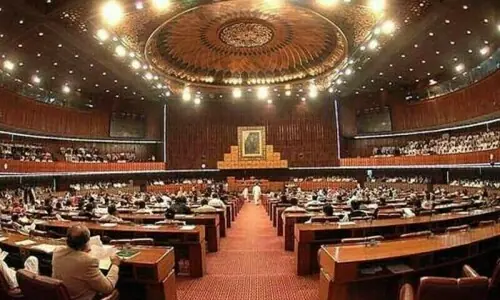
The state has pledged after every such atrocity to protect minorities and crack down on extremism. Yet to achieve both goals, institutional responses are required, and the state has a mixed report card in this area. In a related development, the National Commission for Minorities Rights Bill, 2025, was passed by parliament on Tuesday in order to create a proper framework to address the issues of non-Muslim citizens.
The federal law minister told parliament that the commission would look into issues such as forced conversions, job quotas, sanitation workers’ rights and other “matters of dignity”. The bill’s passage faced significant opposition from both religious and mainstream parties over its proviso that it would have ‘overriding effect’ — meaning that when passed, it would have precedence over previous laws. Many felt this would dilute earlier laws which concerned the Ahmadi community.
In order to get the legislation passed, that clause, as well as suo motu powers for the minorities commission, were dropped. While theological matters are best left to scholars and ulema, when it comes to basic constitutional protections, the fundamental rights of all communities must be protected and guaranteed.
This would not be the first body concerning minorities’ rights in the country. The human rights ministry and the National Commission for Human Rights do similar work, and provincial bodies to protect non-Muslims’ rights already exist. Moreover, a minority rights commission had previously been formed. What the current bill does is give the commission a statutory status.
Creating a dedicated body for the welfare of minorities, and the protection of non-Muslims’ rights, is a welcome step. Yet the body has much work to do in order to create a level playing field for non-Muslim Pakistanis. This body, along with all state organs, must work proactively to address the key issues affecting minorities, and work to resolve these as per the demands of justice.
Moreover, a complementary effort is needed to counter extremism and zealotry in society. Laws and commissions matter little when rabble-rousers decide to work up mobs using religious justifications. Therefore, the primary effort of the state should be to penalise hate-mongers. If incidents targeting minorities occur, then those who are involved in violent episodes need to be swiftly brought to justice. Through such combined endeavours, the journey towards a more equal Pakistan can begin.
Published in Dawn, December 4th, 2025