Peshawar High Court turns down pleas of KP CM, PTI candidate against ECP notices


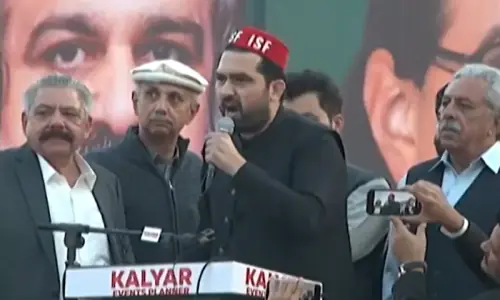
PESHAWAR: Rejecting the pleas of Khyber Pakhtunkhwa Chief Minister Mohammad Sohail Afridi and a candidate supported by the ruling Pakistan Tehreek-i-Insaf in the recent by-elections in Haripur, Sheharnaz Omar Ayub, against the issuance of the Election Commission of Pakistan’s (ECP) notices to them, the Peshawar High Court on Wednesday ruled that since no adverse action had so far been taken against the petitioners, it was too early to take up the matter.
A bench consisting of Justice Syed Arshad Ali and Justice Wiqar Ahmad ruled: “Suffice it to hold that, at present, the petitions are premature and do not call for interference by this Court, as no adverse order has been passed against the petitioners so far.”
While not giving any opinion over the jurisdiction of the ECP in the matter, it observed that it expected that the ECP, in the first instance, would determine its jurisdiction in the matter before proceeding further with the inquiry.
Mr Afridi and Ms Sheharnaz, who is the wife of former Leader of the Opposition in the National Assembly and PTI leader Omar Ayub Khan, had requested the high court to declare illegal and set aside the impugned notices issued to them by the ECP on Nov 20 for allegedly violating the code of conduct announced for the by-election in NA-18 Haripur, where polling was held on Nov 23.
Declares case can’t be taken up as no adverse order issued against petitioners
“It is evident from the available record and the respective contentions of the parties that, so far, no adverse order has been passed against the petitioners. The impugned proceedings are aimed at inquiring into the allegations of violation of the Code of Conduct/offence under the Act (Elections Act, 2017),” the bench declared in a six-page order.
It added that as the inquiry was at a very initial stage, it was not inclined at the current stage to render any opinion on the jurisdiction of the ECP, lest it prejudiced the case of either party at a subsequent stage.
The petitioners were represented by advocates Bashir Khan Wazir, Abdul Rahman Qadar and Shahzeb Qadar Khan, whereas ECP’s additional director general (law) Khurram Shehzad and director (monitoring) Aziz Bahadar also appeared before the court.
The counsel for petitioners said that the mechanism for disposal of complaints, reports for violation of the Elections Act or rules and inquiry, more particularly, about the violation of the code of conduct had been provided under Section 234 of the Act.
They said that the mechanism provided that the commission should constitute a monitoring team consisting of such number of persons as might be determined by it, to monitor election campaign of the candidates and political parties and report, on regular basis in the prescribed manner, to an officer nominated by the commission in respect of each district for the purpose of deciding the complaints regarding any violation by a candidate or a political party of any provision of the Act, rules or the code of conduct.
The counsel said that the nominated officer, after holding summary inquiry, found that the reported violation had been committed and as no other punishment was provided under the Act for such violation, he could impose a fine not exceeding Rs50,000.
They added that if such violation was observed for the second time, it could lead to proceedings for disqualification and that if any party was aggrieved of any such order, they could file an appeal before the commission.
The lawyers argued that the ECP notices violated the mechanism provided under Section 234 of the Act, so the commission had no jurisdiction in the matter.
They insisted that the chief minister had only warned that action would be taken against those found involved in rigging the by-polls.
The representatives of the ECP argued that under Article 218(3) of the Constitution as well as Section 15 of the Act, the Election Commission had the jurisdiction to look into the offences of bribery, personation, undue influence and corrupt practices as provided under the Act.
They argued that the chief minister was charged with seriously violating the election code of conduct and threatening the commission’s officers with dire consequences, so his act amounted to corrupt practices punishable under Chapter X of the Act.
Published in Dawn, November 27th, 2025