Ash cloud from Ethiopian volcano eruption to have no significant impact on southern Pakistan, says PMD

The ash cloud from a volcanic eruption in northeastern Ethiopia would have no significant impact on the coastal areas of Pakistan, including Karachi, and would pass over the Arabian sea, confirmed the Pakistan Meteorological Department (PMD) on Monday.
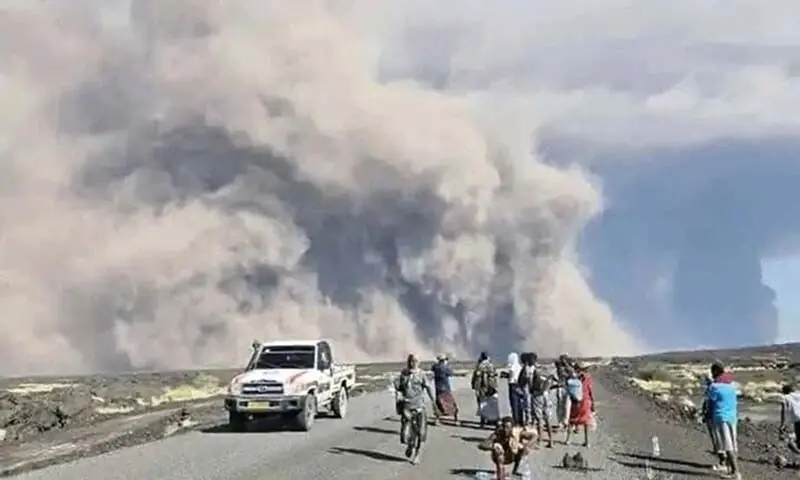
The Hayli Gubbi volcano, located in Ethiopia’s Afar region about 800 kilometres northeast of Addis Ababa near the Eritrean border, erupted on Sunday for several hours. This was the first recorded eruption in nearly 12,000 years.
The eruption sent thick plumes of smoke up to 14 kilometres into the sky, blanketing nearby villages and drifting toward the Arabian Sea region. The volcano, which rises about 500 metres in altitude, sits within the Rift Valley, a zone of intense geological activity where two tectonic plates meet.
Met Office Spokesperson Anjum Nazeer Zaighum, while speaking to Dawn, said the effects of the ash cloud would not be felt in Karachi and it would pass over the Arabian Sea.
“The projections are from last night, and the impact would be felt in the deep Arabian Sea, in Oman, and within the Mumbai FIR (flight region),” the spokesperson explained, referring to earlier projections by Toulouse Volcanic Ash Advisory Centre (VAAC) which stated that the ash cloud would affect southern Pakistan after passing over Yemen and Oman.
The spokesperson added that the ash cloud would be at an altitude of around 50,000 feet. He elaborated that the ash cloud was witnessed 60 nautical miles south of Gwadar today and the office has issued a warning to the concerned authorities, which is still in place.
A local resident told The Addis Standard that the eruption occurred eight kilometres from the main mountain itself.
“Afar TV … described a “massive eruption” late in the morning, noting that the force and sound of the blast were stronger than any previous events recalled by residents,” the Standard reported.
“‘We were extremely shocked by the sound and engulfed in fear,’ one resident said. Phone interviews conducted by the station indicated that the sound and its effects were felt as far away as Djibouti, Tigray and towns in the Wollo area.”
The Standard reported that the explosion caused tremors in the surrounding area and could be heard as far away as Djibouti. The subsequent ash cloud plunged surrounding settlements into “near-darkness”.

Citing Dutch news agency BNO News, the Standard said that the eruption began at 8:30am UTC (1:30pm PKT) and explosions continued throughout the afternoon.
“An advisory from the Toulouse Volcanic Ash Advisory Centre (VAAC) said ash rose to about 45,000 feet (13.7 km) before activity subsided,” the Ethiopian outlet reported, adding that according to the latest VAAC update they received, the eruption had reportedly stopped.
The Smithsonian Institution’s Global Volcanism Program said Hayli Gubbi has had no known eruptions during the Holocene, which began around 12,000 years ago at the end of the last Ice Age.
Simon Carn, a volcanologist and professor at the Michigan Technological University, confirmed on Bluesky that Hayli Gubbi “has no record of Holocene eruptions”.
An update from flight tracking monitor FlightRadar at 3:31am this morning showed the projected path of the ash cloud, which was being blown towards the Arabian Peninsula and the Arabian Sea.
Pakistan will come directly in its path, the monitor showed in its post, stating that the cloud would arrive in approximately 18 hours.
An interactive map from VAAC shows that the ash cloud will pass over southern Sindh before heading northeast into India.

Additional reporting by AFP