The government is set to approve the first ‘Women Entrepreneurship Development Policy’ (WEP) in the coming days, aiming to bring almost half of the country’s population into the formal productive sectors. Officials envisage that promoting women’s entrepreneurship will lead to the growth of small and medium enterprises (SMEs) and cottage industries in the country.
Though the policy is expected to be approved, the key challenge will be to convince the provinces to adopt it while also eradicating duplications to ensure smooth implementation.
The WEP aims to create an equitable and inclusive business environment for women entrepreneurs through measures such as supporting women working informally to transition to the formal sector, exploring new corporate regimes for small business owners, and developing fiscal policy packages and reducing regulatory costs, focusing on ease of doing business.
The other key initiative suggested is to promote women’s financial inclusion through dedicated financing for women-specific initiatives, expanding existing federal and provincial programmes, and ensuring that all banks fully implement the State Bank of Pakistan’s equality policy.
The main barrier for women-led businesses, SMEs, and cottage industries isn’t just financing and safety, but a lack of government support and fragmented responsibilities across ministries
Moreover, the policy aims to promote women’s access to markets by setting up display and exhibition facilities. The policy added that institutional support for women entrepreneurs is vital to address cross-cutting and multi-sectoral challenges, recognising the need to support high-growth women entrepreneurs in technology and proposing measures such as a Women’s Entrepreneurship Platform, women-specific incubators, and dedicated spaces in technology parks.
Among other things, the policy has highlighted a methodology to promote access to information, awareness creation and advocacy. This is essential because most of the 28 women’s chambers of commerce and industry (WCCIs) across the country do not have a functioning website, and even those that do lack promotional links showcasing their members’ businesses.
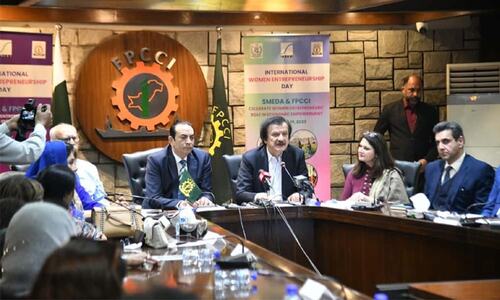
Haroon Akhtar Khan, Special Assistant to the Prime Minister on Industry, acknowledged that currently, women’s businesses and chambers are considered supplementary sources of income for families or just sideline activities of a mainstream family business.
He said the government was taking steps to promote SMEs and cottage industries, including relocating the Small and Medium Enterprise Development Authority (Smeda) headquarters from Lahore to Islamabad to facilitate regular interactions with them. He added that implementing the ‘Women Entrepreneurship Development Policy’ will promote women’s business ventures.
“We understand that empowering women to develop entrepreneurship is based on their local knowledge and expertise, as there is no single solution or business that can be applied to all communities,” Mr Khan said, “But there are necessities that act like platforms to boost businesses.”
He added that women needed to adopt a digital approach, formalise their businesses (eg, becoming filers), and be more active with their local chambers of commerce, preferably the women’s chambers, to strengthen their voice.
Incidentally, the establishment of WCCIs has sparked a new political tussle among the country’s business community, as almost all existing chambers consider their respective WCCIs their rivals.
Samina Fazil, President and founding member of Islamabad WCCI, complained that almost all WCCIs in the country have offices in rented space, and that the necessary government support to encourage women-led businesses, SMEs, and cottage industries is not visible. “The chambers have given two slots for female entrepreneurs in their executive body and silently discourage women from joining the WCCIs,” Ms Fazil added.
Similarly, Falahat Imran, President of Lahore WCCI, said that WCCIs should be treated as equals. “We have tried and tested the previously built chambers and the government. The stark reality is that we are on our own.” She said that WCCIs have to keep trying their best: “We will keep moving forward.”
The WCCIs experience low membership retention due to several reasons, including cultural and societal pressures that limit independent women’s participation in business activities and leadership roles. Unfortunately, male-dominated industries are also visibly reluctant to include women-led businesses in collaborative initiatives.
Amna Munawwar Awan, Founder and President of Khushab WCCI, said that they face challenges in mobilising women entrepreneurs from rural and underdeveloped areas due to insufficient access to market linkages, both local, national, and international, restricting their growth.
“Rural women have issues related to safety, mobility, and transportation, reducing attendance in chamber activities and trainings,” Ms Awan added.However, the key reasons restricting the development of women-led businesses, SMEs, and the cottage industry in the country were not the unavailability of financing, safety, or lack of initiatives alone. But the roles and responsibilities in this regard are spread across different ministries and government departments.
While Smeda was under the Ministry of Industries, the banking sector had a different regulator, and the Chambers of Commerce and Industry and export-related issues were under the Ministry of Commerce.
Similarly, on-the-ground responsibilities, including law and order, are distributed among several departments in the respective provinces. Bringing all provincial and federal departments under a single vision and target has always been a challenge in Pakistan.
Published in Dawn, The Business and Finance Weekly, November 24th, 2025