Nato tests new anti-drone defences to counter Russia
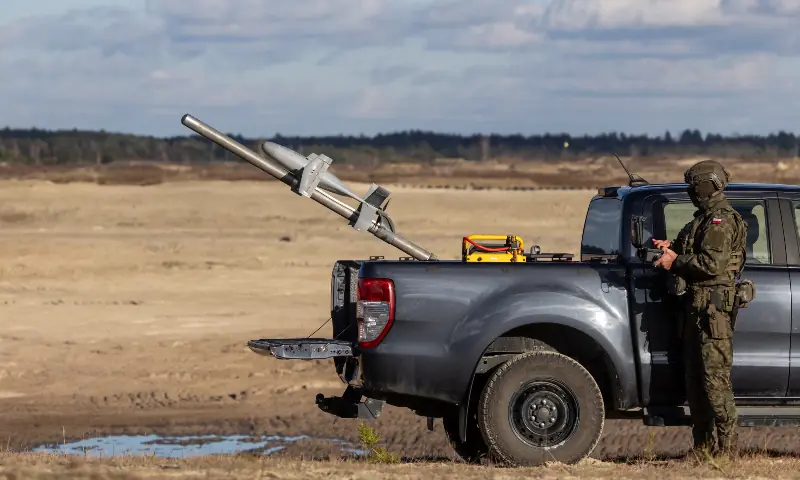

NOWA DEBA: Polish troops launched a drone from the back of a pick-up truck on Tuesday as they trained some 100 kilometres from the Ukrainian border to use a new US-made system designed to counter the threat from Russia.
Guided by a pilot, the unmanned craft swooped through the winter sky on the hunt to destroy its target: a simulated version of one of the attack drones Moscow regularly uses against Ukraine.
The deployment of the Merops system is part of Nato’s hurried efforts to shore up its eastern flank after the alliance scrambled jets in September to shoot down Russian drones over Poland.
That incident, followed by a string of unexplained drone flights that rattled other European countries, served as a wake-up call of the continent’s vulnerabilities almost four years after Russia’s invasion of Ukraine.
In response, Nato has bolstered its forces nearest Russia and the European Union has hastily drawn up plans to build a system of anti-drone defences.
Plugging the gaps
On Nato’s recommendation, Poland and fellow eastern flank country Romania have quickly acquired a handful of the Merops systems to help plug the gaps in the short-term.
The technology, produced by a firm backed by ex-Google CEO Eric Schmidt, has already proved its worth downing Russian drones in Ukraine.
“The system is one of the most effective killers of Russia’s Shahed drones,” US General Curtis King told journalists invited to view the training at a Polish military base, referring to Iranian-designed drones Russia is using massively.
“We estimate it is responsible for 40 per cent of those drones killed in Ukraine.” Crucially, it is also relatively cheap.
Back in September Nato was forced to use its latest F-35 fighter jets firing missiles worth a million dollars each to down Russian drones costing tens of thousands of dollars.
That was clearly unsustainable given that the Kremlin has regularly sent swarms of hundreds of such drones into Ukraine.
In comparison the drones fired by the Merops system only cost some $15,000 each.
The Merops — which can use artificial intelligence to target enemy drones — is just one of numerous similar systems that Nato countries are testing as they seek to rush more capabilities into use.
Gap-filler
Polish, Romanian and US troops underwent some 20 days of training to be able to handle it.
“Once you get your hands on, it’s pretty simple to catch on,” said US sergeant Corey Myers.
“For our younger kids, as long as you’re good with an Xbox controller, it’s very intuitive.”
Given the limited number of such anti-drone systems in Nato hands and the huge areas it has to defend, there is little chance of making the alliance’s eastern flank airtight against Russian incursions.
“To defend such a vast area effectively, I think it might almost be impossible,” said Robert Tollast, a military expert at the UK’s RUSI think tank.
Instead officials and analysts say the systems could be best used deployed around key sites like power stations, airports and military bases.
That means they could help serve to deter the sort of drone disruptions seen recently in countries such as Denmark, Germany and Belgium.
With the EU’s push to develop its own capacities likely to take time, Polish commanders said they see the US system as a stepping stone.
“This system is now battle-tested in Ukraine, and the results there are very encouraging. So we decided to get it as a gap-filler,” said Gen Stanislaw Czosnek, deputy commander of the Polish armed forces.
Published in Dawn, November 19th, 2025