Economic Coordination Committee approves grants for security, defence projects


 1
1
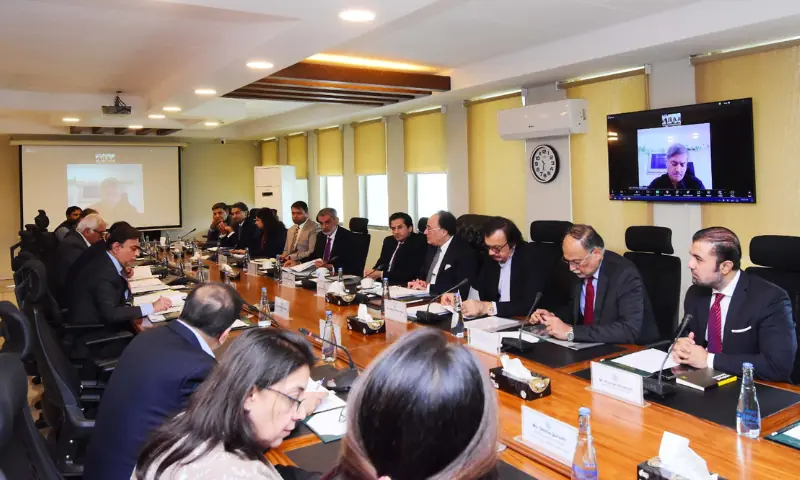

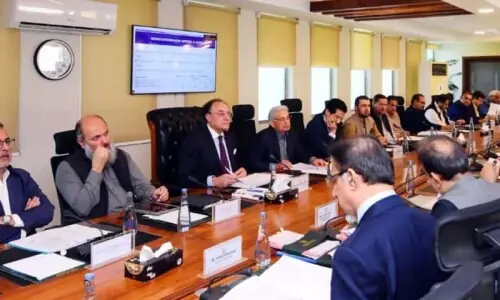
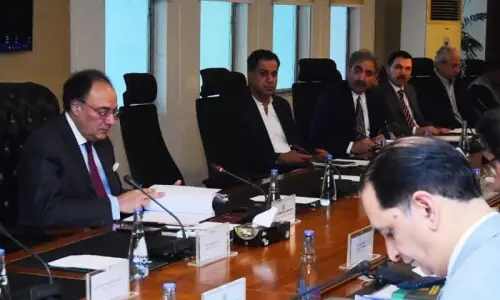
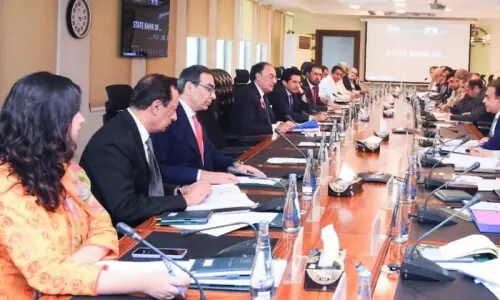
The Economic Coordination Committee (ECC) on Tuesday approved grants pertaining to Pakistan’s security and defence.
In a post on social media platform X, the finance ministry said Finance Minister Muhammad Aurangzeb chaired a meeting of the ECC that was attended by federal ministers, special assistants to the prime minister, secretaries, and senior officials from relevant divisions.
It said the ECC approved “several strategic grants and reforms aimed at strengthening Pakistan’s security framework, defence capabilities, food security, and petroleum sector operations”.
According to the ministry’s statement, a technical supplementary grant of Rs100.3 million was approved for the maintenance of defence equipment used by the federal civil armed forces.
A technical supplementary grant of Rs841.56m was also approved for enhanced border management, internal security and law and order. Further, a technical supplementary grant of Rs50 billion was also approved for defence services projects.
The ECC also decided to establish a new special purpose vehicle, with initial paid-up capital of Rs1,000,000, to take forward the winding up of Pakistan Agriculture Storage and Services Corporation, along with “measures to incentivise foreign participation in offshore oil and gas exploration, including licence extensions and working interest assignments”.
ECC greenlights offshore exploration consortium
Pakistan also approved a new offshore exploration consortium, clearing Turkish Petroleum Overseas Company (TPOC) to take over operatorship of the Eastern Offshore Block-C as part of a push to revive drilling, Adviser to the Finance Minister Khurram Schehzad said.
The ECC approved Pakistan Petroleum Limited’s request to assign part of its interest in the block to TPOC, Mari Energies and state-run Oil and Gas Development Co Ltd, leaving PPL with a 35 per cent stake.
TPOC will hold 25pc and will operate the block once a formal agreement is signed.
“This will bring valuable international offshore operating experience to Pakistan’s exploration landscape and this transition is expected to enhance technical capabilities, operational efficiency, and overall project delivery,” Schehzad wrote on X.
He said the block contains a drill-ready prospect that the consortium will now pursue, a step he added could attract fresh foreign investment.
“With the ECC’s approval, the consortium is now set to advance preparations for drilling operations, marking a new chapter in the country’s pursuit of energy security and resource development,” he said.
In October, bids were awarded for 23 of 40 offshore blocks offered, covering around 53,500 square kilometres, in the first offshore bidding round since 2007.
Pakistan’s 300,000 square kilometre offshore zone, bordering energy-rich Oman, the United Arab Emirates and Iran, has seen just 18 wells drilled since independence in 1947; too few to fully assess its hydrocarbon potential.
Finmin meets delegation representing group founded by tech entrepreneurs
Separately, Finance Minister Aurangzeb held a meeting with a high-level delegation representing Dialog, an invite-only network founded by tech entrepreneurs Peter Thiel and Auren Hoffman.
In a handout, the ministry said the delegation was led by Ambassador Ali Jehangir Siddiqui and also included UK House of Lords Member Simon Stevens, Austrian MP Veit Valentin Dengler, Norwegian MP Himanshu Gulati, Jigsaw Chief Executive Officer Yasmin Green, Xbox-Microsoft Vice President Fatima Kardar and others.
The ministry said that during the meeting, the minister highlighted Pakistan’s economic reforms.
He also stressed the government’s focus on tax reform, energy sector restructuring, privatisation of state-owned enterprises, governance reforms, and rationalisation of federal expenditures.
“He emphasised efforts to broaden and deepen the tax base by integrating technology and artificial intelligence-based monitoring, enhancing compliance, and bringing under-taxed sectors such as real estate, agriculture, and wholesale/retail into the tax net,” the press release said.
The minister also discussed ongoing pension reforms, including the shift to contributory schemes for new entrants and upcoming measures to tackle long-term fiscal liabilities.
Aurangzeb outlined governance improvements in electricity distribution companies, loss-reduction initiatives, private-sector representation on boards, and a renewed privatisation pipeline.
“He reaffirmed the government’s commitment to a competitive tariff regime, long-term sustainability, and greater private-sector participation,” the handout said.