Saudi crown prince expresses support for Abraham Accords, seeks ‘clear path’ for Palestinian statehood


Saudi Crown Prince Mohammed bin Salman said Tuesday his country wanted to normalise relations with Israel through US President Donald Trump’s Abraham Accords, but first needed a “clear path” to Palestinian statehood.
“We want to be part of the Abraham Accords. But we want also to be sure that we secure a clear path to a two-state solution,” the prince said in the Oval Office alongside Trump.
“We’re going to work on that, to be sure that we can prepare the right situation as soon as possible,” he added.
Trump said that he received a “positive response” from the Saudi crown prince about joining the Abraham Accords.
The US president made the remarks in response to a question during a joint press conference with the Saudi Crown Prince, also known as MBS, during his visit to Washington.
When asked about selling F-35 stealth fighter jets to Saudi Arabia, Trump replied in the affirmative, adding that they would be “pretty similar” to those owned by Israel, the jet’s sole operator in the Middle East.
“When you look at the F-35 and you’re asking me if it’s the same, I think it’s going to be pretty similar,” he explained. “They’ve been a great ally, Israel’s been a great ally and we’re looking at that exactly right now. As far as I’m concerned, they’re both at a level where they should get top of the line.”
In response to another question about a defence agreement between Washington and Riyadh, Trump said he and MBS have “pretty much reached an agreement”. When asked if the aforementioned F-35 jets would be part of the agreement, Trump said that it would be a separate deal.
“We’re going to sell them F-35s. We’re going to have a deal, they’re going to … buy them from Lockheed,” Trump said, referring to the aircraft’s manufacturer.
MBS arrives at the White House
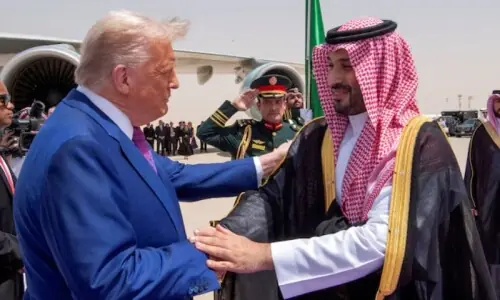
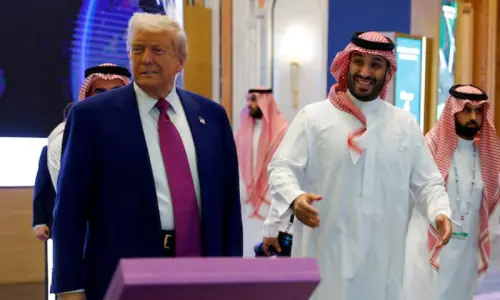
Earlier, President Donald Trump welcomed Crown Prince Mohammed bin Salman to the White House, with the Saudi de facto ruler seeking to further rehabilitate his global image after the 2018 killing of United States-based journalist Jamal Khashoggi and deepen ties with Washington.
Making his first White House visit in more than seven years, the crown prince was greeted with a lavish display of pomp and ceremony presided over by Trump on the South Lawn, complete with a military honour guard, a cannon salute and a flyover by US warplanes.
Talks between the two leaders are expected to advance security ties, civil nuclear cooperation and multibillion-dollar business deals with the kingdom. But there will likely be no major breakthrough on Saudi Arabia normalising ties with Israel, despite pressure from Trump for such a landmark move.
The meeting underscores a key relationship — between the world’s biggest economy and the top oil exporter — that Trump has made a high priority in his second term as the international uproar around the killing of Khashoggi, a Saudi insider-turned-critic, has gradually faded.
US intelligence concluded that MBS approved the capture or killing of Khashoggi. The crown prince denied ordering the operation but acknowledged responsibility as the kingdom’s de facto ruler.
The warm welcome he has received in Washington is the latest sign that relations have recovered from the deep strain caused by Khashoggi’s murder.
Trump greeted MBS with a smile and a handshake on the red carpet, while dozens of military personnel lined the perimeter. The limousine was escorted up the South Drive by a US Army mounted honour guard. The two leaders then looked skyward as fighter jets roared overhead, before Trump led his guest inside.
During a day of White House diplomacy, MBS will hold talks with Trump in the Oval Office, have lunch in the Cabinet Room and attend a formal black-tie dinner in the evening.
Trump hopes to cash in on a $600 billion Saudi investment pledge made during his visit to the kingdom in May. A senior White House official told Reuters that US-Saudi deals on technology, manufacturing, defence and more are expected.
Trump told reporters on Monday, “We’ll be selling” F-35s to Saudi Arabia, which has requested to buy 48 of the advanced aircraft.
This would be the first US sale of the fighter jets to Saudi Arabia and mark a significant policy shift. The deal could alter the military balance in the Middle East and test Washington’s definition of maintaining what the US has termed Israel’s “qualitative military edge”.
Until now, Israel has been the only country in the Middle East to have the F-35.
Beyond military equipment, the Saudi leader is seeking security guarantees, access to artificial intelligence technology and progress on a deal on a civilian nuclear programme.
“The Saudis will be spending a lot of money tomorrow on the US,” a senior White House official told Reuters on Monday.
Eye on China
Former US negotiator in the Middle East Dennis Ross, who is now at the Washington Institute for Near East Policy, said Trump wants to develop a multifaceted relationship that keeps Saudi Arabia out of China’s sphere.
“President Trump believes all these steps bind the Saudis increasingly to us on a range of issues, ranging from security to the finance-AI-energy nexus. He wants them bound to us on these issues and not China,” Ross said.
Trump is expected to pressure MBS for Saudi Arabia to join the Abraham Accords and normalise relations with Israel.
The Saudis have been reluctant to take such a major step without a clear path to Palestinian statehood, a goal that has been forced to the back burner as the region grapples with the Gaza onslaught.
Trump reached Abraham Accords agreements between Israel and Bahrain, the United Arab Emirates, Morocco and Sudan during his first term in 2020. In recent weeks, Kazakhstan agreed to join.
But Trump has always seen Saudi Arabia joining the Abraham Accords as the linchpin to achieving a wider Middle East peace.
“It’s very important to him that they join the Abraham Accords during his term and so he has been hyping up the pressure on that,” the senior White House official said.
Jonathan Panikoff, former deputy national intelligence officer on the Middle East, said that while Trump will urge MBS to move toward normalising ties with Israel, any lack of progress there is unlikely to hinder reaching a new US-Saudi security pact.
“President Trump’s desire for investment into the US, which the crown prince previously promised, could help soften the ground for expanding defence ties even as the president is determined to advance Israeli-Saudi normalisation,” said Panikoff, now at the Atlantic Council think tank in Washington.