• Russia and China expected to abstain as UN Security Council votes on American draft resolution
• Pakistan among nations that have ‘signed off’ on US draft
• World Bank role sought to set up trust fund to finance reconstruction phase
• ‘Reformed’ Palestinian Authority billed to take over administrative functions after eventual Israeli withdrawal
• Washington commits to providing pathway to ‘Palestinian state’
WASHINGTON: Egypt will have a central role in post-war Gaza, being the only member of the Muslim bloc with a direct say in the formation of the proposed Board of Peace (BOP) and the shape of the International Stabilisation Force (ISF) that will secure the war-ravaged enclave following an eventual Israeli withdrawal.
According to the draft of the resolution tabled before the UN Security Council by Washington on Monday, Egypt and Israel — alongside the BOP — will have a final say on how the proposed international force operates.
A flurry of activity is expected during Monday’s UNSC sitting, which is scheduled to vote on the US-sponsored resolution. The UNSC session, scheduled for 5pm New York time (3am Pakistan time) was yet to begin at the time of going to press.
Earlier, a senior UN diplomat told reporters that Russia has not yet decided whether it will submit its draft resolution on creating an international force for Gaza, although it appears unlikely that they will put it to a vote.
The diplomat noted that the Russian draft, which competes with the American resolution, makes no reference to the Peace Council that would be established under the US proposal and chaired by President Donald Trump.
At UN Headquarters, the prevailing view is that the Russian draft resolution is unlikely to move forward.
The main reason is that the American draft has strong support from Arab and other Islamic countries, as well as backing from European, Latin American and African states.
Arab and other Islamic governments, along with the Palestinian Authority, have already issued public statements supporting the American text, while China and Russia do not see a need to oppose the united stance of the Arab and Muslim bloc.
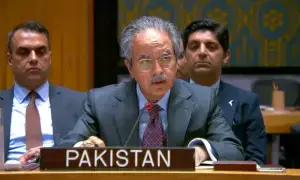
Pakistan has joined the Arab and Islamic statement welcoming and supporting the American draft. Algeria has done the same, although both Pakistan and Algeria had initially wanted a clear roadmap for a future Palestinian state.
Both China and Russia are expected to abstain, allowing the American draft resolution to pass.
Transitional governance
The resolution circulated among Security Council members — which has undergone at least three rounds of amendments over the past week — seeks “a credible pathway to Palestinian self-determination and statehood”, but makes nearly every element of Gaza’s reconstruction — including the operations of the proposed ISF — subject to approval by the BOP and Israel.
The ‘blue draft’ of the US-sponsored resolution — shared with other members of the Security Council ahead of Monday’s vote — seeks recognition for the BOP as an entity with “international legal personality”, and calls on the World Bank and other financial institutions to establish a dedicated trust fund to support reconstruction and development efforts.
In addition, a Transitional Peace Council — to be chaired by President Trump — is envisioned as being tasked with overseeing Gaza’s affairs until December 2027. Operational entities working under this council will be financed through voluntary donor contributions and government support. The text stresses that these bodies would function as transitional administrations, not political governments.
The resolution also seeks UNSC authorisation for the proposed ISF until the end of 2027, making it contingent on approval from the BOP, Israel and Egypt.
“The ISF shall work with Israel and Egypt, without prejudice to their existing agreements, along with the newly trained and vetted Palestinian police force, to help secure border areas; stabilise the security environment in Gaza by ensuring the process of demilitarizing the Gaza Strip,” it says.
Its primary role would be to assist the BoP in monitoring the implementation of the ceasefire in Gaza, and will be funded through voluntary contributions.
Israeli withdrawal
One key revision concerns Israel’s withdrawal. Tel Aviv’s forces would withdraw in “standards, phases and timetables” linked to a disarmament process negotiated among the Israeli military, the international force and guarantor states — including the United States.
Importantly, the ‘blue draft’ – a term used to denote versions of resolutions that are cleared for introduction before the Security Council – envisions the Palestinian Authority (PA) taking over the administration of Gaza following a comprehensive reform programme.
When the PA, which is currently responsible for the West Bank and other Palestinian territories, is “securely and effectively take back control of Gaza”, the resolution envisions that Washington will “establish a dialogue between Israel and the Palestinians to agree on a political horizon for peaceful and prosperous coexistence”.
This language indicates broader recognition in the West for the “two-state solution” and charts a path for Palestinian statehood.
The resolution also calls on all UNSC “member states and international organisations to work with the BoP to identify opportunities to contribute personnel, equipment, and financial resources to its operating entities and the ISF, to provide technical assistance to its operating entities and the ISF, and to give full recognition to its acts and documents.”
Egypt’s significance
Egypt was the first Arab nation to recognise Israel and establish formal diplomatic ties in 1979. The move led to the return of the Sinai Peninsula, occupied by Israel in 1967, and the signing of security arrangements that included limits on military deployments in the region.
The Camp David Accords were signed by Egyptian president Anwar Sadat and Israeli PM Menachem Begin. The accords, negotiated in secret at a US presidential retreat located in Maryland, laid the foundation for ties between the two nations.
However, the United Nations condemned the move, as there was no Palestinian participation. There was widespread opposition in Egypt and the wider Arab world to the peace treaty, and Sadat was later assassinated during a military parade in Cairo in 1981.
Published in Dawn, November 18th, 2025