Three deep-sea ports to expand maritime footprint


 0
0

KARACHI: Maritime Minister Muhammad Junaid Anwar Chaudhry on Thursday constituted a high-level, multi-agency committee to identify potential sites for the establishment of new deep-sea ports, in a bid to prepare the country for the next century of maritime expansion and economic transformation.
The 12-member committee would hold its maiden meeting next week and deliberate on possible locations for developing Port 1, Port 2, and Port 3.
To expedite the process, the committee will meet fortnightly and is tasked with submitting a comprehensive feasibility report, including technical findings, hydrographic maps, satellite data, and investment recommendations to the Ministry of Maritime Affairs within three months.
Pakistan’s coastline spans over 1,024 kilometres from Sir Creek in Sindh to Jiwani in Balochistan, encompassing an Exclusive Economic Zone of approximately 240,000 square kilometres and a continental shelf of nearly 50,000 square kilometres.
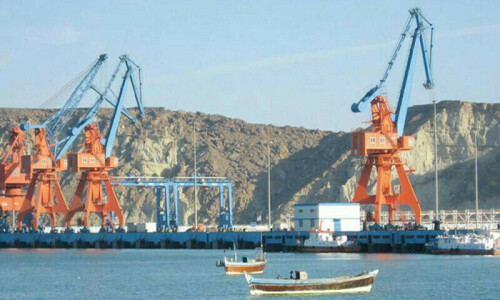
Currently, the three ports in the country are operating below capacity: Port Qasim at about 65 per cent, Karachi Port at 52pc, and Gwadar Port between 5 and 10pc.
Meanwhile, a senior official of the ministry said that the country’s GDP is projected to reach $1 trillion between 2030 and 2035, which will significantly increase the maritime trade and associated industries, while the projections indicate that all three ports could reach full operational capacity between 2035 and 2045 due to growing regional transit trade through CPEC.
The surge in cargo movement, particularly from Afghanistan and the Central Asian Republics, and potential trans-shipment traffic from the Gulf and East Africa, is anticipated in the coming years and could lead to serious congestion at existing ports.
Whereas the rapid coastal urbanisation, tourism development, and expansion of private housing societies along the seafront further complicate the availability of suitable land for new maritime infrastructure along the KPT and the PQA.
To address these challenges, the ministry has envisioned establishing three to four new deep-sea ports equipped with modern cargo handling, green energy integration, and digital port management systems under the ‘Hundred Years Vision’.
The committee comprises representatives from the Port Qasim Authority (PQA), Karachi Port Trust (KPT), Gwadar Port Authority (GPA), the Ministry of Maritime Affairs, the Special Investment Facilitation Council (SIFC), the Surveyor General of Pakistan, Hydrographer of Pakistan, and the governments of Sindh and Balochistan.
Its responsibilities include collecting and reviewing all relevant empirical studies, satellite imagery, and hydrographic surveys to identify and evaluate potential sites along the coastline for new deep-sea ports, port cities, shipyards, and energy hubs.
The committee will analyse hydrographic, oceanographic, and environmental conditions to assess the feasibility of each proposed location.
It will also examine connectivity requirements such as road, rail, and pipeline networks, and assess industrial linkages and logistics corridors to ensure long-term sustainability.
Additionally, the body will assess land availability, environmental sensitivity, security parameters, and proximity to major trade routes, recommending site dimensions, indicative layouts, and investment models for shortlisted locations.
It will propose a phased development roadmap and establish a national framework for prioritising new port projects.
However, coordination with provincial governments and relevant federal agencies will be essential to ensure a unified national approach to maritime expansion and coastal management.
Published in Dawn, November 14th, 2025