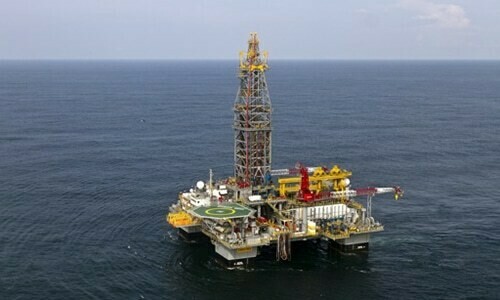
Pakistan revives offshore exploration with 23-block award round

ISLAMABAD: The government has awarded 23 new offshore exploration blocks to three public sector oil and gas producers led by Mari Energies on a provisional basis for three years with investment commitments of about $80 million.
Mari Energies — a joint venture of Fauji Foundation and the federal government and its other entities — has emerged as the leader by securing stakes in all 23 blocks in the bidding round, in which a total of 40 offshore blocks were offered by the government.
The Islamabad-based Mari Energies said that it secured all the 23 blocks, as operator in 18 and as joint venture partner in the remaining five blocks. Mari has 100pc ownership and operatorship in 10 offshore blocks and majority shares along with operatorship of eight others.
Pakistan Petroleum Ltd (PPL) — the country’s oldest producer and Karachi-based state-owned enterprise — secured six blocks as operator and partnership in two others, while the largest producer — Oil and Gas Development Company Ltd (OGDCL), based in Islamabad — was awarded two blocks as operator and six others as joint venture partner.
Mari Energies and partners secure new stakes as govt eyes global investors for next exploration phase
Prime Global Energies — a private firm — also secured operatorship in one block with 31pc stakes, with the remaining 23pc each by Mari, PPL and OGDCL.
These awards are subject to the execution of production sharing agreements (PSAs), the grant of exploration licences, the signing of joint operating agreements (JOAs) among the respective partners, and the completion of other legal and procedural formalities.
The government had received on Oct 31 a total of 23 bids for 40 offshore blocks on offer for exploration. The provisional awards for 23 blocks covered a total area of about 53,510 square kilometres.
Earlier last month, the government had received only one bid for 23 onshore exploration blocks on offer from Mari Energies and that too from Mari Energies. International and local private-sector partners, like Turkish Petroleum, United Energy, Orient Petroleum, and Fatima Petroleum, are also part of these joint venture partners, underscoring growing international interest in Pakistan’s offshore potential, according to the Petroleum Division.
The exploration attempts by leading international firms like Shell and ExxonMobil in Pakistan’s offshore blocks remained unsuccessful, the latest by a consortium led by ExxonMobil about five years ago in Kekra-1, despite the availability of promising hydrocarbon data.
Before initiating the process, the Petroleum Division developed a model production sharing agreement (MPSA), a key document integrated into the bid package, to ensure transparency, competitiveness, and investor confidence. In parallel, the Offshore Petroleum Rules were promulgated to provide a comprehensive regulatory framework, paving the way for renewed offshore exploration in Pakistan’s waters.
A recent basin study conducted by the US firm DeGolyer and MacNaughton (D&M) has indicated a significant yet-to-find potential of hydrocarbons in Pakistan’s offshore basins. Building on this encouraging assessment, the Offshore Bid Round 2025 was launched with a view to offering blocks that allow companies to undertake systematic exploration efforts to test various geological plays across both the Indus and Makran basins.
The Offshore Bid Round 2025 was launched in January this year after a gap of 18 years for the grant of petroleum exploration licenses in 40 Indus and Makan offshore blocks near the jurisdictions of Sindh and Balochistan.
The Petroleum Division said a total of 4,427 work units have been committed for these 23 blocks during Phase-1 of the initial three-year license period, representing an investment of approximately $80 million. The companies have submitted work programmes designed to progressively mitigate the geological risks, and in the event of exploration drilling, investments could reach up to $750m to $1bn, it said.
During Phase-1, the companies will undertake comprehensive geophysical and geological (G&G) studies, including seismic data acquisition, processing, and interpretation, to better define the hydrocarbon potential of Pakistan’s offshore basins. Upon completion of these studies, the Phase-II work programme will be finalised, which will include drilling of exploratory wells in the prospective areas.
The statement said the government strategy to initiate exploration in both the Indus and Makran basins simultaneously paid off, as reflected in the participation and outcome of the bid round. After the completion of G&G work and drilling planning, the ministry will invite global oil majors to join the next phase of offshore exploration, several of whom are already in contact with the government and local companies and are currently evaluating the available data.
Published in Dawn, November 14th, 2025