
In writer-director Guillermo del Toro’s imagining of Mary Shelley’s epic horror novel Frankenstein, the world is strikingly beautiful, but full of vile and sad creatures called humans.
Of particular interest is a man called Victor Frankenstein (Oscar Isaac), a young doctor who has been mentally and physically abused by his strict father — Baron Leopold Frankenstein (Charles Dance) — one of the great doctors of his age who fails to save his pregnant wife, Baroness Claire Frankenstein (Mia Goth in overlong, flowing red veils). Victor, close to his mother, vows to conquer death, which his father, and later fellow doctors, say is an absolute necessity.
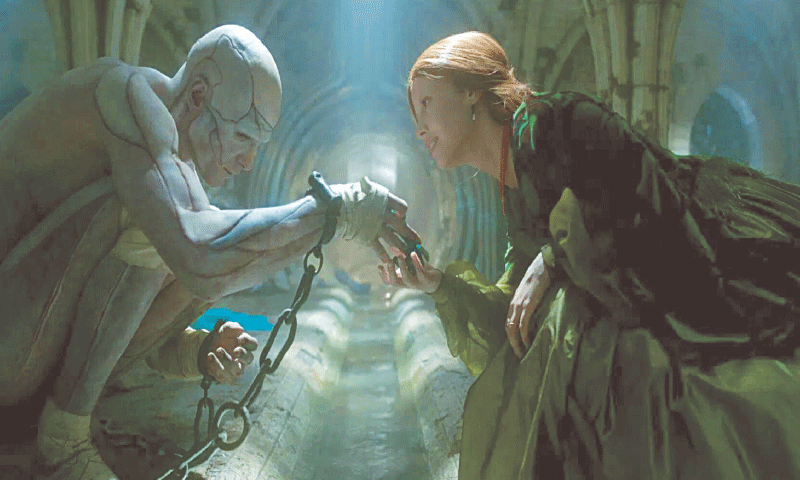
The simple logic and even simpler necessity of death fail to sink into Victor’s mind. Stitching parts of dead bodies together with a power battery, Victor creates the ‘Creature’ (Jacob Elordi) — an indestructible innocent who, at first, wants to live and, later, wants to embrace death.
Victor is first enamoured by, but quickly aghast with, the Creature and begins a saga of revenge, due to which innocents suffer and become casualties. Depending on where one stands with regard to the fidelity of adaptations, the real casualty here may be Mary Shelley’s original novel.
Writer-director Guillermo del Toro’s Frankenstein dazzles visually but fails to create a lasting impact
Like his Pinocchio (2022), del Toro follows Shelley only when it suits his vision. This reminds me of the 1994 version of Frankenstein produced by Francis Ford Coppola and directed by Kenneth Branagh (who also played Victor) and Robert De Niro as “The Creation” (not Creature). At the time, I wondered how different that film was from the novel.
Branagh’s version — titled Mary Shelley’s Frankenstein on his insistence — now seems more true to the novel, yet still creatively empowered; del Toro’s film, meanwhile, is adorned by great sets, costumes and jewellery (Tiffany’s, the great American luxury jewellery brand, is a partner), but driven by a vision that wavers between creative liberty and faithfulness to the novel.
Del Toro’s characters speak the lines — the best of which go to Goth’s dual role as Lady Elizabeth Harlander, Victor’s love-interest — yet the words they utter do not evoke sympathy or emotion. For the most part, what we see is a gorgeous but unfeeling world where, like in many of Del Toro’s films, the spectacle is at the forefront, and fantasy trumps depth and the characters’ appeal.
For instance, the Creature’s instantaneous healing from gunshots and dynamite blasts is downright comic book-ish, and the battery that powers him appears to be the product of a child’s imagination. Much is left up in the air when it comes to Victor’s romance and longing for Elizabeth, who is his brother William’s fiancee.
While one feels a trace of sympathy for the Creature, none extends to Isaac’s Victor, who dominates the prelude and first chapter of the film (the third chapter follows the Creature’s journey). He is superficial and conceited, and Isaac’s riled-up performance feels ill-fitting. A fine actor at times, he plays off-key in contrast to the film’s tone (blame the direction), especially alongside Goth’s subdued, intriguing, yet unconvincing Elizabeth.
Christoph Waltz, who plays Henrich Harlander, Victor’s wealthy benefactor, is also dealt a bad hand. He plays a clichéd villain and one has little doubt that he will have the silliest of demises.
That’s not to say del Toro’s Frankenstein is a bad film. On the contrary, its vistas are immersive and stunning. Shot by Dan Laustsen (The League of Extraordinary Gentlemen,The Shape of Water) in a large format with a 24mm lens, the shots are vast, warped and stretch at the edges. The cinematography, production and costume design are impressive. Yet, when it comes to the story’s themes — life, birth, motherhood, ambition and hubris, science versus nature — not to mention the film’s emotional core, the experience feels superficial.
Like Victor’s stitching together of the Creature, one can see the seams in between and wish that they could have been dealt with with more finesse.
Streaming on Netflix, Frankenstein is rated suitable for ages 18 and over but, then again, the original material was never for ages younger than that
Published in Dawn, ICON, November 16th, 2025