27th Constitutional Amendment Bill sails through Senate; PTI senator resigns after voting in favour
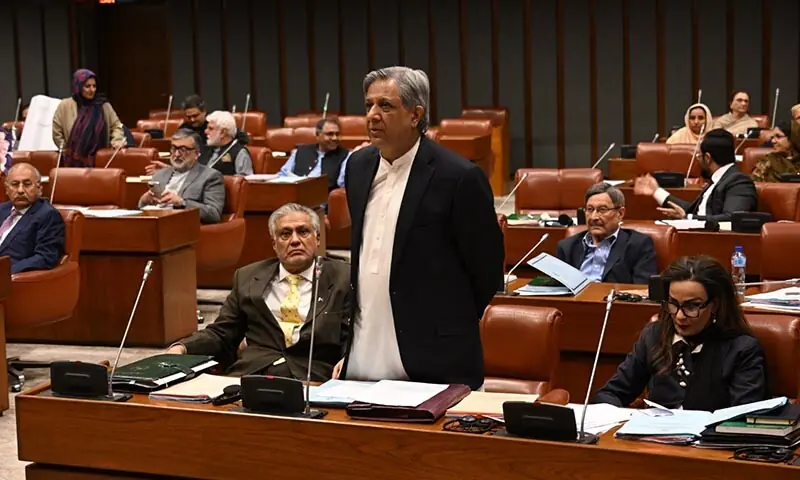
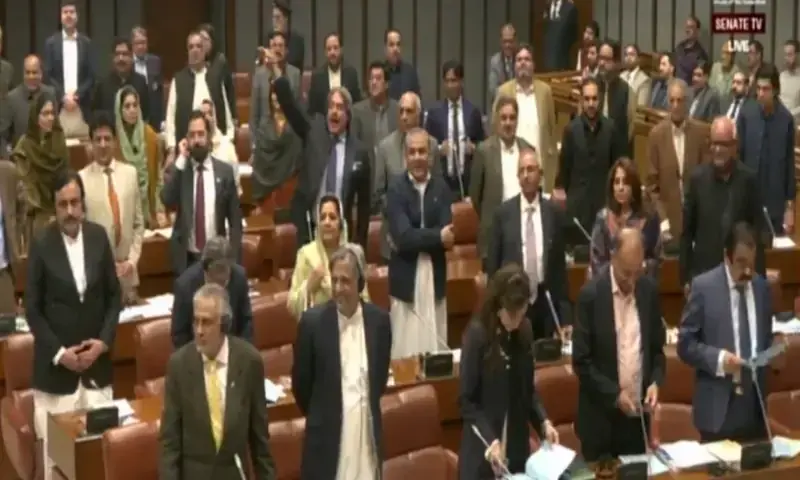

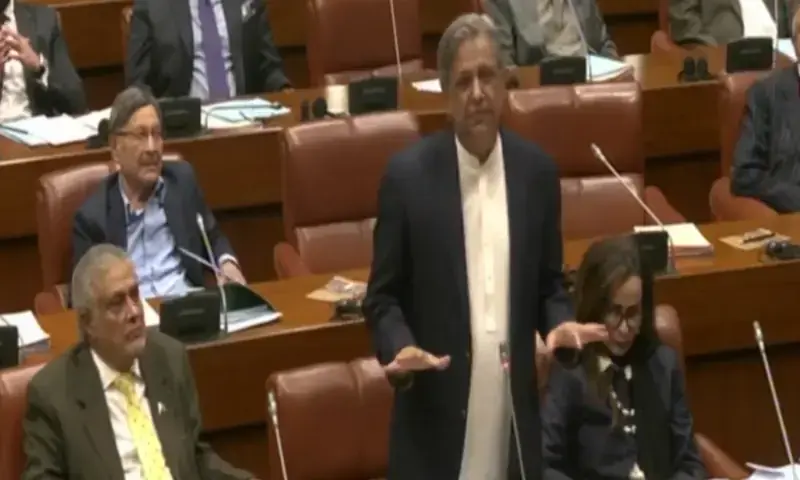
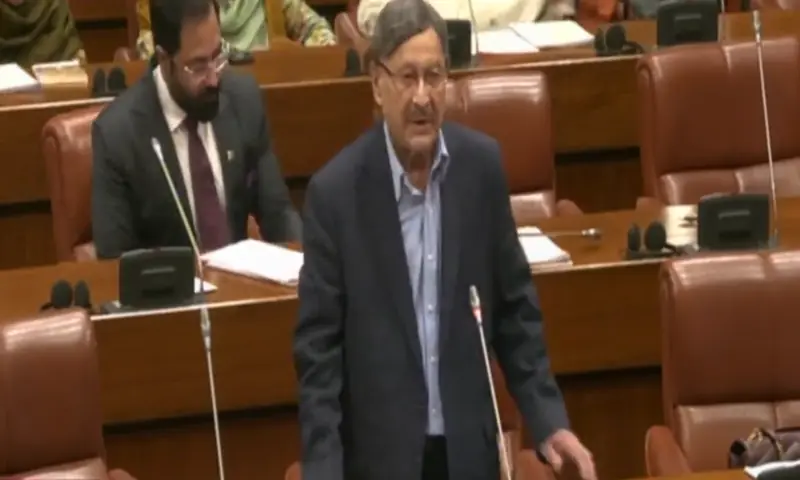
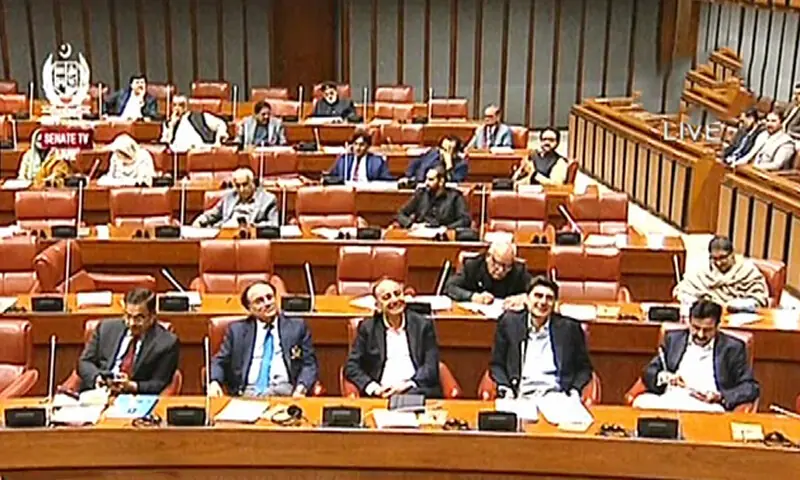

The contentious bill for the 27th Constitutional Amendment sailed through the Senate on Monday after 64 lawmakers voted in its favour, with members of the opposition staging a noisy walkout.
The government and its coalition partners secured a two-thirds majority in the vote following the defection of two opposition members, leading to a total of 64 votes for the bill.
The bill, which had stirred controversy in the country for weeks, was presented in the Senate by Law Minister Azam Nazeer Tarar, while Senate Chairman Syed Yousaf Raza Gilani presided over the proceedings.
Initially, a clause-by-clause voting was carried out. Later, voting by division was conducted, with the entry and exit gates of the Senate closed as per the protocol.
Before the passage of the bill, opposition benches erupted in protest, chanting slogans against the government and its coalition partners. Lawmakers tore up copies of the bill and hurled them toward Tarar’s table as he began to present it.
Most opposition members then staged a walkout, while a few stayed briefly to continue sloganeering before exiting the chamber — paving the way for the smooth passage of the bill.
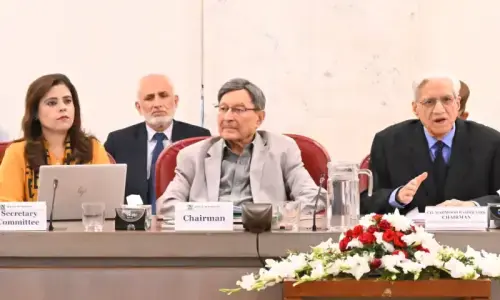
A joint meeting of the Senate and the National Assembly’s (NA) law and justice standing committees — boycotted by the opposition — approved the 27th Constitutional Amendment bill with minor changes. Senate Standing Committee of Law and Justice Chairman Farooq H. Naek presented a report on those before the Upper House.
Following its approval by the Senate, the bill will also have to be voted on in the NA. The session had begun today but it was adjourned. The NA will now reconvene at 11am tomorrow (Tuesday).
In the 336-member NA, the ruling coalition does enjoy a two-thirds majority. It has 233 members while the opposition holds 103. Within the coalition, the PML-N has 125 seats, PPP 74, MQM-P 22, PML-Q five, Istehkam-i-Pakistan Party four, and PML-Z, Balochistan Awami Party, and National Peoples Party one seat each.
PTI senator resigns after voting in favour
Senator Saifullah Abro of the PTI resigned shortly after voting in favour of the bill. Speaking on the floor of the upper house, the lawmaker said he “voted only for Syed Gen Asim Munir”.
He added that the Pakistani armed forces made the nation proud by winning the war with India. “During the 26th Amendment, 10 family members of mine were abducted, but my party (PTI) did not come to the rescue.”
When he tendered his resignation, the Senate chairman said, “We will make you a senator again”.

The Jamiat Ulema-i-Islam Fazl also expelled Senator Ahmed Khan for voting for the bill against party direction.
‘Historic bill’
Shortly after the passage of the bill, Deputy Prime Minister and Foreign Minister Ishaq Dar took to the floor of the house and termed the amendment a “historic bill”, saying that it was an “unfinished agenda” of the 2006 Charter of Democracy signed by almost all political parties.
“There was a feeling to maintain balance, and thus a constitutional court is being formed for the betterment of the judiciary,” he said.
Dar added that the rank of field marshal was now included in the Constitution, adding that space was created for the rank of a five-star general in all three military forces.
“The seniority of the current SC judges and the chief justice would not be impacted by the amendment,” he clarified.
Govt presents parliamentary committee’s report
Earlier in the day, Naek tabled a report in the Senate detailing some changes made in the draft bill by the parliamentary committee. Chairman Gilani asked for the opposition members to be called to the house as well, so they could be present during the briefing.
Naek told the house that the joint committee deliberated on the bill for two days and made “many changes”.
Sharing further details, he said the bill proposed the establishment of a Federal Constitutional Court (FCC), which the committee “unanimously” approved with some changes to the relevant clause.
Outlining those changes, he said there would be equal representation of all provinces in the FCC, and it would also include a representative from the Islamabad High Court.
Moving on to the second change, he said the initial draft of the bill stated that a judge could be nominated for the FCC after serving on the high court for seven years. The committee reduced this qualification merit for the FCC from seven to five years, he added.
Naek further said that the committee also agreed that if an appointment was made to the FCC from among sitting Supreme Court judges, the inter-se seniority of the appointee would remain the same as at the time of the appointment. However, in the case of a fresh appointment of a lawyer or a high court judge, the seniority would be reckoned from the date on which they would assume office.
Moreover, he continued, if multiple judges would take the oath on the same day, their seniority would be determined on the basis of their age.
He added that the Judicial Commission of Pakistan (JCP) was reconstituted under the 26th Constitutional Amendment, with the speaker being authorised to nominate a woman or a non-Muslim candidate to become a member.
The committee changed this to include a technocrat, Naek said. “So now, the speaker can nominate a woman, non-Muslim or technocrat who qualifies to be a member of Parliament for the JCP.”
He highlighted that currently, the SC had suo motu powers and could invoke Article 183 of the Constitution to take up a case at its discretion.
As for the FCC, “we have retained the suo motu powers […] but we would exercise these powers when an application is submitted. The case will be taken up for hearing after the FCC decides whether the application for exercising suo motu powers is valid and needed”.
On the transfer of judges, the PPP senator said that previously, even when the 26th Amendment was passed, judges could be transferred by the president, but the consent of the said judge was required, and two chief justices of the relevant high courts were consulted.
“The amended bill has changed the method of transfers, as now, a judge will be transferred from one high court to another through the JCP, which was reconstituted under the 26th Amendment and has the representation of all — the executive, parliament, judges, civil society, and lawyers,” Naek said.
Naek said that under Article 199 of the Constitution, an interim stay order in matters of revenue remained valid until the case was decided. This created a huge backlog, he remarked, adding that the interim order would now be vacated automatically after one year if no decision on the case was made until then.
Senate debate
The Senate session began shortly after 11am with Senator Manzoor Kakar presiding over the proceedings in the absence of Chairman Gilani.
At the outset, he said some speeches regarding the constitutional amendment could not be delivered yesterday, and proceedings today would begin with those addresses. He then gave the floor to PML-N’s Agha Shahzaib Durrani, whose speech was repeatedly interrupted by the opposition benches.
During his speech, Durrani mentioned that the opposition had questioned that what was the need for a constitutional court. He justified this need, citing the backlog of cases in the Supreme Court. Durrani also berated the opposition, particularly the PTI, for “abolishing the democracy” and “turning the President’s House into an ordinance factory” during its tenure.
His speech was followed by that of PPP’s Zamir Hussain Ghumro, who rejected the opposition’s criticism that the 27th Amendment was a “9/11 on Pakistan“. He defended the planned establishment of the constitutional court, alleging that the SC had not been performing its “original function, but enforcing fundamental rights, which is a function of the high courts”.
“The Supreme Court has been interfering in [matters of] Parliament and the executive,” he claimed, further justifying the need for the constitutional court. “It will not only strengthen the independence of the judiciary but also the federation,” he argued.
Regarding the proposed changes to Article 243, which deals with the command of armed forces, he recalled the recent conflict with India in May. “The chief of army staff, the Field Marshal won a war for Pakistan,” he said, adding that he deserved immunity from criminal proceedings and arrests.
“What is the problem with this? Do you want to drag your heroes through the streets and courts?” he questioned.
He added that the PPP believed the 27th Amendment would be a “milestone in advancing democracy, the Constitution, and the 18th Amendment”.
After Ghumro concluded his speech, PTI’s Fawzia Arshad pointed out that an opposition leader had still not been notified in the Senate. The post has been vacant since the disqualification of PTI’s Shibli Faraz in August.
Arshad said the pendency of the notification was a denial of legislative rights to the PTI.
She also assailed the proposed 27th Amendment and its proponents, saying that “institutions are being trampled and their rights are being taken away”.
For his part, Muttahida Qaumi Movement-Pakistan’s (MQM-P) Amir Waliuddin Chishti said his party was promised changes to Articles 142 (advocate general for a province) and 140-A (local government) under the 27th Amendment.
“Now, after two days, I am hearing that while the amendments came under discussion, it is being said that they may be included in the 28th Amendment,” he added.
PML-N Senator Khalil Tahir Sindhu also referred to the May conflict, saying, “The entire nation won the war. The media and opposition also won. Everyone did. But under whose leadership? General Syed Asim Munir sahib.”
Senator Sindhu quipped that it was not as if some land was being named for the army chief, but only an honorary title was being bestowed on him. He claimed that all Commonwealth nations had officers who remained in uniform for life.
He also highlighted Field Marshal Munir’s role in “trade and foreign affairs as he accompanied the prime minister” on multiple visits.
The PML-N leader dismissed the concerns regarding the 27th Amendment as “frivolous and concocted”, asserting there was nothing contradictory to the Constitution in it.
Later, Kakar paused the proceedings and said the house would meet again at 3.30pm.
Speaking to Dawn on condition of anonymity, a key minister said the government planned to get the bill passed today, “no matter what.”
Will ensure amendment does not pass: PTI
Separately, PTI Senator Ali Zafar said while speaking to the media in Parliament that the opposition would ensure the amendment was not passed if the government did not have the requisite numbers.
“It is possible they may not be able to table it today,” he said while speaking to the media.
He further said that the opposition was against giving immunity from criminal proceedings to anyone. “We are saying that if anyone has committed a crime, be it a president or a governor, they should be punished according to the law and the Constitution,” he said.
However, Information Minister Ataullah Tarar defended the inclusion of a clause for providing lifetime immunity to the president from criminal proceedings and arrests under the proposed amendment.
“The heads of state enjoy immunity across the world. This is a choice, and this system prevails in the whole world […] I think there is no harm in this,” he said while speaking to the media. He also welcomed the premier’s decision not to pursue the clause for immunity.
The minister further said the amendment was for “good governance”, improving the federation’s relationship with the provinces, and for strengthening defence“. He said, constitutional courts also existed in other parts of the world, adding that this was also included in the Charter of Democracy signed in 2006.
Tarar said the demand for constitutional courts was jointly made by the PML-N, PPP and the Awami National Party, and that the Constitution was a living document which continued to evolve.
He asserted that the government had the requisite votes, terming the amendment “positive” and in line with international practices.
MQM-P backs Article 243, reiterates call for LG powers
In his address, Senator Faisal Subzwari, parliamentary leader for the Muttahida Qaumi Movement-Pakistan (MQM-P), said: “When you concede your space, those succeeding you get even less space.”
As he looked towards the opposition benches, Subzwari expressed the wish that politicians were as concerned about merits and justice when they were in power themselves. He stressed that all highs had a downfall, adding that the remark was meant for everyone.
Speaking on changes in Article 243, he said, “We wish that after the passage of this amendment […] the honour of the Pakistan Army, the defence of Pakistan and the state of Pakistan rises, especially during a time when India — much more powerful than us and with a more armed military — is present on our eastern front.”
The MQM-P leader also mentioned the “dispute” on the western front with Afghanistan, and added that on such occasions, there was a need to “encourage and support the armed forces in every possible manner”. He criticised PTI’s Omar Ayub for making remarks in the National Assembly that doubted the military’s preparedness and arms supplies.
On the “much-debated” changes being brought in the judiciary, Subzwari said the formation of the FCC should “bear fruit” and not remain limited to high courts.
“What steps have been taken by the constitutional courts that will be formed or have been formed that will impact the ordinary petitioner?” We need to answer this,“ he said.
Subzwari recalled the MQM-P’s demand for local bodies’ autonomy made in an amendment submitted in the NA last year. He noted that the matter was still with the relevant standing committee and said the MQM-P will approach other parties, including the PTI and the PPP, for it.
He refuted the impression that empowering local governments (LGs) amounted to rolling back the 18th Amendment that provided provincial autonomy.
The lawmaker stressed that giving LGs powers in the same way as provinces was to ensure that the citizens there received the resources distributed to them. “This is a case for Jacobabad and Kashmore, and of Sajidabad and Rahim Yar Khan, which are away from their provincial capitals,” he said.
Subzwari acknowledged that the proposals made earlier on the National Finance Commission (NFC) shares — which were not included in the current amendment bill following the PPP’s opposition — needed a debate. He suggested that a certain share be allocated for provincial finance commissions in the NFC.