Garlic cultivation brings new hope for farmers in S. Waziristan
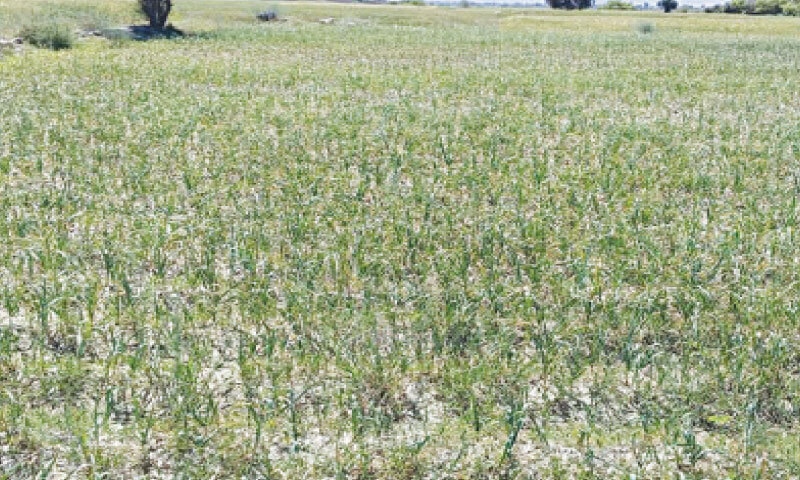

SOUTH WAZIRISTAN: A growing trend of garlic cultivation in Upper South Waziristan district has sparked fresh economic optimism among local farmers.
In the Makin, Tiarza and Sarvekai tehsils, a large number of farmers have shifted from traditional crops to garlic this year, encouraged by last season’s successful experiment which proved both productive and profitable.
Jamal Malyar Mehsud, a social activist and farmer, told Dawn on Saturday that climatic conditions of Upper South Waziristan were highly suitable for garlic cultivation.
According to him, soil composition, moderate temperature, and availability of water made the region ideal for the crop’s growth. “That’s why farmers are gradually moving away from traditional crops like wheat, maize and rice to garlic,” he said.
Growers seek govt support to boost production, rid country of imports
Mr Mehsud shared that last year he cultivated garlic on less than one kanal of land and harvested around 350 kilogrammes.
The encouraging yield convinced him to expand the experiment this year.
Another local farmer, Yaseen Malik, achieved even higher productivity – harvesting 500kgs from just one and a half kanal of land. “We have now realised that garlic can be far more profitable than other crops,” he said, adding the crop’s short duration and market demand have made it a promising alternative for small-scale farmers.
Agricultural experts say over the past four years, garlic has been cultivated on an average of 30,000 acres annually across Pakistan, producing about 117,000 metric tonnes. However, this amount is still far below the country’s total requirement. To meet domestic demand, Pakistan imports nearly 62,000 tonnes of garlic every year, costing the national exchequer approximately Rs11.75 billion annually.
Farmers in Upper South Waziristan believe with proper guidance, access to quality seeds, fertiliser subsidies and marketing support, the region could significantly increase production and help reduce the country’s dependence on imports. “Garlic can become a game-changer for our local economy,” said Mr Mehsud. “If the government provides technical support and facilitates access to markets, farmers here can meet not only local but provincial demand as well.”
According to the latest agricultural census, Upper South Waziristan has around 157,000 acres of cultivable land. Yet, in recent years, garlic cultivation has been limited to only 50 acres. This year, however, farmers claim that the area under cultivation has expanded three to four times compared to previous years - a sign of the region’s growing shift towards high-value crops.
Agronomists suggest the federal and provincial agriculture departments should seize this opportunity by introducing training programmes, improved seed varieties, and storage facilities to sustain the trend.
They argue that the region’s climate gives it a comparative advantage that could turn Upper South Waziristan into one of Pakistan’s leading garlic-producing zones.
Experts also believe that promoting garlic cultivation could have broader socio-economic benefits, particularly in reducing rural poverty and creating local employment. If current trends continue, analysts say, Upper South Waziristan could achieve self-sufficiency in garlic production within the next few years and even supply surplus produce to other parts of the country.
Published in Dawn, November 9th, 2025