SOCIETY: A WOMAN ON THE VERGE

In 2027, Naushaba Roonjho intends to do something almost unthinkable for a woman from her conservative Sindhi village: to run for political office against entrenched male politicians.
It’s a remarkable ambition for a 33-year-old who, less than a decade ago, was thrown out of her family home for the simple act of working outside it. But for Naushaba, running for office is the logical culmination of a journey that began with a single act of defiance — sitting for her matriculation exam when no woman from her community had ever done so before.
“I did not want to be a conventional woman like others, who are dependent on their parents or husbands,” she tells Eos from her modest home in Shaikh Soomar, a dusty village of 150 families in Sindh’s Thatta district. “I chose a different and difficult life.”
BREAKING THE MOULD
Shaikh Soomar village sits 10 kilometers from the town of Jhirrak, and is a collection of mud-brick houses where most girls’ education ends at primary school — if it begins at all. Naushaba attended the village school until fifth grade before, like most girls of the conservative Roonjho community, her studies were abruptly halted.
But while other girls accepted this fate, Naushaba continued her education at home, studying by lamplight after finishing her household chores. In 2010, at 18, she sat for the matriculation exam as a private candidate — and passed, becoming the first woman from her community to do so.
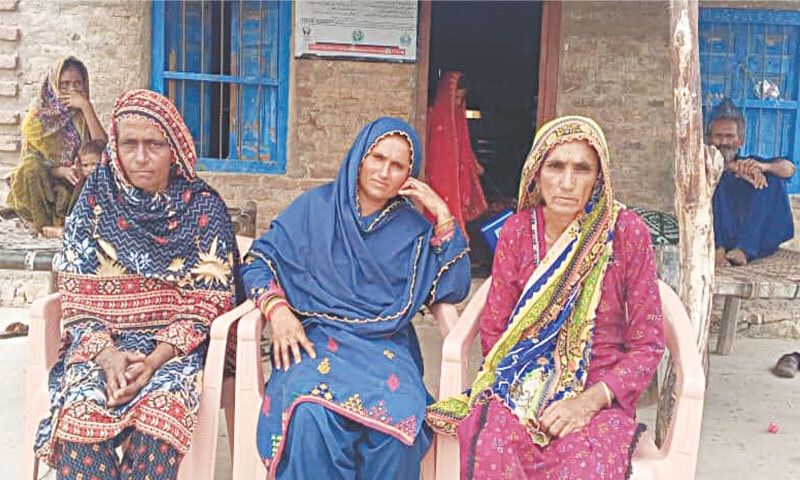
Naushaba Roonjho has had a transformational impact on her conservative village in Sindh, becoming its first woman to pass matriculation, a community health leader and an education crusader. Now, she intends to contest local body elections…
That same year, she was married to her cousin Muhammad Uris, a daily-wage labourer who, unlike most men in the village, supported her educational aspirations. “I saw something different in her,” says 44-year-old Uris. “She was not content with the life most women accepted. I thought, why should I stop her from becoming something more?”
For the next seven years, Naushaba lived the life expected of her — raising three children, managing household chores, stretching her husband’s meagre income to feed the family. But she watched. She saw women die in childbirth from preventable complications. She saw girls pulled out of school at puberty. She saw potential extinguished by poverty and tradition.
When the National Rural Support Programme (NRSP) advertised for community workers in 2017, Naushaba saw her chance. She applied without telling her extended family.
SUCCESS AND SETBACKS
“My first pay was 6,000 rupees,” she recalls. For a woman who had never controlled her own money, it was transformative. The work involved going door-to-door promoting health and hygiene practices, and soon other community-based organisations began hiring her for similar outreach work.
But success came at a cost. “When Naushaba started working as a social worker, people taunted me,” says 44-year-old Uris. “They would say that a decent man would never allow his wife to work and that she would ruin our honour. But I decided to stand by her through thick and thin.”
The pressure intensified. In 2019, Naushaba’s family issued an ultimatum: stop working or leave the family’s house, where Naushaba lived along with her husband and three children.
“They said I was bringing shame on the family,” Naushaba recalls. “They said I was setting a bad example for other girls, that I was destroying our traditions.”
Naushaba chose to leave.
With their combined savings and Uris’ earnings, they built a one-room house on a small plot of land. It was cramped and basic, but it was theirs.
The struggle taught Naushaba the importance of financial independence. Through the Sindh Rural Support Organisation (SRSO), she acquired a loan of Rs300,000, which she invested in livestock. “I bought cattle and sold them after a year,” she reveals. “We used the money for improvements to our mud-brick house and to invest in future endeavours.”
She began working on vaccination drives, water and sanitation projects, and health initiatives across multiple villages. But one mission consumed her more than any other: getting girls into school.
THE EDUCATION CRUSADE
Shaikh Soomar has one government school that serves boys and girls together — a reality that keeps many girls at home, their parents unwilling to send them to a mixed environment.
“We don’t have a separate school for girls, which is a deterrent for their parents,” Naushaba explains. To counter that, she went door-to-door to convince parents to enrol their daughters.
Akram Roonjho, a teacher at the school, says that over 100 girls have enrolled over the last few years due to Naushaba’s efforts. Naushaba’s own daughters — Naila, 13, and Nadia, 11 — are among the enrolled students, along with her eight-year-old son.
Still, the school has no separate building for girls, which remains a barrier for conservative families. Naushaba has repeatedly petitioned local Union Council (UC) representatives for a separate girls’ school, but her requests have gone unanswered — a fact that fuels her political ambitions.
MOTHERS AND CHILDREN
Maternal and infant mortality is another issue that haunts Naushaba. “Most of the village women are negligent about their health issues and many expectant mothers of Soomar Shaikh village die during delivery,” she tells Eos.
According to The Pakistan Maternal Mortality Survey 2019, in Sindh, 224 women die per 100,000 live births — well above the national average of 186 — with such tragedies more common in rural areas. The under-five mortality in the province stands at 77 deaths per 1,000 live births, also higher than the national figure, according to the World Bank.
Naushaba found a way to address the issue while attending a medical camp organised by the charity HANDS. Working with local community organiser Qasim Dal, she convinced the organisation to establish regular services in Shaikh Soomar.
Now, a sonologist and a doctor visit the village every fortnight. Initially, though, locals were reluctant to send their women to doctors. Again, it was Naushaba who intervened, explaining women’s health issues to men and convincing them to let their wives and children seek advice and treatment from professionals. She has since trained two other women to conduct such sessions in her village and those around it.
“After getting expert advice from doctors, women are using birth control pills and children are getting better access to medicine and nutrition,” Naushaba reveals.
THE POLITICAL TURN
By 2024, Naushaba had established herself as one of the most effective community mobilisers in her area. But she’d also hit a wall — she could advocate and organise, but couldn’t convince local government officials to implement solutions.
This realisation has led to her decision to contest the next local body elections, slated for early 2027.
“I have tried too hard to facilitate my village, but these efforts are not enough until I get a chance in politics,” she tells Eos. “We have voted but failed to see the impact. Our local political leaders appear unconcerned by our basic needs and issues.”
It’s an audacious move for a woman who, less than a decade ago, was ostracised for simply working outside her home. She’ll be running against established political figures with deep pockets and extensive patronage networks.
Khadim Shar, who works with SRSO, believes women like Naushaba are catalysts for broader social change. “In societies where cultural taboos and rigid traditions dominate, her story stands as a powerful example,” he says.
For Naushaba, the decision to enter politics stems from a simple realisation: advocacy has its limits without institutional power. She believes political parties and local leaders have continuously ignored her community’s issues and she wants to be a strong voice in political corridors.
“My village is my world and I want to make it a better place for everyone who lives here,” she affirms. “Our women are suffering from different issues. That is not their destiny, but due to administrative flaws. I am hopeful that, through collective efforts, we will bring change in every sphere of life.”
The writer is a Sindhi fiction writer and journalist. He can be reached at akhterhafez@gmail.com
Published in Dawn, EOS, November 9th, 2025