Pakistan, US explore ways to develop ‘economically entrenched strategic partnership’


 8
8

The United States and Pakistan early on Saturday reaffirmed their commitment to strengthening bilateral ties between the two countries, with Islamabad’s envoy describing it as an effort to build an “economically entrenched strategic partnership“.
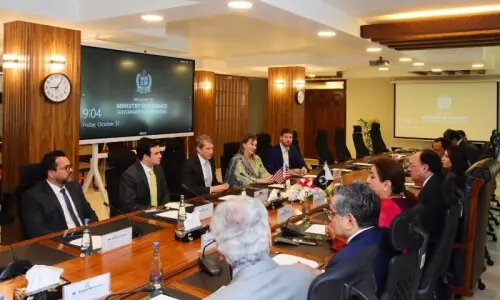
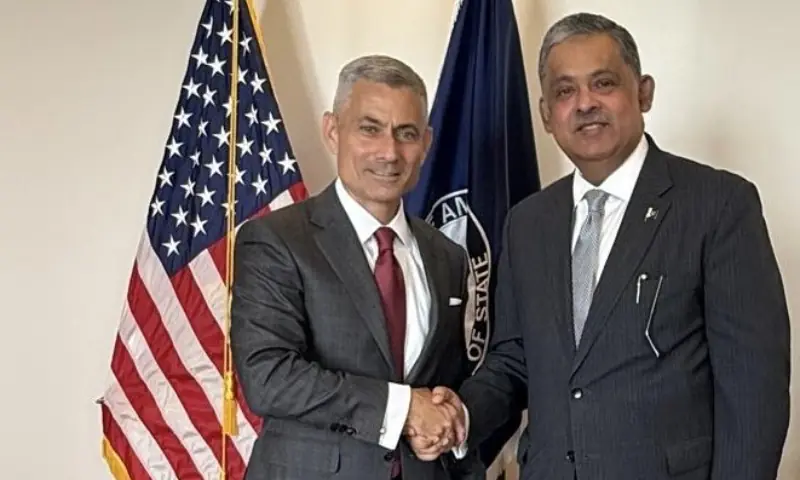
The development came as S. Paul Kapur — who assumed charge as the US assistant secretary of state for South and Central Asian affairs on October 22 — met Pakistan’s Ambassador to the US Rizwan Saeed Sheikh at the State Department for what was described as a cordial and forward-looking exchange.
Ambassador Sheikh said the two sides explored practical ways to translate recent high-level political resolve into concrete cooperation.
“We discussed the ways and means of translating the resolve — expressed at the leadership level — of developing Pakistan–US ties into an economically entrenched strategic partnership, through sustained engagement in multiple domains of mutual interest,” he said in a post on social media platform X.
Meanwhile, Kapur said it was a “pleasure” to meet the Pakistani envoy.
“We discussed ways to advance the US-Pakistan relationship and make our countries more prosperous and secure,” he said in a post on X.
Kapur’s meeting with Ambassador Sheikh comes as Washington and Islamabad recalibrate their relations under US President Donald Trump’s second administration.
After years of uneven engagement and recurring mistrust, both sides are now emphasising economic cooperation alongside traditional security ties.
In recent months, US officials have pointed to Pakistan’s potential role in regional stability and its capacity to contribute to economic and energy initiatives in South and Central Asia. The Trump administration has also encouraged American firms to explore investment opportunities in Pakistan’s infrastructure, minerals, and technology sectors.
For Islamabad, the new tone in Washington offers an opportunity to diversify its partnership with the US, while the Trump administration appears keen to reduce Pakistan’s overreliance on China. Officials in both capitals say they want to anchor the relationship in trade, investment, and long-term development — not merely in aid or counterterrorism cooperation.
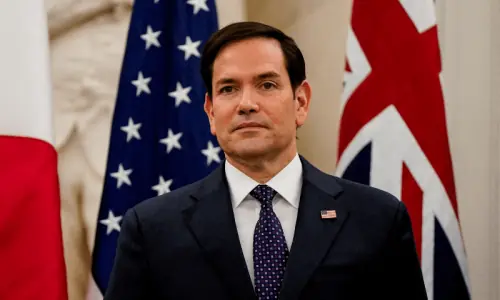
Late last month, US Secretary of State Marco Rubio said that the US sees an opportunity to expand its strategic relationship with Pakistan, but added that the recent strengthening of ties between the two countries did not come at the expense of Washington’s relationship with New Delhi.
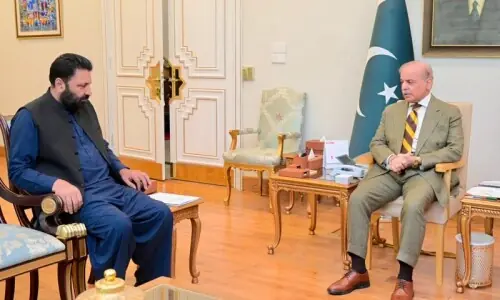
In September, Prime Minister Shehbaz Sharif also met with Trump in the Oval Office, where they discussed regional security and cooperation along the lines of counter-terrorism, among other matters. Chief of Army Staff Field Marshal Asim Munir was also present during the meeting.
Trump’s South Asia narrative
Trump has continued to highlight his role in what he calls the prevention of a nuclear war in South Asia following the brief but intense military conflict between India and Pakistan earlier this year in May.
During several public remarks, he has claimed that his administration’s swift diplomatic engagement “stopped a nuclear conflict” after the two neighbours exchanged air strikes, and that “eight planes were shot down“ during the clashes.
While New Delhi has not confirmed Trump’s account, his repeated references to that episode reflect Washington’s renewed interest in South Asian stability — and the value it assigns to maintaining direct communication with both capitals.
Despite the fresh tone, the relationship needs greater effort to sustain its current momentum. Washington continues to view Pakistan through a regional lens — balancing its strategic interests between India and China — while Islamabad seeks broader recognition of its economic and geopolitical relevance.
Analysts note that although the two countries are again speaking of a “strategic partnership“, much will depend on how the rhetoric translates into measurable progress. Both sides must still bridge differences over regional security, trade access, and Pakistan’s deepening engagement with China.
As one observer in Washington noted, “It’s an encouraging start — but what matters now is whether this goodwill can evolve into a sustained, structured partnership.”