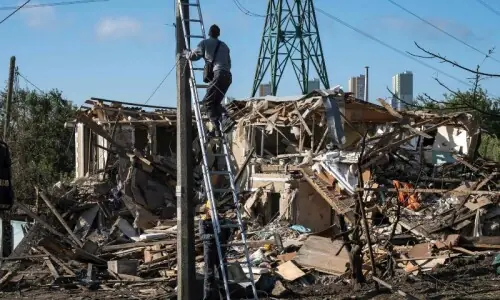
PV-19 (Kazakhstan): The wind whistles through the empty shell of a Soviet-era building that towers above a southern desert in Kazakhstan.
Its construction in the 1980s was the first step in the Soviet Union’s secret plan to build a new uranium mining city in the middle of the steppe to fuel its Cold War nuclear ambitions.
The plan was ditched shortly after the Chernobyl nuclear disaster in 1986. But after two decades of neglect, the empty steppe is in the spotlight again.
This time it is Kazakhstan, a former Soviet republic with a fifth of global uranium reserves, that is cashing in on the revival of an all but forgotten industry.
“What we see today is a true nuclear renaissance,” said Mukhtar Zhakishev, head of Kazakhstan’s state-owned uranium mining company, Kazatomprom.
“Atomic energy fell out of favour after Chernobyl. But the world is keen on uranium again. We are well-positioned to benefit from this,” he said, speaking at the newly opened East Mynkuduk PV-19 uranium mine near the border with Uzbekistan.
Demand for uranium is booming as China, India and Russia build new reactors, and the West seeks to diversify energy sources and reduce greenhouse gas emissions.
Uranium exploration in Kazakhstan started in 1948, a year before the Soviet Union tested its first nuclear bomb in the north of the Central Asian state.
Today Kazakhstan, which inherited mining technology and expertise from the Soviet Union, hopes to become the world’s No.1 uranium producer by 2010, surpassing Australia and Canada.
Kazatomprom has set up joint ventures with Western firms and plans to open a number of new mines similar to PV-19 in a move that would more than triple its annual production to 17,500 tonnes by 2015.
“After the Soviet Union collapsed, life came to a standstill around here. Many people left. Mining activity fell. Life was tough. Those who stayed lived only to make ends meet,” said Vladimir Shavanda, a senior engineer at another mine, PV1.
“The biggest difference between then and now is that we are now working with a purpose.”
Kazakhstan, a steppe country the size of Western Europe, is better known for its vast oil and gas reserves in the Caspian Sea. But it has made uranium production one of its priorities.
The successor firm to the Soviet atomic authority in Kazakhstan, Kazatomprom is already the world’s No. 3 producer of the radioactive metal which can be used to fuel nuclear reactors and make atomic weapons.
“Kazakhstan will produce more uranium than the whole of the Soviet Union in its best years. ... But we don’t just want to become the world’s biggest exporter. We want to be a company producing high-quality, value-added uranium,” said Zhakishev.
“In the next two or three years we are expecting a number of deals that would shake up the entire global uranium market.”
The price for uranium oxide, or yellow cake, has reached levels not seen since the 1980s in recent years.
Kazakhstan gave up its entire nuclear arsenal after the Soviet collapse in 1991. It now wants to develop a civilian nuclear programme and build its own atomic reactor.—Reuters