EVEN as Donald Trump crisscrosses the globe, bringing his purported peacemaking skills to parts he didn’t even know were at war, his administration has openly been preparing for militarised regime change in Venezuela. There is nothing new about America’s designs on its ‘backyard’. Latin America’s 20th-century history is replete with instances of unwarranted US interventions and attempted regime change operations. Those in living memory stretch from 1954’s Guatemala coup to the Bay of Pigs in 1961, the 1973 Pinochet putsch in Chile and the invasion of Panama in 1989.
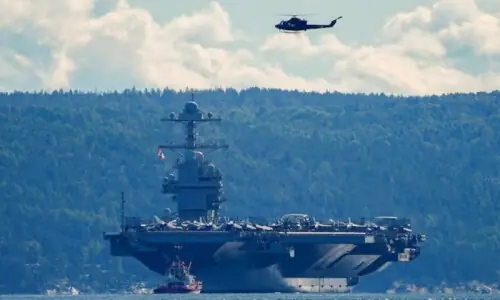
The last of these has frequently been referenced as the most likely model for tackling Venezuela, after Trump authorised CIA ground operations. For the past couple of months, US forces have been targeting boats in the Caribbean, designating them as drug-smuggling vessels. No evidence has been offered.
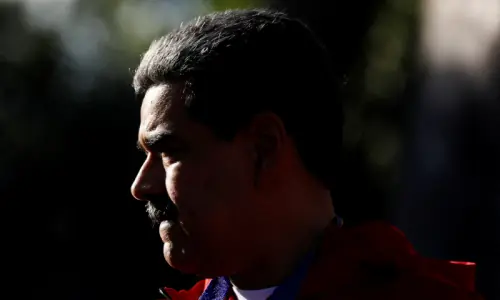
Latin America has long served as a key supplier of the seeming urge among Americans to blot out reality, but Venezuela has never been a major culprit in the drug trade. By almost every account, it has little or no role in the stateside fascination with fentanyl. Designating Nicolás Maduro as the head of a non-existent cartel comes across as a hollow excuse for regime change, but it helps to disguise the ideological motivation behind the endeavour.
Trump’s concern with drugs may be genuine — who knows? — but the basic demand/ supply formula appears to have escaped his attention. No drug lords in Latin America or elsewhere would bother establishing supply chains to the US in the absence of constant demand. The opioid crisis in the home of the brave and the land of the free is primarily a symptom of societal dysfunction. Disrupting one or two supply trails can only make a temporary difference.
Peacemaker Trump doubles as warmonger.
But the belligerence against Venezuela has little to do with drugs. Back in the first Trump term, his short-lived NSA John Bolton was keen to invade Cuba, Venezuela and Nicaragua. Back then, Trump demurred. Even in his second term, he was not impressed by Marco Rubio’s arguments about human rights violations or electoral malpractices. Hence Rubio — the offspring of unhinged anti-Castroites, and the first person since Henry Kissinger to concurrently serve as NSA and secretary of state — leapt upon the drug trade as an excuse, and Trump was suddenly convinced. He called off negotiations in which Maduro had allegedly expressed a willingness to share Venezuela’s substantial mineral wealth with the US and to effectively end trade ties with China and Cuba.
Maduro has served for the past dozen years as an often disappointing and occasionally disturbing successor to Hugo Chávez, whose socialist vision stretched far beyond Venezuela. His endeavour to lift the poorest Venezuelans out of poverty was supported by Cuba, and Fidel Castro was instrumental in reversing the US-backed neoliberal coup that briefly toppled Chávez in 2002.
Chávez won several internationally authenticated elections until his death in 2013, but his chosen successor has strayed from the Bolivarian impulse in ways that many supporters of Chavismo see as a betrayal. For some of them, the manipulation of the 2024 poll was the last straw. Allegations about his desperation to win Trump’s favour only add to the charge sheet, although it’s quite possible that his standing will improve in the face of naked US hostility.
That hostility has lately extended to Colombia, whose president, Gustavo Petro, has been among the most vociferous supporters of Palestinian rights. His US visa was revoked after his no-holds-barred speech to the UN General Assembly last month, and sanctions have been invoked after he responded angrily to the extrajudicial execution by America of more than 40 people in the Caribbean.
Trump’s actions and intentions have been questioned by both a bunch of Democrats and a handful of Republicans, the latter mostly concerned about the threats to isolationism implied by the America First impulse. After all, an invasion of Venezuela would suggest a continuity with the neocon tendencies that the MAGA crowd despises. Trump might relent if someone whispers into his ear the obvious fact that blatant warmongering in the Caribbean will diminish his chances of obtaining the Nobel Peace Prize he desperately covets — apart from doing little or nothing to disrupt the flow of fentanyl into the US. But he’s notoriously capricious, and might see an advantage in adding to the US treasure chest of South American scalps.
Trump has yet again betrayed his ignorance of even recent history in describing Colombia’s Petro as “the worst president they have ever had — a lunatic with serious mental problems”. His obscene language is par for the course, but perhaps he should take a good look in the mirror before hurling accusations that fit his own image.
Published in Dawn, October 29th, 2025