‘Society expects us to learn a lingua franca to get ahead in life’


 0
0
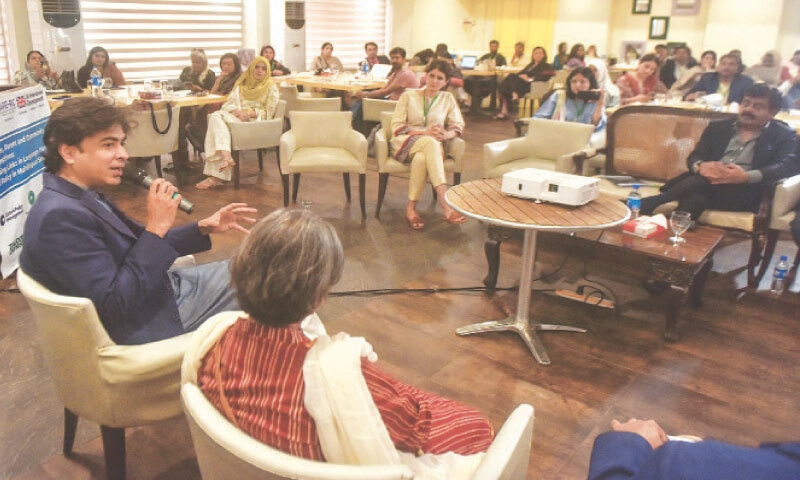
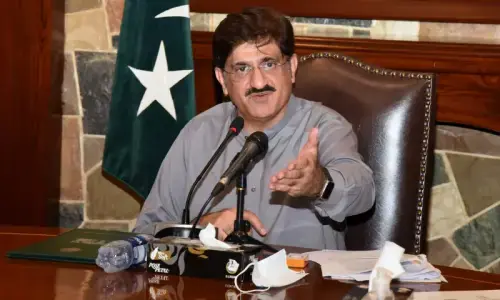
KARACHI: “Learning for us began from our mother’s lap when the first language we heard was our mother tongue. But society expects of us to learn the lingua franca to get ahead in life. It is like taking dictation from colonial culture,” said Sindh Education Minister Syed Sardar Ali Shah.
He was speaking at a policy dialogue on ‘Teacher, parent and community perspectives and the missing links in language planning and policy in multilingual settings’.
The event was organised by Durbeen, in collaboration with the United Kingdom’s Data and Research in Education-Research Consortium (DARE-RC) and the Foreign Commonwealth & Development Office (FCDO), here on Tuesday.
Durbeen and the University of Oxford were jointly awarded the DARE-RC grant in December 2024 to conduct a study on the experience and perceptions of stakeholders about the impact of the school-home language gap on learning outcomes, as well as identity formation of multilingual learners in Khyber Pakhtunkhwa and Sindh.
The aim is to improve learning by removing language barriers for low-income and marginalised communities, in particular. The findings will come up with evidence-based policy recommendations to enhance educational outcomes, social mobility, and economic growth.
“When we talk of the Single National Curriculum, we are looking at how our half teetar and buttaire [grey francolin and quail] children, who may be Sindhi, Baloch, Punjabi and Pakhtun, are unable to prove their ethnicity because of misplaced legacies. Language proficiency in English is good but you need wisdom, too, which comes from your heritage,” the education minister pointed out.
“We want to save the languages of Waris Shah, Bulleh Shah, Shah Abdul Latif Bhittai and also Ghalib. How else are we going to coexist if we forget the language of our ancestors? That’s why we need a public and private policy to teach languages properly in our schools. I’m convinced and committed to this cause,” he said.
Earlier, the chief academic officer at Durbeen and DARE-RC project lead, Dr Fauzia Shamim, explained that many children speak a language at home which differs from their school’s medium of instruction. “It results in weak comprehension and disengagement. Therefore, there is a need for a policy that recognises the languages children actually use that values linguistic diversity as a resource rather than an obstacle,” she said.
Senior Departmental Lecturer at the University of Oxford and co-lead of the DARE-RC project, Dr Aliya Khalid, said that they seek to reduce language barriers for low-income and marginalised learners and generate actionable insights for an evidence-based language-in-education policy development.
During a panel discussion with Dr Shamim as the moderator, Zindagi Trust President Shehzad Roy pointed out that we have children who speak a mother tongue at home who then go to school and speak in Urdu as they write in English and pray in Arabic.
Senior educationist Dr Fatima Darr said that here parents want their children to learn English as it is seen as the language for upward mobility.
Durbeen’s CEO Salma Ahmed Alam, DARE-RC’s Regional Lead for Sindh Dr Rana Hussain, DARE-RC’s Deputy Research Director Dr Dilshad Ashraf, Professor of Linguistics Dr Liaquat Channa, Director of Research at AKU-IED Dr Sajid Ali and Managing Director of Sindh Education Foundation Gahanwar Ali Laghari also spoke.
Published in Dawn, October 29th, 2025