Jam Kamal pushes EU on basmati, ethanol
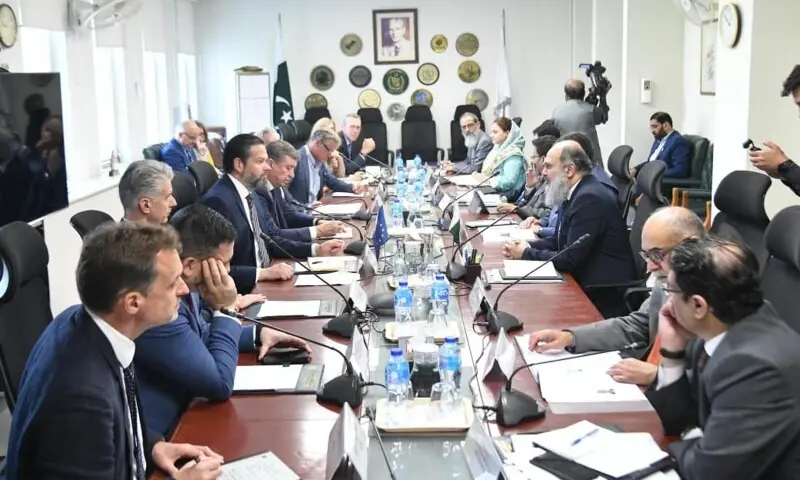
ISLAMABAD: Pakistan has called on members of the European Parliament to address two pressing trade concerns — the withdrawal of duty concessions on ethanol exports and delays in the Geographical Indication (GI) registration of Basmati rice — both of which directly affect the livelihoods of millions of Pakistani farmers.
The demand was raised during a meeting with a high-level delegation from the European Parliament’s Committee on Development, led by Lukas Mandl of Austria and comprising Robert Biedro (Poland), Juan Fernando López Aguilar (Spain), Tomáš Zdechovský (Czechia), and Marc Jongen (Germany). They were accompanied by senior advisers Christian Meseth, Janetta Cujkova, and Teresa Paula de Figueiredo Mergulhão, as well as EU Ambassador to Pakistan Raimundas Karoblis.
Commerce Minister Jam Kamal Khan headed Pakistan’s delegation.
An official statement said the minister highlighted two major trade issues: the removal of duty concessions on ethanol exports under the GSP+ scheme — a move that has significantly hurt rural livelihoods — and the long-standing delay in GI registration for Basmati rice.
Pakistan urged the EU to ensure a fair and impartial decision that recognises its historic claim to the globally prized variety.
The minister underscored that both matters are critical for Pakistan’s rural economy, particularly following devastating floods that disrupted agricultural production and incomes.
Reaffirming Islamabad’s commitment to deepening EU-Pakistan relations, Mr Khan emphasised that the GSP+ framework remains vital for promoting sustainable trade, development cooperation, and human rights progress. He also noted Pakistan’s recent election to the UN Human Rights Council for 2026-2028 as evidence of international confidence in its constructive role.
Highlighting domestic progress, he mentioned the “A status” accreditation awarded to the National Commission for Human Rights by GANHRI, and new social legislation, including the Islamabad Child Marriage Restraint Act 2025. Other reforms include the establishment of the Commission for the Protection of Journalists and Media Professionals, the forthcoming National Commission for Minorities, and a Policy on Interfaith Harmony — all reflecting the government’s commitment to freedom, tolerance, and inclusion.
Global challenges
In a separate meeting with Pakistan Peoples Party leader Senator Sherry Rehman, who heads the Senate Standing Committee on Climate Change, the EU delegation discussed avenues for closer cooperation on climate, trade, and development.
Ms Rehman stressed that parliament-to-parliament diplomacy is essential for building shared responses to global challenges, including climate resilience, public health, displacement, and humanitarian crises.
Published in Dawn, October 28th, 2025