Argentina’s Milei vows more reforms after stunning election win


 0
0
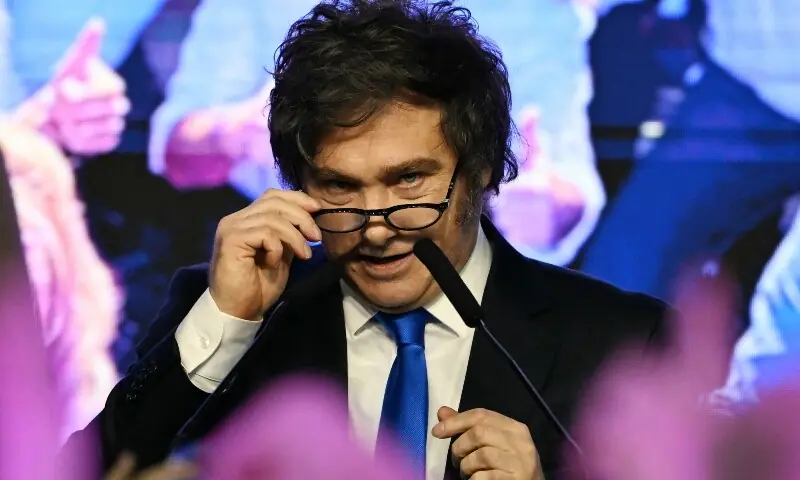

Argentine President Javier Milei hailed his party’s runaway victory in Sunday’s midterm elections as a “turning point” for the country and vowed to charge ahead with his agenda of shrinking the state and deregulating the economy.
Milei’s small La Libertad Avanza (LLA) party rebounded from a series of setbacks to win 40.84 per cent of the votes cast for members of Congress, far outpacing the opposition in an election closely watched by jittery investors.
“Today we reached a turning point, today begins the construction of a great Argentina,” the 55-year-old president told supporters at a victory party in Buenos Aires.
He promised to continue on the reform path with what he predicted would be “the most reformist Congress in Argentina’s history”.
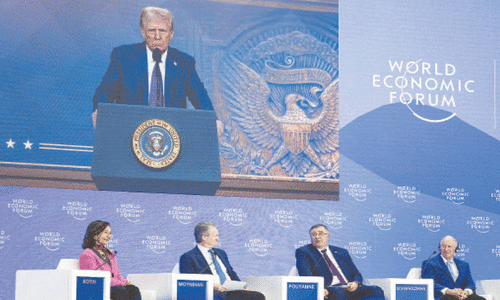
US President Donald Trump, a close ally, congratulated Milei and said his Argentine counterpart was doing a “wonderful job!”
Half of the seats in the Chamber of Deputies and one-third of the Senate seats were up for grabs on Sunday.
Milei said LLA had more than tripled its seat count, winning 101 seats in the lower house Chamber of Deputies, up from 37, and 20 seats in the Senate, up from six.
Forward, not backwards
The centre-left Peronist movement, in power for much of Argentina’s post-war history, trailed in second place with 31.64pc.
“Far more Argentines want to move forward than go backwards,” Milei said on the demise of the opposition.
The elections were the first national test of Milei’s support since he won office two years ago on a promise to revive the long-ailing Argentine economy through a series of painful reforms.
The run-up to the vote was marked by a run on the national currency, the peso, that forced Milei to seek a bailout from Trump.
Washington promised an unprecedented $40 billion package of aid, but the assistance came with a warning from Trump to Argentines that he would not “be generous” if the election did not go Milei’s way.
“Our confidence in him was justified by the People of Argentina,” the US president said on Monday.
At the LLA election party, hundreds of Milei’s supporters celebrated the results with cheers, hugs, chants and even tears.
“I’m very happy and excited; I didn’t expect such a large number,” Facundo Campos, a 38-year-old marketing consultant, told AFP, comparing the joy to the “last goal of the last World Cup won by Argentina!”
Maria Jesus Galan, a 45-year-old health official, said while there “some room for improvement” in Milei’s government, “it has a great future”.
Turnout at four-decade low
Ahead of the election, several Milei voters had spoken to AFP about their disappointment with his leadership, particularly the corruption scandals involving members of his inner circle.
But they remained viscerally opposed to the Peronist movement, whose figurehead, former president Cristina Kirchner, is under house arrest after being convicted of corruption.
At 67.9pc, turnout was the lowest in a national election in four decades, reflecting disillusionment with the entire political class.
The most surprising results were in Buenos Aires province, a Peronist stronghold, where LLA clawed its way back from a defeat by the Peronists in last month’s local elections to a toss-up.
Adriana Cotoneo, a 69-year-old pensioner voting in Buenos Aires, told AFP she backed Milei’s party “not because I believe it’s the best option, but because I’m clear about who I want to be gone.”
Former TV pundit Milei has cut tens of thousands of public sector jobs, frozen public works, cut spending on health, education and pensions, and led a major deregulation drive since taking office in December 2023.
His reforms were blamed for initially plunging millions of Argentines deeper into poverty. They did, however, slow inflation by two-thirds — to the relief of many —although at the expense of faltering economic growth, consumption and manufacturing.
Investors began dumping the Argentine peso last month amid concerns over the economy and support for Milei, but Trump stepped in to shore up his closest Latin American ally.
The US Treasury has intervened several times in the market in recent weeks, buying up pesos to help keep it afloat.
Ahead of the election, expectations were high that the government could depreciate or devalue the peso, widely seen as too strong, immediately after the vote.
But questioned about the possibility on Sunday, Economy Minister Luis Caputo replied with an emphatic: “No.”
“Monday is just another day, nothing changes to the economic program or the band system,” he said, referring to the peso-dollar exchange rate band set by the government in April.