3
3

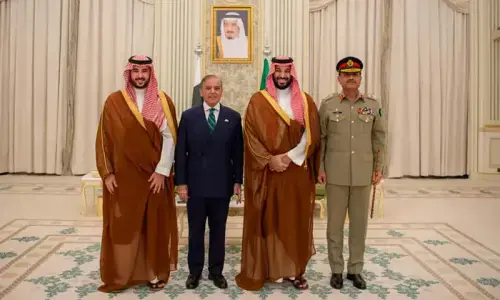
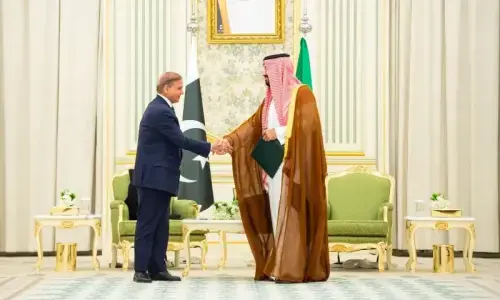
IN these times of frequent global conflict, as the old order collapses and new rules are being written, there is much talk of collective security. In this regard, the signing of the Pakistan-Saudi Strategic Mutual Defence Agreement last month was seen as a major development in the geopolitical and defence spheres.
Though Islamabad and Riyadh have been allies for decades, the pact has solidified the defence relationship, even though questions remain about some of the finer details of the deal. Regardless, comments by Pakistani officials that the pact could be expanded to other states have led to speculation in global media that a ‘Muslim Nato’ may be in the works, specifically due to the stated mutual defence clause of the Pak-Saudi deal.
It is indeed an enticing — if difficult to achieve — idea that a collective defensive arrangement could prevent aggression against Muslim states. In the past year, Pakistan has faced aggression from India. Elsewhere, Israel has been on the rampage. In the current year alone, apart from the genocide in Gaza, the Zionist state has attacked Lebanon, Syria, Yemen, Qatar and Iran. Perhaps if the Muslim states had a stronger defensive arrangement, Tel Aviv might have thought twice about carrying out the slaughter in occupied Palestine, as well as attacking sovereign countries at will.
While bilateral pacts are one thing, as this paper has previously noted, the framework for a defensive arrangement of Muslim states already exists in the shape of the Saudi Arabia-based Islamic Military Counter Terrorism Coalition, headed by former army chief Gen Raheel Sharif. The need is to extend this coalition to all OIC members, and ensure that aggression against one is indeed considered aggression against all. Excluding any Muslim state will defeat the purpose of the entire endeavour. This reformed alliance should focus on collective defence, and no other states or blocs should feel threatened by it.
Though the OIC has hardly lived up to its potential, perhaps facing existential challenges to their sovereignty, Muslim states may now seriously consider putting up a united political and military defence to prevent aggression against all OIC members. Such an alliance can work on several principles, foremost of which can be defending against external threats and coordinating action against transnational terrorist groups.
Moreover, once Muslim states bind themselves under a collective defence framework, it may be easier to resolve intra-Muslim disputes peacefully, such as the Pakistan-Afghan stalemate. Nato may not be the best exemplar, but it has proven that European states that were once at war with each other have now combined forces for a common defence. Muslim states can choose to work in silos and pursue narrow interests. Or they can pool their resources and put up a collective defence in times of immense insecurity.
Published in Dawn, October 26th, 2025