Extra-judicial killings ‘worst form of violation’ of Constitution: Justice Minallah
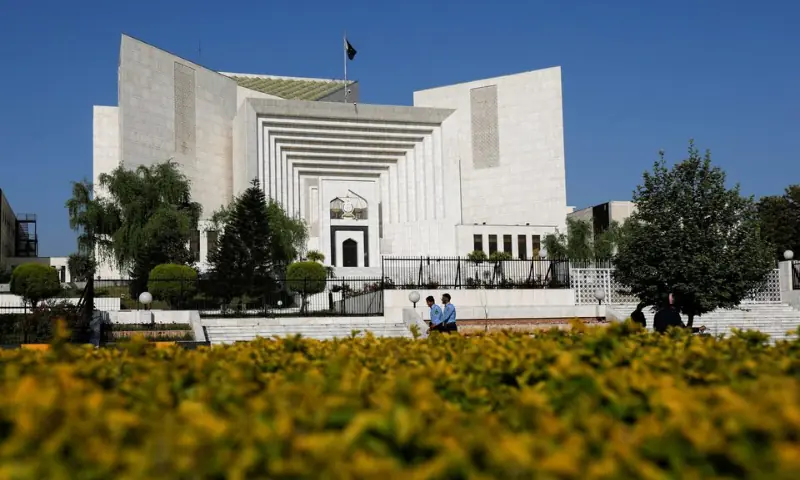
Supreme Court judge Justice Athar Minallah on Friday termed extra-judicial killings, custodial torture and the excessive use of force as the most “intolerable crimes” in a democratic society, calling them the “worst form of violation” of the Constitution.
In his dissenting note on the court’s judgement issued in a case pertaining to the killing of Mohammad Hayat Mirza, a Karachi University student, in Turbat, Justice Minallah said that there can be “no tolerance” for such acts and conduct by law enforcement agencies and their members.
In 2020, police arrested a soldier of the Frontier Corps (FC), Shadiullah, on charges of killing Mirza and started an investigation after registering a case against him. The case was registered against the suspect on the complaint of Mohammad Murad Baloch, the brother of the deceased.
The convicted had appealed to the SC following his sentencing by a trial court. The trial court, in a judgment on January 20, 2021, convicted the appellant under Section 302(b) (premeditated murder) of the Pakistan Penal Code and he was sentenced to death.
However, the SC issued its 2-1 majority verdict on Shadiullah’s plea on September 17, 2025, a written order for which was issued yesterday. According to the verdict, the death sentence was commuted to life imprisonment.
The ruling was issued by a three-member bench comprising Justices Athar Minallah, Irfan Saadat Khan, and Malik Shahzad Ahmad Khan, among whom Justice Minallah dissented.
“In a society where grievances relating to enforced disappearances, use of excessive force, abuse of power, extra-judicial killings and violation of fundamental rights by law enforcement agencies are widespread, impunity in case of crimes committed against the citizens becomes the most aggravated form of transgression of law,” Justice Minallah stated.
“The gravity intensifies when a citizen falls victim to aggression by a law enforcement agency or its officers and members,” he said. “Any such act or conduct is intolerable in a society governed under the Constitution.”
Justice Minallah said that the rule of law is “eroded” when law enforcers take the law into their own hands and “arrogate to themselves the role of a judge and an executor”, adding that the appellant had abused his position of authority and trust.
“The officers and members are provided weapons and ammunition for the exclusive use to protect the people and to serve them in their best interest,” he said in his note.
“As a uniformed disciplined force, each officer and member of the FC Balochistan is presumed to be highly trained and that each would demonstrably display high standards of professionalism and exemplary conduct at all times while dealing with the civilian population for whose benefit they have been entrusted with onerous duties and obligations,” he stated.
Deterrent punishment, he said, is not only to maintain a balance between the gravity of wrong done by a person but “also to make the offender an example for others as a preventive measure for reformation of the society”.
“In the case of heinous crimes committed with premeditation and in a gruesome manner, no leniency ought to be shown to the culprits,” Justice Minallah said.