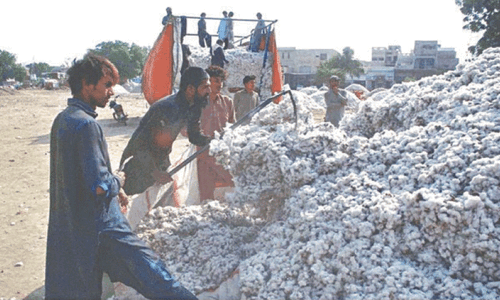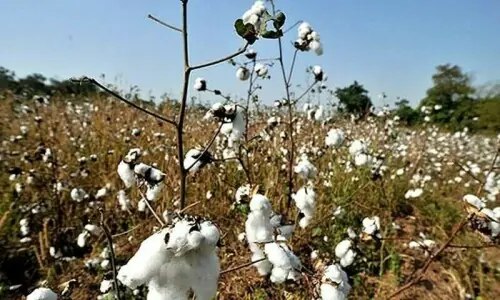

LAHORE: Despite a 22 per cent year-on-year increase in national cotton production, the domestic market has seen a sharp decline in fresh arrivals during the first half of October. This slowdown has raised concerns about a potential supply shortage, driving a bullish trend in the prices of raw cotton, cottonseed and oilcake.
Data released by the Pakistan Cotton Ginners Association (PCGA) shows that from Oct 1 to 15, the arrival of seed cotton (phutti) at ginning factories across the country plummeted by 30pc compared to the same period last year, signalling that the initial strong momentum of the season is flattening out earlier than expected.
Cotton Ginners Forum Chairman Ihsanul Haq disclosed that a cumulative 3.796 million bales of phutti had reached ginneries by Oct 15, marking a 22pc rise over last year’s 3.102m bales. However, the fortnightly report highlights a worrying drop: only 751,000 bales arrived in the first half of October against 1.062m bales last year.
The slowdown in arrivals has led to a sharp moderation in the overall national production increase, which stood at a robust 49pc above last year’s figures as of Sept 30, down to just 22pc. Similarly, Punjab’s year-on-year production growth has declined from 56pc to 28pc (1.52m bales), while Sindh’s growth has fallen from 45pc to 19pc (2.276m bales).
Fortnightly production plummets; growth slows from 49pc to 22pc this season by mid-October
“The early start to picking, caused by unexpectedly high temperatures and increased cultivation of early varieties in Punjab, led to an unusually rapid arrival pace initially. Several experts had already warned that the October reports would show a decline in the growth rate, and this report confirms those fears,” Mr Haq stated. He expressed concerns that the subsequent reports might even show the overall production dipping below last year’s final tally.
The unexpectedly low arrivals have immediately impacted commodity prices. Cottonseed (banola) and oilcake prices saw a jump of Rs100 to Rs200 per maund, now reaching Rs3,600 and Rs3,100 per maund, respectively, with lint (raw cotton) prices expected to follow a similar upward trajectory from the start of the next working week.
Meanwhile, textile mills have procured 3.04m bales from ginneries, a 17pc increase from the 2.591m bales bought last year. Notably, exporters have purchased a record 125,000 bales, sharply up from only 3,200 bales in the corresponding period last year. Currently, 520 ginning factories are operational nationwide.
A persistent issue causing anxiety among stakeholders is the stark contradiction in production figures. The PCGA’s report shows Punjab’s cotton production at 1.52m bales, which is more than 100pc lower than the 3.081m bales reported by the Crop Reporting Service (CRS) Punjab for the same period.
Sajid Mahmood, Head of the Transfer of Technology Department at the Central Cotton Research Institute, told Dawn that Pakistan’s 2025 cotton season has now entered a “decisive stage where the earlier fast pace of crop arrivals is slowing down”.
He attributed the complexity of the cotton economy to “global fluctuations in cotton prices, varying demand and supply trends, rising import volumes, and local market uncertainty”. Mr Mahmood confirmed that the decline in fortnightly arrivals signals a clear slowdown in the picking pace, which “may result in the season ending earlier than usual, creating temporary supply pressure in the market”.
On pricing, he observed that while “some growers and middlemen have tried to control arrivals to push prices upward”, the weak global demand, coupled with large crops in countries like China, the USA, and Brazil, has limited the impact.
Published in Dawn, October 19th, 2025