National Judicial Policy-Making Committee proposes KPIs for judges to ensure accountability
• Automated evaluation systems will consider both qualitative and quantitative performance indicators
• Safeguards for judicial independence discussed
• AGP says steps taken to address enforced disappearances through tweaks to ATA
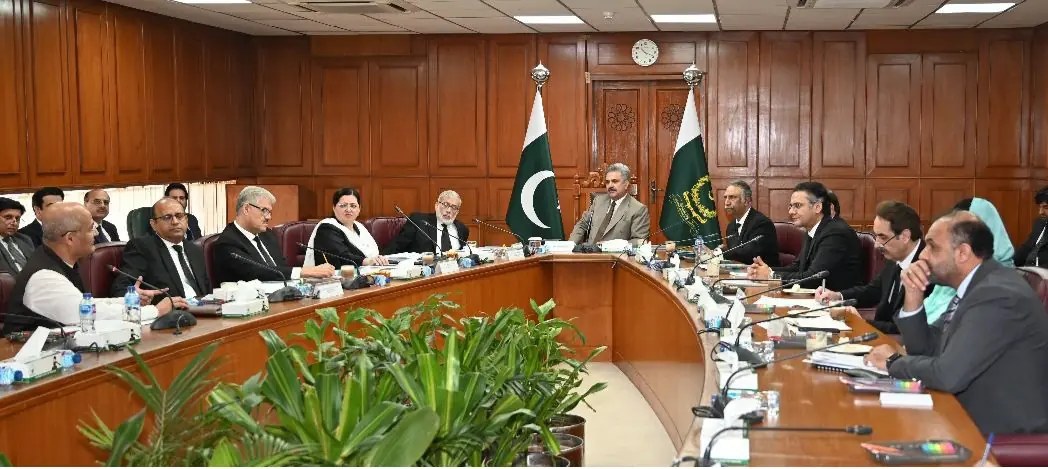
ISLAMABAD: The National Judicial Policy-Making Committee (NJPMC) on Friday discussed wide-ranging reforms aimed at strengthening the performance and independence of the judiciary, with a particular focus on introducing Key Performance Indicators (KPIs) for judges to ensure accountability and uniform standards across the district judiciary.
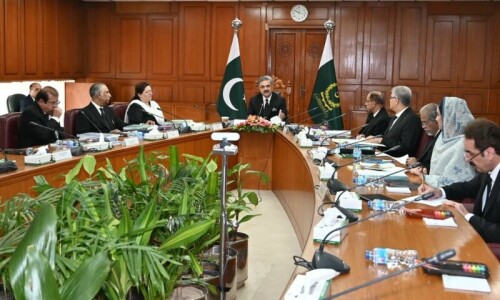
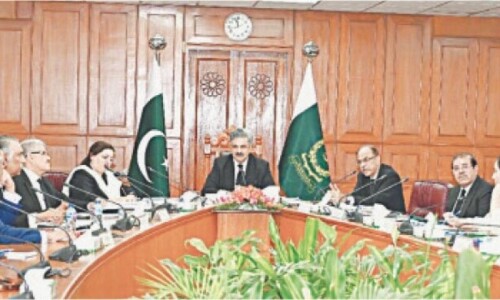
The meeting, chaired by Chief Justice of Pakistan (CJP) Yahya Afridi, also underscored the need for harmonised policies among high courts and data-driven evaluation mechanisms to enhance judicial efficiency and integrity.
The committee, about the district judiciary reforms, discussed the comprehensive recommendations submitted by the subcommittee on harmonising policy innovations across various high courts.
The recommendations include: formulation of Key Performance Indicators (KPIs) for judicial officers aligned with the World Justice Project’s Rule of Law Index; uniform eligibility criteria and standardised recruitment rules for judicial appointments; unified syllabus and evaluation framework for examinations; joint and specialised training programmes for judges; and uniform service terms and conditions for members of the district judiciary.
Performance evaluation
The chair additionally emphasised the need for data-driven and automated performance evaluation systems, integrating both qualitative and quantitative indicators.
He highlighted that the concept of “judgement to follow the judge” should form part of the evaluation dossier. The chair also proposed diploma courses for judges of special courts and regular counselling sessions for stress management.
The committee appreciated these forward-looking recommendations and decided to constitute a committee comprising all chief justices of the high courts to review the proposals and submit consolidated recommendations for discussion in the next meeting.
Efforts of HCs acknowledged
On safeguarding judicial independence, the CJP acknowledged the efforts of all high courts for notifying Standard Operating Procedures (SOPs) that provide a mechanism for an institutional response to extraneous influence on judges at the district level. The chair further observed that similar safeguards were necessary to protect the independence and integrity of judges of the superior judiciary.
In this regard, the committee was apprised by the chair that he has proposed amendments to the Code of Conduct for Judges to establish an institutional mechanism for responding to extraneous influence.
The proposed amendments also include provisions that were approved by the Supreme Judicial Council (SJC) in 1967 and 2003, and circulated for compliance at that time, but were not incorporated in the notified Code of Conduct. The substitution of an article relating to judges’ exposure to the media was also discussed in detail.
Use of Generative AI
The LJCP secretary, on the ethical use of Generative Artificial Intelligence in the judiciary, informed the committee that the subcommittee of the National Judicial Automation Committee (NJAC) has finalised a Draft Ethical Guidelines for the use of Generative AI in the Judiciary after extensive consultations with national experts and all high courts.
The guidelines propose a high-level ethical and operational framework for the responsible integration of AI technologies within the judicial system, ensuring alignment with national digital policies and international best practices.
Enforced disappearances
Attorney General for Pakistan (AGP) Mansoor Usman Awan informed the forum that the issue of enforced disappearances has largely been addressed through the recent amendment to Section 11EEEE of the Anti-Terrorism Act, 1997, which requires the production of a detained person before a magistrate within 24 hours.
The AGP further assured the committee that a comprehensive mechanism to redress complaints of non-compliance with this legal requirement is being considered by the government and will be presented to the committee in its next meeting.
The committee appreciated the assurance given by the AGP.
The meeting concluded with appreciation for the sustained efforts of all high courts, the Ministry of Law and Justice, and the Law and Justice Commission Secretariat for their valuable contributions toward strengthening the administration of justice, promoting institutional coherence, and enhancing public confidence in the judicial system.
Published in Dawn, October 18th, 2025