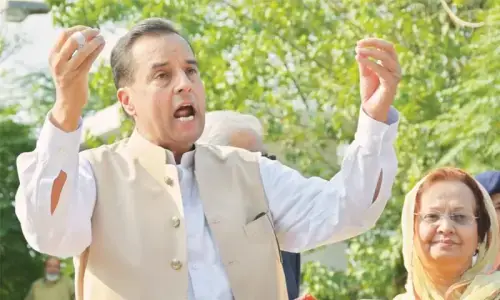
LAHORE: Over 120 women farmers and workers gathered at the Lahore Press Club on Wednesday to mark the Rural Women’s Day and demanded gender-just food systems and recognition of women’s vital role in food production.
The event was organised by the Pakistan Kissan Rabita Committee (PKRC) in collaboration with the Tameer-e-Nau Women Workers Organisation (TWWO), as part of the coordinated women-led mobilisations across Asia initiated by the Asian Peoples’ Movement on Debt and Development (APMDD).
The participants called for the recognition of women as food producers in all agricultural and food system policies, equal access to land, water, seeds, and resources, and protection from climate-induced disasters that threaten rural livelihoods.
They also demanded that the government prioritise domestic food sovereignty over export-oriented corporate farming and secure climate finance from rich nations to support adaptation for women farmers and workers.
“Women in rural Pakistan are the backbone of our food systems, yet they remain invisible in policy and resource allocation,” said Riffat Maqsood, chairperson of the TWWO.
“From sowing seeds to harvesting crops, women sustain our agricultural life, but as floods, droughts, and corporate land grabs worsen, they are losing access to land and livelihoods. Gender-just food systems mean giving women the right to land, water, and fair prices — not charity but justice,” she said.
The mobilisation at the Lahore Press Club comes at a time when Pakistan’s agriculture continues to suffer from recurring floods and droughts, devastating crops and rural livelihoods.
The 2022 floods alone submerged a third of the country, affecting over 4 million women working in agriculture. Rural women and girls are among the most affected, often walking long distances to collect water and firewood as climate stress deepens.
Despite contributing the least to global emissions, small-scale farmers and fishers bear the highest costs of climate adaptation. “Rural women cannot and should not be forced to pay for a crisis they did not create.
The government must demand public, grants-based climate finance from rich countries under the UN Climate Convention to transform Pakistan’s food systems into ones that are sustainable, equitable, and climate-resilient,” said a representative of the PKRC.
The event also coincided with World Food Day and the 80th anniversary of the UN Food and Agriculture Organisation (FAO). Speakers criticised the FAO’s historic promotion of industrial agriculture, which they argued had degraded soil and water, displaced small-scale producers, and intensified the climate crisis.
Ms Riffat said, “As the FAO marks 80 years, we remind the world that industrial agriculture has failed to feed our people. Real food security comes from women-led, small-scale, and ecological farming systems — not from corporate control of our lands and seeds.”
Published in Dawn, October 16th, 2025