“How very often do we belittle or undermine the blessings around us?” wondered Sarah as she peeped her head out of the 26-seater coaster’s window.
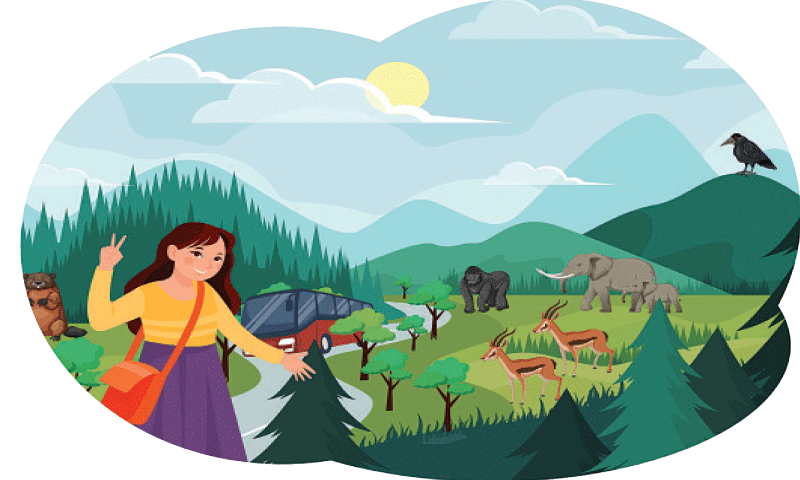
She, along with her family, was travelling to Skardu for vacation by road. Almost all the youngsters thought that a road trip was not a good idea, as the roads were uneven and not safe. But some opined that it would be fun to enjoy the scenery and would be more of a learning experience.
Sarah took the last seat. She had brought some books along and wanted to read in peace. Soon she dozed off for a short while until someone knocked on the window next to her. The bus had stopped, and a small boy holding some locally made beautiful handicrafts in his hands had knocked on her window. She quickly sat up to look.
The things in his hands were beautiful, so Sarah asked him the price. There was, of course, a bit of negotiation, and she bought a small peacock made of stones and some glassy material.
As she looked at the peacock, she couldn’t help admiring the creativity of the little boy’s family. A truly artistic piece. All the features of the peacock were meticulously done.
“Such children should have better opportunities and should somehow leave this place for better prospects,” she thought to herself, as Sarah had always been a staunch advocate of moving abroad and not wasting time here in the quest for better opportunities.
As the other family members were freshening themselves at the spring that ran along the roadside, Sarah sat with the boy and had a chat by the corn cart. She noticed that the boy picked up the husk that fell from the cart, so she asked him the reason.
The boy told her that they either made things out of it or used it as fodder for their goats. The little boy was not shy; he was street-smart and knew how to deal with inquisitive tourists.
The driver honked — it was time to go. The long journey lay ahead and it was just the beginning. Sarah sat back in her seat, but she kept thinking about the boy who, with such limited resources and such a tedious lifestyle, seemed extremely content.
As the coaster moved further towards the mountainous destination, Sarah saw little girls herding huge animals. They excelled in their task to the extent that all the cattle and goats moved according to their directions. And the best part was that as soon as the coaster stopped, the same girls quickly grabbed pre-made trays and ran towards the tourists — all the way from the huge rocks. They were selling some fresh berries.
Sarah had never eaten those berries, so she was reluctant to try them, but the driver told her they were safe. She bought a packet and ate one — it tasted good.
As others discussed the taste of the berries, Sarah again admired the selling skills of the little girls, who kept their eyes keenly on the road so as not to miss any tourists, even while tending to the animals.
“Where do you get these berries from?” Sarah inquired.
One of the girls pointed at a tree whose leaves were being enjoyed by the goats, and as the animals had their meal, these young girls neatly made packets of the fruits of the tree to sell.
“Wow!” Sarah enjoyed the smartness of the kids so much that she couldn’t help smiling to herself.
As the coaster moved on, Sarah took out her cell phone and started scrolling through old photos. She came across her own picture in which she was posing with a daisy crown. It was from a visit to Koh Murree some years back.
Sarah looked at the photo thoughtfully. She vividly remembered that she had purchased the crown of daisies from a child who was holding a few crowns in his hand and wanted to sell all of them to her family. The crowns were beautiful.
“Again… making the best out of any opportunity!” wondered Sarah with admiration.
During her stay in Skardu, Sarah visited the magnificent sites all around. The beauty of the region no doubt leaves one in awe, but this time, Sarah was not only enjoying the natural gifts bestowed upon us as a nation, but also observing the young and creative local entrepreneurs. She observed with fascination and admiration the young minds finding opportunities from all around them and using them to earn for their families.
On her way to Upper Kachura Lake, a beautiful tourist spot, she met small girls selling the yummiest mulberries. They had large trees in their backyards and from this natural source, they managed to earn some money too. Then there were dried cherries and apricots as well. During the harvest season, they would dry the fresh cherries, apricots, peaches and berries in the sun on rooftops, and use the preserved ones throughout the year.
A message beep on her phone brought Sarah back from her thoughts. It was her teacher’s message, asking her to participate in a debate competition. The topic of the competition was about the brain drain caused by the lack of opportunities in our country. Knowing Sarah’s viewpoint, her teacher had found her the best choice to speak in favour of this topic.
When Sarah went back to school, she shocked her teacher by saying that she would speak against the motion instead of in favour. The teacher agreed to let her change her stance.
On the day of the debate, Sarah advocated strongly that opportunities lie everywhere — it is just about having the guts to use them in the best possible way. She insisted that the authorities should arrange some sort of basic schooling for children in rural areas because they were already skilled; they performed so many tasks that schoolchildren in urban areas could not. They just needed conventional learning to excel in their lives. If only they were provided with some technological knowledge along with basic reading, writing, and mathematics skills, they would no doubt be successful, improving not only their own lives but the whole nation’s.
Sarah admitted in her speech that she had always disliked the weaknesses in us as a nation to the extent that she had started ignoring the strengths. The pollution, mismanagement of resources, lawlessness, corruption, etc., are no doubt the ugly bits of us, but the whole is not the same. We need to fix ourselves instead of disowning ourselves!
She ended with a beautiful quote from Daniel Radcliffe: “Being self-critical is good; being self-hating is destructive. There’s a very fine line there somewhere, and I walk it carefully.”
Amidst loud applause, she requested everyone in the audience to be critical only to improve, not to belittle oneself.
Dear children, here is a message for all of you: love the country you live in. Enjoy its independence, own its innumerable blessings and take pride in the little achievements that we as a nation have made. Running away from the ‘unwanted’ is not the solution. Facing challenges, finding better paths and then succeeding is the ultimate goal. The negativity around you should not hold you back — you are our future and it is surely beautiful!
Published in Dawn, Young World, October 18th, 2025