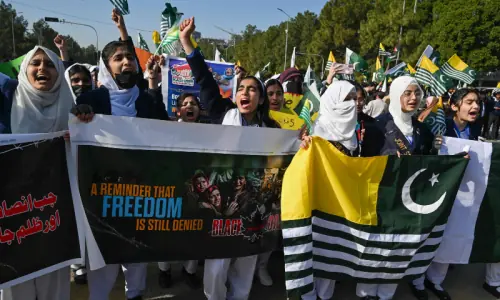
The latest hearing of cases against Baloch Yakjehti Committee (BYC) chief Dr Mahrang Baloch and other group leaders was held in Quetta District Jail instead of an anti-terrorism court (ATC), it emerged on Sunday, with the advocacy group terming the development a “disturbing display of institutionalised repression”.
The BYC, a Baloch advocacy group working against enforced disappearances since 2018, posted in a statement on X that the judicial remand of the detained BYC leaders was further extended for ten days.
Mahrang and other BYC leaders, including Sibghatullah Baloch, Beebow Baloch, Beebarg Baloch and Gulzadi Baloch, were arrested under the Maintenance of Public Order Ordinance (MPO) in March and have remained in custody since then, being remanded multiple times.
Israr Baloch, the counsel for Mahrang, confirmed Saturday’s developments to Dawn.com. The case was heard by Judge Muhammad Ali Mobin of ATC-1, he said.
“Instead of presenting the BYC leaders in ATC-1, the BYC legal team was summoned to District Jail Quetta, where the cases were heard,” Israr said.
“During the hearing, the prosecutor could not submit the challan, due to which the charges could not be framed against the detained BYC leader and nor could a formal trial be initiated,” he added.
The hearing was adjourned until October 18 and Judge Mobin ordered the prosecution to submit a challan by then, he said.
Earlier, the BYC said in its X post that the shift to “jail hearings marks a grave and deliberate attempt to suppress transparency, exclude public scrutiny, and further institutionalise the criminalisation of peaceful political dissent in Balochistan.
“By moving the proceedings behind prison walls, the state effectively bars families, journalists, and neutral observers from witnessing the process which is a direct violation of Pakistan’s own constitution and international standards on fair trial and due process.”
BYC leaders’ arrest
Mahrang, along with other BYC members, was arrested on March 22 on allegations of “attacking” the Quetta Civil Hospital and “inciting people to violence”. The arrests were made a day after the group faced a police crackdown while protesting against alleged enforced disappearances.
She was taken into custody under Section 3 of the Maintenance of Public Order (MPO) — a law that empowers authorities to arrest and detain individuals suspected of posing a threat to public order — for a period of 30 days (first term). Thereafter, her detention was extended for an additional 30 days (second term) through a decision of the Balochistan Home Department in April.
After the BYC leaders had completed three months in custody in June, the provincial government issued a fourth extension order, extending their imprisonment by another 15 days.
Following their detention under the MPO, cases were also registered against Mahrang and other BYC leaders under different sections of the Anti-Terrorism Act and the Pakistan Penal Code.