Ahmed and Osama were known as “mischief makers,” not because they were truly wicked, but because they loved fun and adventure. The 12-year-olds lived in two adjacent flats on the top floor of a high-rise overlooking the Karachi Port. From their windows, they could see ships and boats of all sizes — cargo vessels, trawlers and tiny fishing boats — moving slowly across the glittering Arabian Sea.
At night, after dinner, they often sat together by the window, talking and imagining wild adventures. They would watch the lights twinkling far away and pretend they were captains sailing to mysterious islands or exploring unknown lands. Their conversations were full of excitement and dreams, and sometimes, they promised each other that one day, they really would go on a great sea adventure.
One such night, as the sea breeze drifted through the open window, Ahmed suddenly said, “Let’s go off in one of those boats! It would be such an adventure!” His eyes sparkled with excitement. He was tired of homework, routines and what he called his “boring life.”
Osama gasped. “We can’t do that! You know we’re not even allowed to go far from home alone, let alone to the port.”
“Never mind that,” Ahmed replied quickly. “We’ll sneak out quietly. It’s only a bit of fun. Life’s dull enough and we haven’t had any adventure for ages.”
Osama hesitated. He was softer, more cautious — but easily persuaded. Soon, both boys tiptoed out of their apartments and slipped into the busy, noisy street below.
“Let’s take a rickshaw to the port!” said Ahmed eagerly. After a few minutes, they found an old rickshaw driver who looked tired and ready to go home. At first, he refused, but Osama pleaded and offered him an extra fifty rupees. The man sighed and finally agreed.
The port was still bustling with activity when they arrived. The salty smell of the sea mixed with the diesel fumes of the ships. Men shouted instructions, ropes creaked and waves slapped against the docks. The boys’ hearts pounded with nervous excitement as they looked around for an empty boat.
“We’re sure to find one,” Ahmed whispered confidently. “Someone must have left one unguarded for the night.”
“But it’s stealing,” murmured Osama. “What if we get caught?”
“It isn’t stealing,” Ahmed said quickly. “We’ll bring it back. We just want to sail for a while — and we’ll even leave some money for the petrol we would use. It’s not like we’re doing anything bad.”
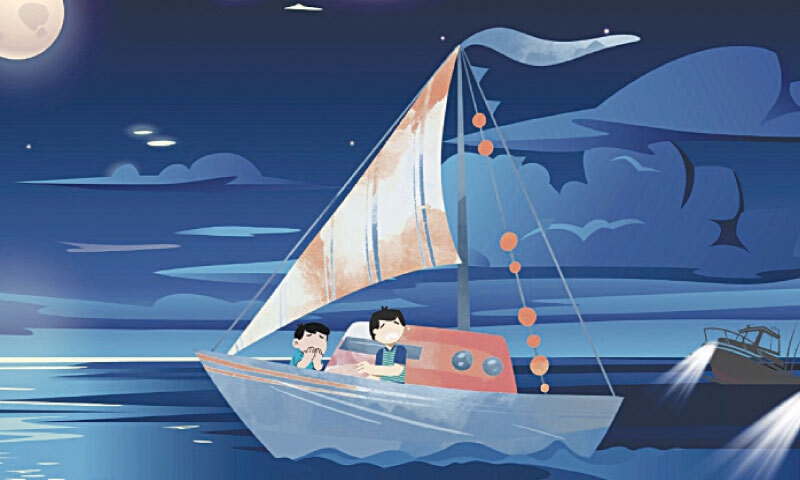
Down by the stone steps in a quiet corner of the port, they found exactly what they wanted — a freshly painted fishing boat, its outboard motor gleaming in the moonlight. The sea shimmered like liquid silver under the night sky.
Osama, nervous but excited, started the engine. The motor coughed, then roared to life. The boat moved gently away from the dock, gliding over the dark, rippling water. The boys grinned at each other, thrilled beyond words. They passed the big cargo ships they had so often seen from afar, hearing faint voices and clanging sounds as sailors worked. The men on the decks spoke in different languages, proof that the ships had come from faraway lands.
On and on they went, past the harbour lights and out toward Manora Island.
“Isn’t this fun?” Ahmed shouted over the sound of the engine. But before Osama could reply, a deep, booming sound echoed through the air — like a siren. In seconds, bright white searchlights flashed across the sea, sweeping in every direction. The boys froze.
“What’s happening?” cried Osama. “We shouldn’t have come! I told you!” his voice shook with fear.
Ahmed’s heart thudded in his chest. “Turn back! Quickly!”
Stealthily, Osama turned the boat around, weaving in and out of the blinding lights. Sirens wailed, echoing across the water.
“Crouch low!” whispered Osama as a beam of light swept just inches from their boat. Both boys ducked, holding their breath until it passed.
It felt like forever before they finally reached the harbour again. Their hands trembled as they tied the boat to the dock. Then, without saying a word, they ran all the way home, panting and terrified. The streets were quiet and when they reached their flats, the lights were still off. Their parents hadn’t returned yet, and baby Kamran slept peacefully in his cot. The boys collapsed on their beds, hearts still racing.
The next morning, Ahmed’s father sat at the breakfast table, reading the newspaper as usual. “They still haven’t caught that escaped convict,” he said aloud. “Apparently, the biggest police and navy search of Karachi Port took place last night. A convict tried to escape the country through the sea! Many boats were searched and several people were arrested.”
Ahmed froze, staring at his toast. His father folded the paper and looked up. “You’d better hurry to school,” he said casually.
At school, Ahmed and Osama walked together silently. The adventure that had seemed so thrilling just hours ago now felt foolish and dangerous.
“We could have been caught,” Osama whispered. “Our parents would have been so worried — and we might have been mistaken for criminals.”
Ahmed nodded, his face serious. “You’re right. It wasn’t brave. It was stupid. Fun isn’t fun if it puts us or others in danger. Next time, we’ll think before doing something crazy.”
The two boys exchanged a quiet promise that day — that their next adventure would stay within the limits of safety, and that some thrills just weren’t worth the risk.
Published in Dawn, Young World, October 11th, 2025