DAMASCUS: Women and minorities were under-represented in a weekend ballot for members of Syria’s transitional parliament, results announced on Monday showed, for the first assembly to form since the ouster of longtime ruler Bashar al-Assad.
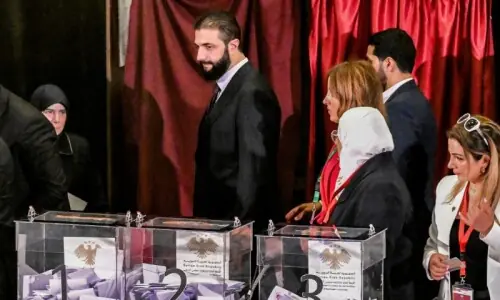
In a process criticised as undemocratic, several thousand members of local committees cast their ballots on Sunday to elect members of the assembly, which will have a renewable 30-month mandate. Interim President Ahmed al-Sharaa is to appoint 70 representatives to the 210-member body.
Local committees — appointed by the electoral commission, which itself was appointed by Sharaa — are to select the other two-thirds, though ballots in the Kurdish-held northeast and southern Syria’s Druze-majority Sweida province were postponed.
Electoral commission spokesperson Nawar Najmeh told a press conference that only four percent of the 119 members selected were women, noting the number “is not proportionate to the status of women in Syrian society and their role in political, economic and social life”.
The commission had previously said women made up 14 per cent of the more than 1,500 candidates. Najmeh said only two Christians were among the winners, calling the representation “weak considering the proportion of Christians in Syria”.
He said that “perhaps the president’s third could compensate” for some underrepresented components of Syrian society but rejected any quota system.
Syrian-American Henry Hamra, the first Jewish candidate since the 1940s, was not selected.
Seats in southern Syria’s Druze-majority Sweida province, which suffered sectarian bloodshed in July, and the Kurdish-held north and northeast are outside Damascus’s control and were excluded from the process.
On March 10, Syria’s Kurds and Damascus agreed to integrate Kurdish-administered civil and military institutions in the country’s northeast into the state by the year’s end, but negotiations on implementing the deal have stalled.
Najmeh said that “we are serious about having supplementary ballots” to fill the assembly’s seats, but that due to the delay in implementing the March 10 agreement “we are unable to set timetables for (ballots in) Raqa and Hasakeh”.
Political and rights activist Nour al-Jandali, who was selected for a seat in central Syria’s Homs, said the new lawmakers “have a great responsibility”.
She noted challenges the new legislature faces, including “how we re-establish a state built on freedom, citizenship and justice”, adding that “women must have a real and active role” in drafting public policy.
Under a temporary constitution announced in March, the incoming parliament will exercise legislative functions until a permanent constitution is adopted and new elections are held.
Published in Dawn, October 7th, 2025