0
0

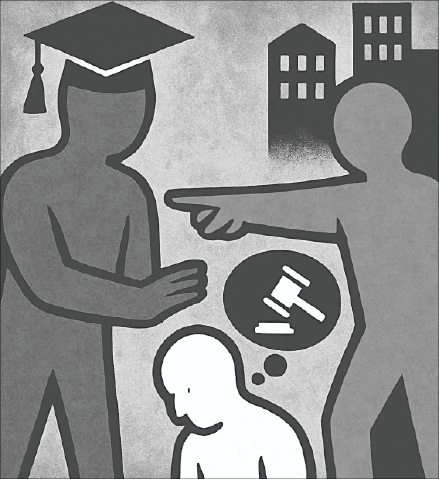
THE Sindh government’s recent plan to outsource school education through public-private partnerships (PPPs) has sparked a new debate. While the move is being portrayed as a step towards improving quality, it raises more concerns than confidence. Punjab has already adopted a similar model, and Sindh has tried partial outsourcing through the Sindh Education Foundation (SEF).
However, past experiences suggest that such partnerships often fail to bring about a real change in learning outcomes, while public funds continue to be misused or poorly managed.
Supporters of the initiative claim that involving private organisations will lead to better school infrastructure, qualified teachers, updated curriculum as well as advanced learning tools. In theory, this sounds promising, especially if it helps underprivileged children in remote areas access quality education free of cost. But theory and reality often differ.
The practical concerns are many. For example, what happens to the thousands of government teachers and staff already working in these schools? Will they be laid off, reassigned or absorbed by private operators? What guarantees are there that the private partners will maintain standards, avoid corruption and prioritise students’ interests over profit? Can a government that has failed to deliver quality education itself suddenly become an effective regulator of private actors?
Outsourcing education is nothing but an admission of failure. Instead of fixing the fault within, the government is trying to shift responsibility. The people of Sindh do not need more experiments. They need genuine, well-planned education reforms that strengthen the public system instead of replacing it with unproven alternatives.
True reforms would mean investing in teacher training, upgrading school facilities, reducing corruption, and making education policies more transparent.
Yasir Ali
Larkana
Published in Dawn, October 4th, 2025