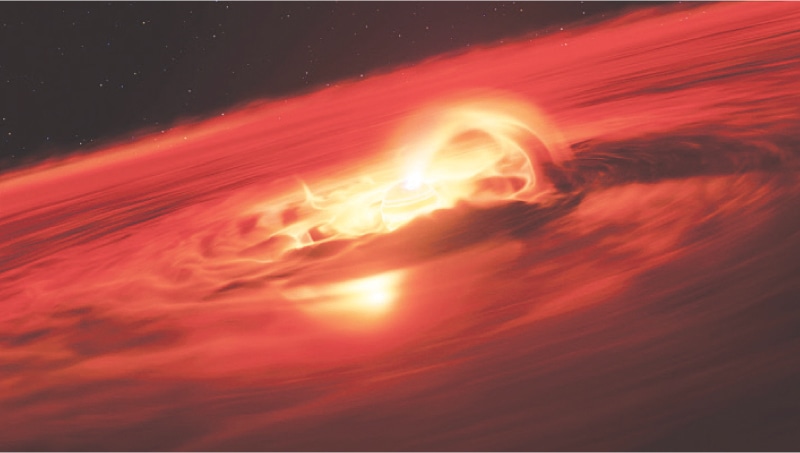
PARIS: A mysterious “rogue” planet has been observed gobbling six billion tonnes of gas and dust a second — an unprecedented rate that blurs the line between planets and stars, astronomers said on Thursday.
Unlike Earth and other planets in our solar system which orbit the Sun, rogue planets float freely through the universe untethered to a star. Scientists estimate there could be trillions of rogue planets in our galaxy alone — but they are difficult to spot because they mostly drift quietly along in perpetual night.
These strange objects intrigue astronomers because they are “neither a star nor a proper planet,” Alexander Scholz, an astronomer at Scotland’s University of St Andrews and co-author of a new study, said. “Their origin remains an open question: are they the lowest-mass objects formed like stars, or giant planets ejected from their birth systems?” The team of researchers behind the new study were stunned to observe an astonishing growth spurt in a rogue planet around 620 light years from Earth in the constellation Chamaeleon.
The planet, officially called Cha 1107-7626, has a mass five to 10 times bigger than Jupiter. Scholz explained that the object is “still in its infancy,” being roughly one or two million years old.
The object grows by sucking in matter from a disc that surrounds it — a process called accretion. But what the astronomers saw happen to Cha 1107-7626 “blurs the line between stars and planets,” study-co-author Belinda Damian said in a statement.
In August this year, the planet suddenly started devouring matter from its disc at a record-breaking six-billion-tonnes per second — eight times faster than a few months earlier.
“This is the strongest accretion episode ever recorded for a planetary-mass object,” said lead study Victor Almendros-Abad of the Palermo Astronomical Observatory in Italy.
Published in Dawn, October 3rd, 2025