0
0

Evolving technologies of the last four decades have brought the world together to indulge in music like never before, with products such as the Sony Walkman and Apple iPod keeping people entertained on an entirely new level in their respective eras. Modern streaming services such as Spotify, YouTube Music and Apple Music have upped their game for providing quality content services as part of a stiff global competition.
But what about the music itself? Has it evolved for the better or worse in all these decades?
The debate remains contentious. Yet there’s a broader agreement on older music from the ’80s and ’90s having a special kind of nostalgic effect on Millennials and Gen-Z. From synth pop to power ballads and new wave to rock songs, the collection is vast enough to make us appreciate the kind of quality lacking in today’s remix- and auto-tune-infused content.
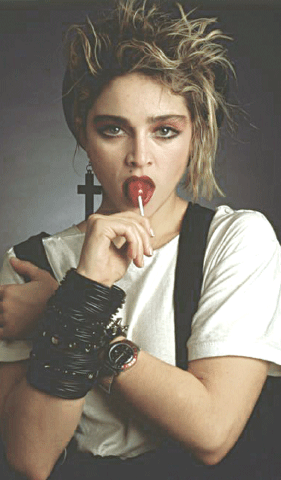
If artists such as George Michael, Madonna, Bryan Adams, Michael Jackson, A-ha, Hall and Oates and Richard Marx defined the ’80s pop music era, then the ’90s were all about Nirvana, Backstreet Boys, Mariah Carey, Take That, R.E.M., Savage Garden and Spice Girls.
An millennial aficionado of ’80s and ’90s English pop laments the alleged loss of musical creativity in contemporary times
The list isn’t exhaustive, of course, with an expansive library of sleeper hits and one-hit wonders riding the wave to establish their place in history. Mr Mister’s Broken Wings, Animotion’s Obsession, Chris Isaak’s Wicked Game, Cutting Crew’s [I Just] Died in Your Arms Tonight and Los Del Rio’s Macarena are some of them.
There have been instances where cover songs gained wider recognition than the originals. Laura Branigan’s Self Control is one such song, which was originally sung by Italian singer Raf as part of the Europop scene emerging in Italy and the then-West Germany during the ’80s.
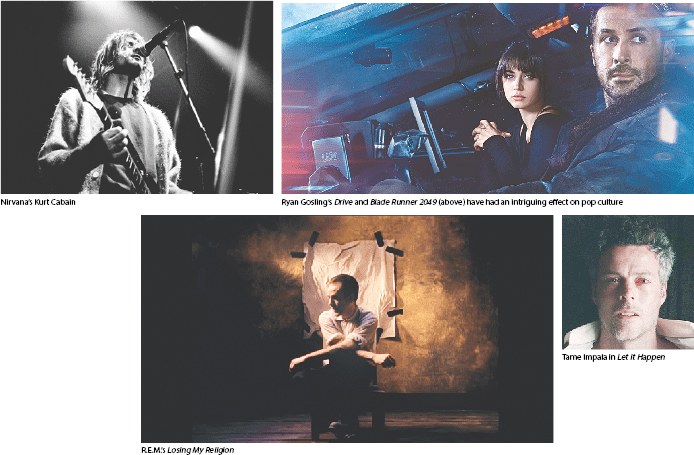
Other mainstream covers, such as Soft Cell’s Tainted Love and Nirvana’s The Man Who Sold the World, became pop culture sensations with the former used in the 2001 parody film Not Another Teen Movie and the 2020 Netflix psychological horror show The Haunting of Bly Manor.
Speaking of pop culture, the majority of music released in those decades were integral for MTV and Top of the Pops signature moments, which were the ‘YouTube’ of their time. Then we had TV shows such as Miami Vice, whose gritty yet glamorous world introduced mainstream songs in a style that made Don Johnson one of the most recognised television stars in the world.
If one wishes to understand how music truly transcended cross-generational appreciation, then look no further than Netflix’s Stranger Things, whose aesthetics and thematic approach reintroduced forgotten favourites for younger audiences. While numerous iconic songs were featured, Kate Bush’s 1985 Running Up the Hill was the breakthrough pop culture moment in Season 4 which established a global musical foothold.
If we are to compare modern music then artists such as Tame Impala, Kavinsky, Gunship, The Weeknd and Dua Lipa are the closest to provide the vibes that take us back to a bygone era. Tame Impala’s and Kavinsky’s music is trippy and eclectic, while Gunship and The Weeknd keep synth-pop music alive and kicking as a tribute. As for Dua Lipa, her style of music reminds us of the ’90s and early 2000s, when the likes of Gwen Stefani and Avril Lavigne ruled the charts.
The emergence of a viral meme culture associated with Ryan Gosling’s films such as Drive and Blade Runner 2049 has had an intriguing effect on pop culture, with Tame Impala’s Let it Happen and Kavinsky’s Nightcall becoming household names thanks to Instagram and TikTok. This has been the case with Tony Dalton and Robert Pattinson as well, with fancams using nostalgic music for effect.
On a very special note, slowed and reverb versions are a regular feature nowadays and their implementation in acclaimed songs elevates the experience. Nevertheless, I find most modern music repetitive and repulsive, with a dearth of creativity that peaked in the 2000s.
Exceptions, such as those mentioned above, are always there but the overall degradation implies a lethargic approach to the music industry, which is a tragedy in itself. Maybe it has to do with my preferences, but that doesn’t seem to be the case if looking at the larger picture.
Music is a lifeline for everyday entertainment and the efforts of hardworking and creative artists should go a long way. The merits and demerits of modern songs aside, let’s just hope that creativity returns to the levels we yearn for soon enough. In the meantime, let’s keep the spirit of older music alive and pass it on to future generations.
Hassan Khan is a journalist turned entrepreneur and an alumnus of King’s College London. He can be reached at hassan.khan06@icloud.com. X: *@mhassankhan06*
Published in Dawn, ICON, October 5th, 2025