0
0

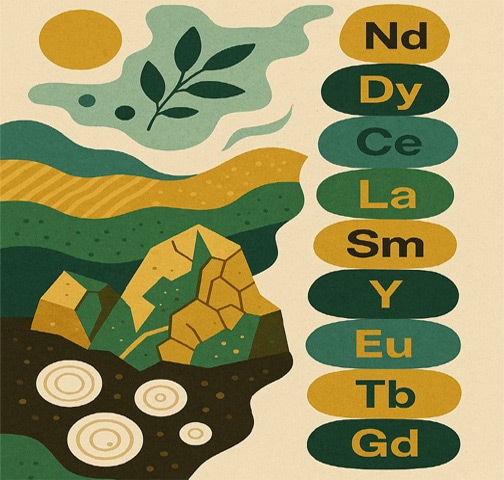
WHILE the world scrambles to secure rare earth elements (REEs), Pakistan is sitting on a geological goldmine. From bastnaesite and monazite in Punjab’s Salt Range to copper and uranium in Balochistan’s Chagai hills, and from pegmatites enriched with monazite, xenotime and allanite in Swat and Dir to granitic bodies in Gilgit-Baltistan (GB), studies have confirmed that Pakistan has at least 12 of the 17 REEs. Preliminary estimates suggest their worth could run into trillions of dollars. But these riches remain buried, underutilised, and largely invisible in our economic priorities.
Globally, REEs have become a new frontier in geopolitics. China controls more than 80 per cent of global refining capacity, a dominance that gives it enormous leverage in world trade. The United States, the European Union and Japan have all declared REEs critical raw materials essential for defence, renewable energy and the digital economy.
Each electric vehicle requires 10-15kg of REEs for high-performance magnets; a single wind turbine may use more than half-a-tonne; and modern defence systems depend on them. The World Bank projects that global demand for these minerals will triple by 2030.
In this context, Pakistan’s reserves could provide not just economic opportunity, but also strategic strength. If developed systematically, these reserves could position Pakistan as a regional hub for REE production and processing, generating billions in export earnings, reducing dependence on imports, and supporting the growth of local industries.
However, the story so far is one of missed opportunities. Exploration remains underfunded, with little modern geo-
physical or geochemical mapping. No refining capacity exists, which means that whatever is extracted is often exported in raw form, only for Pakistan to buy back expensive refined products. Policy frameworks are absent, and environmental safeguards remain poorly enforced. The result is a paradox: Pakistan is resource-rich but benefit-poor.
But the future does not need to repeat the past. Pakistan has a chance to turn its REE potential into a driver of economic development if decisive steps are taken. The first is to create a national REE policy that sets a clear roadmap for exploration, processing, and sustainable mining. Investment in geophysical surveys and drilling, particularly in Balochistan and GB, must be prioritised.
Establishing local refining and beneficiation plants would ensure that value is captured domestically rather than lost through raw exports. Public-private partnerships could attract both local industries and foreign collaborators, such as Japan or South Korea, who have strong expertise in advanced materials but are heavily dependent on Chinese supplies.
Equally important is ensuring sustainability. Rare earth mining can be environmentally destructive if poorly managed. Pakistan must learn from the mistakes of others, and adopt global best practices, including recycling REEs from e-waste and enforcing strict environmental standards. Building technical expertise through universities and research centres will also be critical, equipping a new generation of Pakistani scientists and engineers with the knowledge to lead in this strategic sector.
Pakistan has the resources. The world has the demand. What remains is the will to act. REEs are not just about geology; they are about the future of our economy, our technology, and our place in the world. The time to act, however, is now.
Dr Jahangir Khan
Mianwali
Published in Dawn, September 29th, 2025