CULTURE: IN NEED OF A SECOND WIND
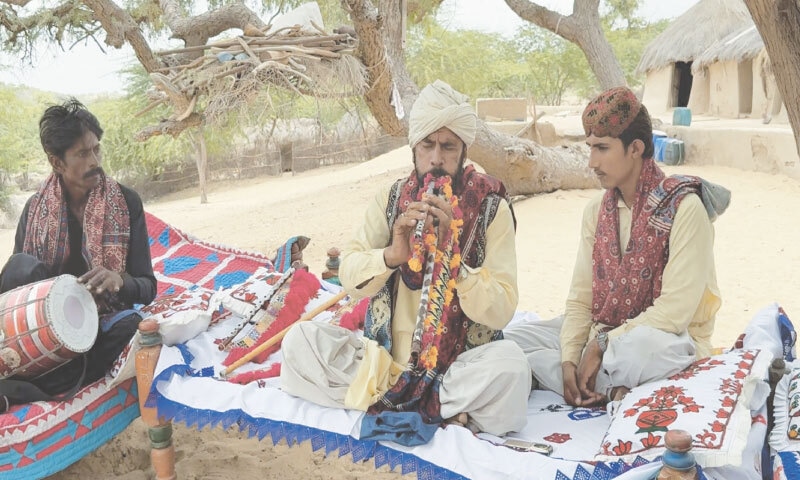


Karo Hajam, now in his sixties, has been playing the alghoza for the past 25 years. For him, the instrument is more than just music — it embodies the rich cultural heritage of Sindh.
“The alghoza is like my heartbeat,” Hajam tells Eos, gently holding the beautifully carved twin flutes he has preserved with love and care for decades. “Whenever I play it, I feel the terrestrial rhythms and all of nature singing along with me.”
This unique conversation with nature is made possible by the instrument’s distinctive design. The alghoza is a wind instrument that consists of two flute-shaped recorders: one flute carries the main tune, while the other provides a steady drone, producing a hypnotic sound that distinguishes it from other wind instruments.
Normally, the alghoza-nawaz [alghoza player] and music experts call the former a female sound and the latter a male sound. The male sound or note continuously keeps playing with the same pitch without any gap, while the female sound or note fluctuates, varying in pitch.
The alghoza’s hypnotic drone has echoed across Sindh’s deserts for centuries. Now, master players of this twin-flute instrument fear it could fall silent…
Hajam tells Eos he first learned the instrument from Ustad Rehmatullah Deplai, who was a student of the famous alghoza master, Misri Khan Jamali. “I had a passion for this instrument since childhood, and learning from such a master was a dream come true,” Hajam recalls.
THE HEART OF SINDH’S FOLK TRADITION
The alghoza is among Sindh’s oldest folk instruments. Originally, it consisted of a single flute. Misri Khan Jamali later modified it by adding a second smaller flute, called the “dedh”, and refined both to create the full twin-pipe instrument used today.
Now, two types of wood are used to make it: the kirara (Capparis decidua) wood is used for the flute producing low notes, and taalhi (Dalbergia Sissoo) wood, also known as shisham, is for the flute producing high notes. A nib or a reed is attached at the top of each flute with beeswax, which works as gum. The beeswax is heated and the reed or nib is dipped into it and then fixed on to the top of the flute. It is then left to dry under the sun, till it congeals to hold the reed and the flute together.
Prof Noor Ahmed Janjhi, a scholar of Sindhi literature, traces the instrument back to the life of shepherds and wandering herders. “The alghoza was never merely entertainment,” he explains. “It was born in the solitude of the desert, played by those who moved with their flocks. Its music reflects the colours, moods and memories of Sindh’s landscapes.”
Hajam makes his instrument from local kirara wood. “I craft and play the alghoza myself, which makes performing even more distinct, because I am connected to it from the very first phase,” he adds.
Hajam performs frequently at fairs and social and cultural gatherings across Sindh, where the alghoza remains a symbol of folk identity. He adds that the performances take place in numerous languages — Urdu, Sindhi and Dhatki (or Thari) — showcasing the alghoza’s versatility and appeal across different communities.
Prof Janjhi adds that some alghoza masters, such as Misri Khan Jamali — often regarded as the father of the alghoza — performed not only across Pakistan but also globally, presenting the instrument to audiences around the world. “Misri Khan Jamali’s exceptional capability to blend classical ragas with folk tunes set a benchmark for generations of players,” he tells Eos.
“These ustads [teachers] were not just musicians, they were custodians of our cultural soul,” Janjhi reflects. “When they played, people felt every excitement — delight, yearning, festivity — all through the alghoza.”
RAISING A MASTERFUL NOTE
Mastering the alghoza is no simple task, explains Hajam. He tells Eos that it took him years of practice to play uninterruptedly without breaking breath. “The instrument demands patience, dedication and a deep connection with rhythm,” he points out.
Training begins with learning circular breathing, followed by moving from simple tunes to complex melodies. A player must control both flutes simultaneously, producing harmony between melody and drone. Hajam notes that achieving this balance is what separates amateurs from true masters.
Regardless of the challenges, the next generation is slowly showing curiosity. Thirty-year-old Ali Gul from Mithi in Tharparkar is one of the few young enthusiasts determined to master the instrument. “I grew up listening to recordings of Ustad Misri Khan and watching Hajam sahib perform at fairs and festivals,” Gul tells Eos. “The sound feels like it belongs to us, to our land and I want to make sure this tradition continues for the next generation.”
But the situation is far from ideal. For young Gul, it is the lack of formal training and a scarcity of teachers that is an impediment. This scarcity is compounded by a broader issue noted by the veteran Hajam: a general “lack of interest among the younger generation”, who are increasingly drawn to modern and electronic instruments.
AN INSTITUTIONAL FILLIP
For traditions like the alghoza to survive in the modern age, personal passion may not be enough. They often require institutional support. This was the thinking behind a potential solution spearheaded by the education minister in Sindh, Syed Sardar Ali Shah.
In June 2022, the Sindh government announced plans to recruit 1,500 music teachers in Grade-14 to teach at 750 government schools across Sindh, as part of a pilot programme. A little over a year later, in August 2023, the ministry announced that 319 candidates had cleared the test, paving the way for their appointment as music teachers.
But opposition from religious groups — for whom institutionalising music is anathema — pressure from political rivals over appointments and bureaucratic bottlenecks, such as teachers’ selection criteria and the release of funds, means the project is yet to take off.
It also didn’t help that the appointment of music teachers took place just before the dissolution of governments ahead of the previous elections. Moreover, the appointment of music teachers was clubbed with tens of thousands of other appointments, which were challenged in court.
In June 2024, the Sindh High Court annulled thousands of appointments across 140 departments in one fell swoop, with the provincial government of Sindh agreeing to start the entire process afresh, in accordance with the law, after re-advertising all posts. Since then, the music teachers who cleared the test have held sporadic protests, demanding progress on their appointments. One aspirant who cleared the test tells Eos that they have been promised a solution multiple times, but none seems forthcoming.
It also doesn’t help that a recruit cannot be older than 33 years at the time of appointment. “Most proficient music practitioners are older, including the overwhelming majority who cleared the test,” Shah, the provincial education minister, tells Eos.
For now, reveals Shah, the Sindh government has found a solution to the issue. “Music teachers will be hired as ‘interns’, which has no age cap.” Shah tells Eos that a summary regarding the same has been moved. “We will soon have music teachers at around 300 schools, with each paid 50,000 rupees [per month],” he adds.
So, the survival of the alghoza once again falls to individuals such as Karo Hajam and Ali Gul. The institutional lifeline they had hoped for is tangled in red tape and political dispute, a silent symphony of bureaucratic failure.
Yet, in the face of this, Hajam’s hope transforms from a gentle optimism into a defiant act of preservation. His breath, and the breath of a handful of others, continues to be a force keeping the drone alive. For now, every note remains a story, every melody a memory — but each one is a hard-won victory against the encroaching silence.
The writer is a freelance journalist from Tharparkar, Sindh. He can be contacted at gr.junejo123@gmail.com
Published in Dawn, EOS, September 21st, 2025