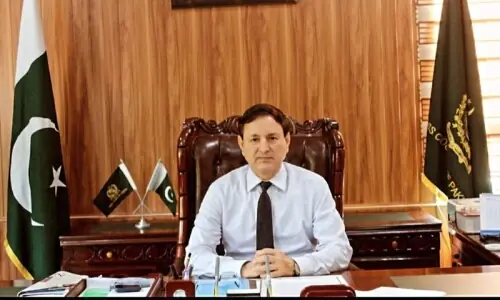
ISLAMABAD: National University of Modern Languages (Numl) on Wednesday said in collaboration with the Federal Directorate of Education (FDE) and National Vocational and Technical Training Commission (NAVTTC) it had empowered 1,000 students of FDE schools and colleges and targeting more 5,000 in the next five years.
Federal Minister for Education and Professional Training Dr Khalid Maqbool Siddiqui accompanied by the acting secretary of the Ministry of Education, Rector Numl, Maj Gen Shahid Mahmood Kayani and senior university officials, faculty and students attended the certificate-distribution ceremony.
During the ceremony certificates were distributed among 400 students from 10 schools and colleges of Islamabad who completed their language courses.
According to a press release issued by Numl, the university’s rector highlighted the success of the initiative, sharing that Numl had already trained 1,000 students in various languages and aimed to train 5,000 more over the next five years. He applauded Numl’s faculty for their dedication to equipping young learners with language skills, adding that “language is a bridge to culture”.
In his keynote address, Federal Education Minister Dr Khalid Maqbool Siddiqui stressed that language was both identity and a vital means of communication. He noted the remarkable progress of female students, emphasising the role of education in national development.
Drawing a comparison with China, he said: “China has not turned 1.5 billion people into a liability but an asset.” He underscored that languages were the need of today and tomorrow and urged youth to work towards making Pakistan a model nation that stood tall in the region.
Meanwhile, a press release issued by the education ministry stated: “Under the Prime Minister’s Youth Skill Development Programme, the Languages Training Programme had been successfully launched through a strategic collaboration between NAVTTC and Numl, and the FDE.
“This programme exemplifies the government’s vision of transforming Pakistan into a hub of talent, innovation, and global engagement,” it said, adding that Languages Training Programme offerred free, high-quality training in vital international languages including Chinese, German, Arabic, Japanese, and Korean. By equipping students with these skills, Pakistan is building bridges of communication and commerce that connected its youth to the global economy.
“More than 800 students across Islamabad enrolled in the programme, with hundreds successfully completing the rigorous six-month training. These graduates are now equipped not only with language proficiency but also with cultural understanding, new pathways to higher education, and enhanced opportunities for international employment,” read the statement of the education ministry.
“This programme is our promise to the young people of Pakistan. We will continue to provide them with tools to secure brighter futures, access better jobs, and compete on the international stage,” the press release quoted education minster as saying, adding that he emphasised that this as just the beginning.
IT lab inaugurated
Dr Khalid Maqbool Siddiqui, inaugurated a “state-of-the-art IT Lab at Islamabad Model College for Girls (VI–XII), G-11/1, under the Disruptive Education: Transforming Schools into Foundries of Emerging Tech project,” says a press release.
It said that lab has been designed to not only support regular coursework but also provide students with specialised training in cutting-edge fields such as Python programming, JavaScript, DevOps, Blockchain and Web 3.0, AI-powered tools, e-commerce fundamentals, and data visualisation.
Speaking on the occasion, the minister commended the FDE, the college administration and partner organisations including CMPak, LearnOBots, and IST for their efforts in introducing technology-enabled learning in public-sector institutions. He assured the ministry’s continued support for strengthening IT and science education facilities across Islamabad.
The press release said through this initiative, 30 Type-A labs equipped with desktop computers and 106 Type-B labs equipped with Chromebooks have been established, while 150 Tech Fellows are providing training to students. The project aims to equip the youth with 21st-century ICT skills, preparing them to thrive in the global knowledge economy.
Published in Dawn, September 18th, 2025