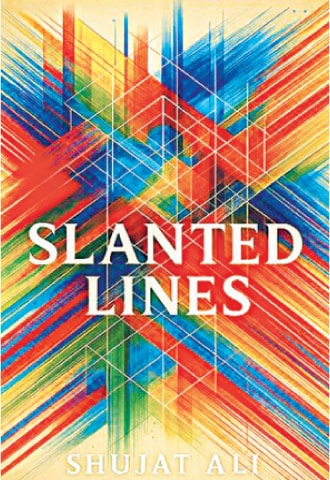
Slanted Lines
By Shujat Ali
ISBN: 978-969-749-311-1
Auraq Publications
203pp.
Shujat Ali, a respected government servant, has written a number of short stories in Urdu; Slanted Lines, however, is his first entry into the field of English fiction-writing.
Grammatically and linguistically, the book does contain a number of unfortunate shortcomings, but since it would be unkind and uncharitable for a reviewer to dwell on those at length — especially since this is a debut — I will simply comment on those in a brief paragraph below, before proceeding to discuss the text’s plot and characters.
In this day and age, it is politically incorrect — not to mention offensive — to bandy around terms such as ‘fatty’ when casually referring to women’s figures or ‘black’ and ‘white’ when referring to their complexions. Rana Tauheed Saquib, the book’s main protagonist, is not essentially an offensive or unpleasant man, however. Rather, the author appears not to have understood the point that certain turns of phrases and idioms that may be acceptable in Urdu and other languages are simply unacceptable when writing in English. It is one thing to underscore when something is an objectionable insult and quite another thing to blithely and naively proceed to strew such terms casually throughout a novel.
Auraq Publications is far more culpable than the author when it comes to having slipped up as regards editing this book. There are a number of other problems which weigh down the writing, which ranges from awkward at best to ludicrously clumsy at worst. For instance, we all understand that Tauheed is proud of his thick hair when younger, but his anxiety about his coiffure is alluded to no less than half a dozen times over the course of this slim 200-page novel. Handing the book over to a competent editor would have prevented it from sliding into the realm of woefully inadequate writing.
Having said that however, I should add that one of the strengths of the novel is that it faithfully depicts the trials and tribulations a middle-class Pakistani male of relatively low income has to face in order to support a family. Although inelegantly written, there is no question as to the novel’s thematic sincerity.
A debut English novel provides a genuine window into the the trials and tribulations of a typical low-income Pakistani male but is marred by inelegant writing
Tauheed’s father was a lazy ne’er-do-well factory worker who was unable to give his son a sound education. In spite of this, Tauheed managed to get a job as a junior editor for an Urdu newspaper. He eventually moves on to a better-paying job at an advertising agency, but not before a series of fairly daunting monetary struggles. Matters are not helped by the fact that he has to place almost the entirety of his salary in his mother Zeenat’s hands, so that she is able to run their household with some semblance of dignity.
In his early 30s, Tauheed falls for a female colleague, and decides to break off an engagement of long-standing that his family had arranged for him. Zeenat is frankly disgusted by this and the protagonist’s father is enraged. Tauheed’s fiancée is a pleasant but rustic, young woman from Sukkur, and one can tell that the Karachi-bred Tauheed prefers to choose a more sophisticated woman from the metropolis.
Although Tauheed’s marriage with Afroza doesn’t start off badly, it goes rapidly downhill as financial and familial pressures begin to take their heavy toll. Some scenes, such as when he finds (much to his horror) that there are cockroaches in his food, are pathetic to the point of being hilarious in a black comic sense.
However, although Tauheed loves his two little girls, Afroza is such a shrewish harridan that the reader begins to feel almost as sad as the protagonist does about how bleak and joyless a long-term future with her appears to be. Selfish and unhelpful, Afroza does little to alleviate the stress of Tauheed’s miserable, middle-class existence. I realise that this type of predicament is all too often found in Pakistani society, but that does not prevent it from depressing even the most cheerful and sanguine-tempered of readers.
Although some readers might take issue with the point that Tauheed first finds solace in pornography, and then in a hunt for a second (more amiable) wife, I do not think one needs to be too quick to judge him. At heart, Rana Tauheed is neither a particularly devious nor an especially diabolical individual. Had he been so, he might have ended up making far more money, and at least Afroza would not have been able to throw his relative penury in his face consistently.
His desire to seek a second wife decades younger than himself might also shock some readers but, given his background, situation and mentality, this desire (and even its materialisation) comes as no real surprise. Over the course of the book, he loses his self-respect far more rapidly than he loses his hair; his desperate attempts to win the heart of a sly young woman who has no attractive marital prospects are, in aggregate, more worthy of pity as opposed to censure.
In spite of the book’s brevity, an astonishing amount of information is packed into it. The author describes every aspect of Tauheed’s Karachi-based life, ranging from his body and dietary habits, to his obsession with voluptuous women who tantalisingly dangle the promise of sex before him. In spite of his morose moods and difficult circumstances, one cannot help but applaud the single-minded way in which Rana Tauheed pursues his goals, regardless of whether those goals are understandable or vile (in certain cases, both).
I cannot in all honesty say that Slanted Lines makes for an enjoyable read, given the clumsy writing. However, I can certainly add with more truthfulness that such books provide a genuine window into the dreary life of a typical low-income Pakistani male.
One wonders whether matters would have turned out differently had Tauheed’s father managed to bestow a good education on his son. While that may not have guaranteed that the protagonist would end up making a good marriage, it could perhaps have given him better career options from which to choose. However, there is nothing to be gained from dwelling on such a moot point…alas.
The reviewer is associate professor of social sciences and liberal arts at the Institute of Business Administration. She has authored two collections of short stories, Timeless College Tales and Perennial College Tales, and a play, The Political Chess King
Published in Dawn, Books & Authors, September 14th, 2025