Afghan quake survivors ‘refusing to return home’


 0
0
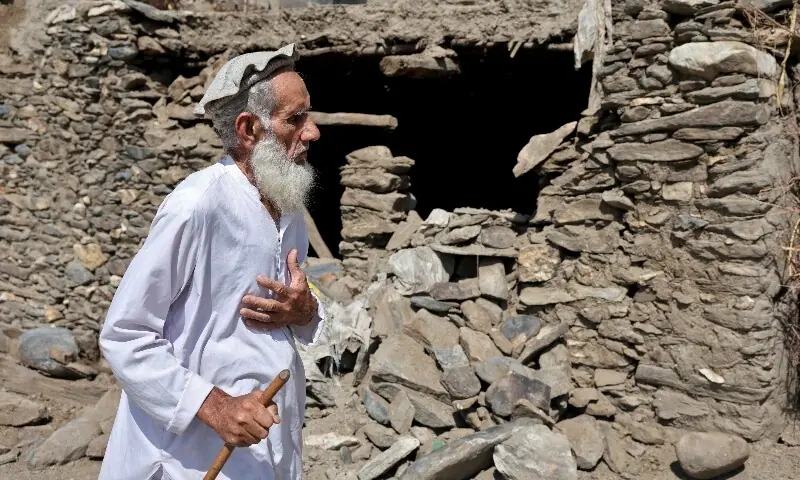

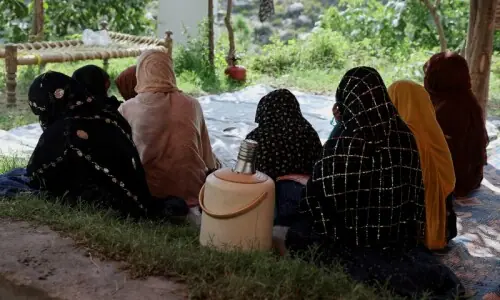
MASUD: Haunted by the fear that aftershocks could bring rocks crashing down from the mountains, the survivors of Afghan earthquakes vowed not to return to destroyed villages but camp in fields and on riverbanks instead, even without tents to keep off the rain.
“We have no shelter, not even a tent,” said 67-year-old farmer Adam Khan, leaning on a stick outside his ruined home in the village of Masud in Afghanistan’s eastern province of Kunar, devastated last week by earthquakes and subsequent aftershocks.
“It rained last night, we had no place to take cover,” he added. “Our biggest fear is the big rocks that could come down at any moment.”
Aid groups sped in food and supplies by helicopter, but survivors say help is patchy and slow.
Families cluster in makeshift camps dotting the area. In the village of Shaheedan, farmer Shams-ur-Rahman, 40, said he lost six relatives and fled with his family of nine. Now they sit in the open beside a road, flanked by their few possessions.
“The tents they gave us cannot even accommodate our children,” he said. “On the way down from the mountain, I had no shoes for my son, so I shared mine with him in turns as we walked down.”
For some, the displacement looks set to be permanent. In the harsh glare of the sun Gul Ahmad, 51, stood beside his relatives, the women of his family crouched in the shade of a wall as their pop-up tents flapped in the dust nearby.
“Even if there is no earthquake, a simple rainfall could bring rocks crashing down on us,” he said. “We will not go back. The government must provide us a place.”
Without sufficient shelter, sanitation and food, the trauma will spread disease and poverty in one of the world’s poorest and most quake-prone nations, international aid agencies say.
Some of the worst affected are children. Twelve-year-old Sadiq was pulled out alive after being trapped for 11 hours under rubble, in which his grandmother and a cousin were killed beside him.
“I thought I would die,” he said, sitting quietly on a rope bed as cousins and uncles milled around the family’s shelter. “It felt like doomsday.”
Female aid workers
The World Health Organisation has asked Taliban authorities to lift restrictions on Afghan female aid workers, allowing them to travel without male guardians and help women struggling to access care after a powerful earthquake killed 2,200 people in eastern Afghanistan.
Published in Dawn, September 9th, 2025