BUSINESS: PAKISTAN’S STUTTERING START-UPS


In August 2021, Airlift raised a record-breaking $85 million in its Series B round — the largest single funding deal in Pakistan’s start-up history.
Founded in 2019 as a mass-transit service before pivoting to instant grocery delivery, it quickly became the poster child of Pakistan’s tech ambitions. With global investors on board and a sleek model of expansion, Airlift redefined what was thought possible for a homegrown start-up. At its peak, the company operated in multiple cities and employed thousands.
Yet less than a year later, in July 2022, Airlift announced its permanent shutdown, citing the global recession, a downturn in venture capital markets and a failed funding round. The news sent shockwaves across Pakistan’s start-up ecosystem, exposing the fragile foundations beneath the country’s tech dream.
And Airlift was not alone. EasyTickets, Foodpanda’s quick-commerce ventures, and several digital ticketing and delivery start-ups met similar fates once investor appetite cooled.
The collapse of technology-driven giants such as Airlift and Careem reveals a broken start-up ecosystem. But behind the shocking headlines and high failure rate, a new, more resilient culture is trying to emerge…
Even global players have struggled. In July 2025, Careem, which once transformed urban mobility and digital payments in Pakistan, suspended its services after nearly a decade. Despite reshaping commuting habits and introducing millions to cashless payments, Careem could not survive soaring inflation, shrinking investor appetite, and relentless competition from cheaper rivals, such as inDrive and Yango.
These high-profile collapses are not mere bad luck; they expose a recurring pattern of hype, unsustainable models and a systemic lack of support within Pakistan’s burgeoning start-up ecosystem.
A STORY IN NUMBERS
The fragility of Pakistan’s start-up ecosystem shows up clearly in the numbers. According to Invest2Innovate’s (i2i) Pakistan Start-up Ecosystem Report 2024, more than 80 percent of start-ups close down within their first three years — a trend also confirmed by research from digital financial services provider Karandaaz.
The report on Pakistan’s start-up ecosystem also highlights that, after reaching almost $360 million in 2021 and $350 million in 2022, investment dropped sharply to just $70 million in 2023. In the second quarter of 2023, only $5.6 million was raised across six deals — the weakest in three years.
THE CORE CHALLENGES
Syed Azfar Hussain, the head of the National Incubation Centre (NIC) in Karachi, tells Eos that failure rarely stems from one mistake. “It’s usually a mix,” he says, adding that the most common issue is building something nobody really needs. “Founders get so attached to their idea that they forget to ask if it solves a problem people will actually pay for,” he continues.
Saba Kalsoom, who works with i2i, adds that shutdowns, though rarely documented, usually occur due to inability to raise follow-on capital, rigid business models or product-market misfits, and founder fatigue or team misalignment.
Farhad Shafqat, who is part of NIC Peshawar, adds that many founders, particularly in the early stages, don’t have the emotional resilience to recover from a failure and may feel discouraged or defeated.
A STEEP LEARNING CURVE
These systemic challenges are often felt most acutely by individual founders, as it seems to have occurred in the case of Shahzad Mahdi, a young entrepreneur from Skardu. He tells Eos that his journey began with a product deeply tied to his region, shilajit, the extract of which is used for its healing effects in a number of diseases, including arthritis and bone infections.
“Being close to its natural source in the mountains, I felt uniquely positioned to offer a pure, high-quality product in a market flooded with diluted alternatives,” Mahdi recalls. Determined to create something credible and world-class, he invested heavily in premium packaging and branding.
However, the market response was sobering. Consumers, accustomed to cheap, impure shilajit, balked at the higher price of his authentic product. Bridging that gap between value and perception proved a major challenge. Mahdi ran the venture for about a year before stepping back.
“We were never taught how to fall,” Qaiser Abbas, an organisational psychologist and executive coach, tells Eos. “So, when a start-up collapses, it doesn’t feel like an idea failed — it feels like I failed,” he says.
Abbas urges founders such as Mahdi to separate self-worth from business outcomes. “You are not your pitch deck. Failure is not a verdict, it’s a version update,” he says, highlighting that even ventures that don’t succeed provide lessons on understanding the market, testing early and building the right support network — all stepping stones for future success.
LIMITS OF SUPPORT
Government-backed incubation programmes have tried to nurture resilience. The Punjab Information Technology Board (PITB) has run initiatives such as Plan9, Regional Plan9 (RP9) and the National Expansion Plan of NICs. The PITB says it has collectively graduated over 1,100 start-ups, generated Rs2.9 billion in revenue and created more than 24,000 jobs by March 2025.
Plan9 remains the largest incubator in Pakistan, while regional programmes have brought incubation to smaller cities. Complementary initiatives, such as e-Rozgaar, have trained thousands of freelancers. But even within these structures, survival is far from guaranteed.
Muhammad Hasnain, who managed RP9 Sahiwal, tells Eos that, during his tenure, he oversaw 52 ventures with targeted mentorship, business development support and investor networking. “Many graduates showed sustainable growth after the programme,” he adds. However, he adds, 60–70 percent of start-ups still failed due to weak ideas, lack of founder commitment or delayed stipends.
To help start-ups grow and survive, i2i’s 2025 policy brief suggests making the rules easier for them. This includes updating company laws so it’s simpler to register a start-up, legally recognising modern investment methods like Simple Agreements for Future Equity (SAFE) and convertible notes (loans from investors to start-ups), and making it easier to set up funds focused on start-ups. The brief also recommends giving new businesses some breathing room by letting them test ideas in a safe space (called a regulatory sandbox) and offering support programmes, such as fellowships, for founders whose businesses fail.
COMMUNITY AND RECOVERY
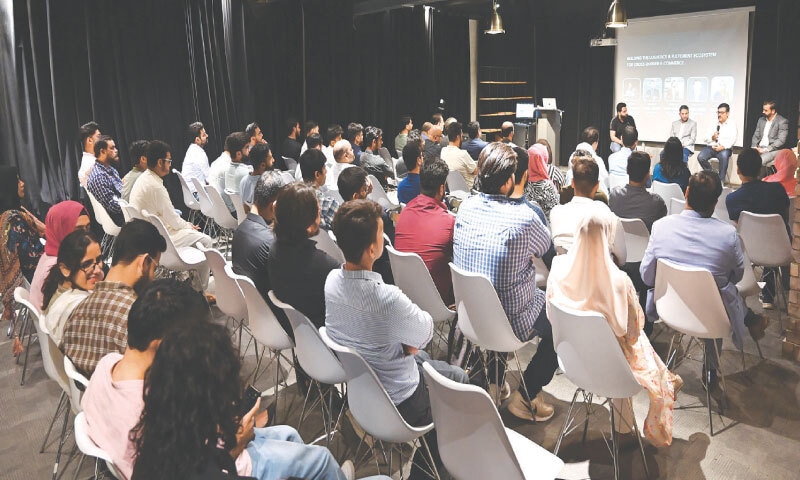
Co-working spaces have become a vital part of Pakistan’s start-up ecosystem, providing affordable workspaces, community support, and the flexibility that early-stage entrepreneurs need to grow.
As of May 2025, the country has 449 co-working spaces, with the majority located in Punjab (274), followed by Sindh (115) and Islamabad Capital Territory (51). These spaces not only offer infrastructure but also foster innovation and collaboration by hosting workshops, pitch sessions and networking events.
Najia Rizwan Syed, who runs the co-working space called The Hive in Karachi, says that entrepreneurs who experience failure initially appear withdrawn or subdued, but being in a co-working environment, surrounded by others who are actively building, gradually helps them re-engage.
Syed also highlights patterns in founders who manage to bounce back: “Those who recover, maintain clarity around their core motivations, stay engaged with the start-up ecosystem and are open to feedback or pivoting,” she adds.
She notes that Pakistan’s culture around failure is slowly evolving. “While public discussions remain limited, second-time founders, mentors and some investors are increasingly engaging more candidly about setbacks.”
The shutdown of giants like Airlift and Careem was a seismic shock to Pakistan’s tech dream. But the ensuing struggle — documented in the high failure rates and founder stories — isn’t a sign of demise.
It is the difficult, necessary groundwork for building a more mature, sustainable and, ultimately, a successful ecosystem where failure is not an end, but a version update on the path to success.
The writer is an investigative journalist.
X: @saddiamazhar
Published in Dawn, EOS, September 6th, 2025