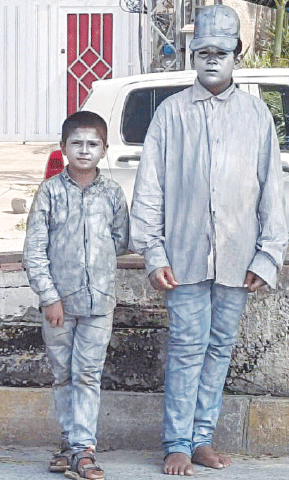
ISLAMABAD: Two small children stand quietly by the roadside on a busy Islamabad street, their faces painted in a faint shimmer of gold. They are neither playing nor performing. They are working. Ten-year-old Sameer and his five-year-old sister Eman Fatima come here every day.
Their job isn’t in a shop, a factory, or a school. Their place of work is the open roadside, where they silently pose for attention from passing vehicles. It is their family’s only hope to make ends meet. Sameer is the eldest of four siblings. His father, a bykea rider, struggles daily to earn enough to cover basic expenses, including rent, food, and unpaid electricity bills.
Their mother, a homemaker, manages the household with whatever little she receives. But with rising inflation and uncertain income, the family was forced to make difficult choices.
Education was one of the first things to go. Once enrolled in school, Sameer had to drop out. The cost of books, uniforms, and fees became impossible to bear. He now stands barefoot in worn clothes, his small frame alert yet subdued. In his effort to be noticed, he switches between poses—arms lifted like wings, body frozen like a statue—trying to draw the attention of passing drivers who might lower their windows and hand him a few rupees.
Next to him stands his younger sister, little Eman Fatima, around five or six years old. She tries to mimic her brother’s every movement. Her presence adds a quiet sadness to the already bleak scene.
She is far too young to fully understand why she is there and the role she is playing. She only copies her brother with innocent trust.
Her hands rise when his do. She watches the road, not with excitement, but with silent expectation.
They are somehow different from others like them on the road—a road that runs between housing societies inhabited by the well-to-do. Unlike aggressive street vendors or beggars, Sameer and Fatima don’t chase cars or call out.
They do not tap on windows or plead. Their strategy is stillness, a quiet presence relying only on eye contact and the rare kindness of strangers. It is their silence that leaves the deepest impression. Sometimes, someone notices. Many pass by.
The little money they collect is taken home and given to their mother. It is never enough, but it helps. Some days it means a cup of tea or an extra roti on the table.
Sameer, despite his age, carries himself with the seriousness of someone who no longer expects life to be fair. His movements are careful. He rarely smiles. Poverty has pushed him into a world where survival has replaced childhood, and responsibility has come too soon.
Just a few streets away, life looks very different. Children his age put on school uniforms, carry backpacks, and are dropped off at private schools. They return home to hot meals, toys, and help with homework.
Their evenings are filled with cartoons, games, and bedtime stories. Their problems revolve around missed assignments or screen-time limits.
Sameer and Fatima’s concerns are simpler but heavier: whether they will manage to collect enough to contribute to the day’s income for a family already struggling to survive in a rented house.
Their presence on the roadside does not mean their parents are indifferent.
They are simply helpless. Their father leaves before sunrise, returning late at night with an aching back and barely a few hundred rupees.
Their mother makes the most of what they have, but even essentials like medicine or clothing are often out of reach. Sending all four children to school is no longer possible.
Children like Sameer and Fatima are not rare. Every major city in Pakistan has its share of roadside children—some selling small items, some wiping windshields, others simply watching the road in silence. Their existence is often dismissed or misunderstood. Many are assumed to be part of organised begging networks, but behind these quiet faces are often broken homes, failed safety nets, and dreams slowly slipping away.
What makes Sameer’s situation even more heartbreaking is how ordinary it has become. He is not an exception. He is one of many.
These children are not looking for pity. They need access to free and inclusive education, to safe shelters, to food security programmes, to policies that lift their families rather than leaving them behind. They deserve more than survival.
Along the roadside, Sameer and Fatima continue their silent performance. They are not loud. They are not disruptive. They are just there—golden faces in a city that rarely stops to look. They are far too young to bear this weight.
But poverty rarely asks permission before taking away what is sacred. Though their faces shine with gold paint, their future holds little light.
- The writer is a freelance journalist.
Published in Dawn, August 31st, 2025