Nation must embrace ‘new economy’, says Aurangzeb
• Warns ignoring crypto regulations can expose Pakistan to sanctions, other risks
• Says financial inclusion, transparency, speed key drivers for blockchain adoption; promises conducive environment
• Finance minister surprised by absence of aide to PM on crypto from event
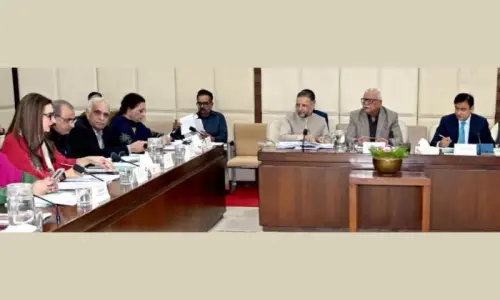
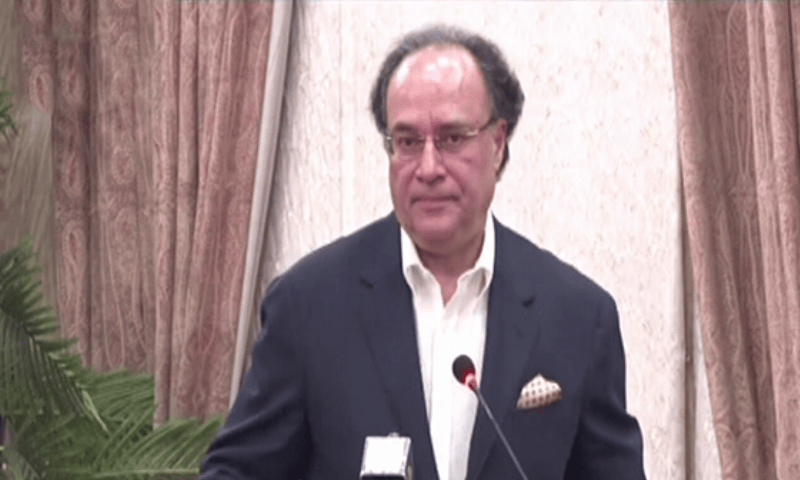
ISLAMABAD: Finance Minister Muhammad Aurangzeb on Saturday acknowledged that the country’s banking system was more complex than those of other countries, underscoring the need for a decisive transition toward blockchain technology and digital assets.
Mr Aurangzeb expressed surprise at the absence of Bilal Bin Saqib, special assistant to the prime minister on blockchain and cryptocurrency, from the ‘Leadership Summit on Blockchain and Digital Assets: Technology and Innovation’. The event focused on emerging technologies — considered foundational to Pakistan’s evolving economic architecture.
The minister noted that Mr Saqib had been specifically appointed to advance this agenda, and his participation in the seminar was therefore of considerable importance. However, he affirmed that his ministry remains open to engaging with the event organisers on this critical issue.
Mr Aurangzeb reiterated that Pakistan’s banking infrastructure is comparatively more intricate than global standards and called for improvements in legislation governing digital investments. He also revealed that crypto mining was under active consideration, with a dedicated crypto council already established to explore its regulatory and economic implications.
‘Regulatory framework’
The minister outlined the regulation of this transformation. He cautioned that given the scale of activity, ignoring digital assets could expose Pakistan to risks related to KYC, AML, sanctions, and monitoring, potentially reversing hard-earned progress on the FATF front.
The minister emphasised that regulatory dimensions would be thoroughly examined. “It took five years of sustained effort to exit the grey list,” he said, adding, “We have no intention of re-entering that cycle.”
In this context, he highlighted the establishment of the Pakistan Virtual Asset Regulatory Authority (PVARA), whose inaugural meeting is scheduled for next week, as a milestone towards a balanced regulatory framework.
Senator Aurangzeb stressed that Pakistan must leverage international experience, drawing on models from Dubai, Singapore, and the EU, while ensuring that national interests remain paramount. He commended the support received from international experts and organisations in helping Pakistan fast-track its regulatory and policy frameworks.
FM Aurangzeb emphasised the need to embrace blockchain to drive innovation, financial inclusion, and transparency, while urging a balanced regulatory approach as the nation’s youth increasingly adopt digital assets.
“We have to accelerate our journey in terms of adopting transformative technologies like blockchain and digital assets, assuring the government’s full support,” he remarked. He noted that 20-25 million Pakistanis, particularly young people, were already engaged in digital asset-related activities in one form or another. “This scale of participation cannot be ignored,” he remarked, stressing the need for acknowledgement, education, and structured policy responses to harness this growing trend.
Calling it an opportune time to move forward, he underscored the importance of ensuring that all developments remain within a regulatory framework.
He highlighted that while Pakistan was making strides in achieving macroeconomic stability, the next imperative was to actively participate in shaping the new economy driven by blockchain, artificial intelligence, and Web 3.0 technologies.
He underscored three key drivers for blockchain adoption in Pakistan: financial inclusion, transparency, and speed. By enabling faster, cheaper, and more efficient transactions, blockchain and allied technologies can provide critical solutions for banking, remittances, agriculture, IT, freelancing, and energy.
He cited successful initiatives such as the development of e-KYC systems through blockchain, which reduce duplication of compliance processes in banking, as practical examples of progress.
“We must harness their energy, channel it through education and regulation, and integrate it into a system that strengthens the economy while safeguarding national interests. This is not just about keeping pace with global change—it is about ensuring Pakistan’s rightful place in the new economy.”
He reaffirmed the government’s commitment to providing an enabling environment for the private sector to lead economic growth. He emphasised that facilitating traders and investors was a top government priority. He noted that economic reforms were underway and the national economy was gradually moving toward stability.
The minister said the country must embrace this shift as part of its new economy by fostering financial inclusion, transparency, and efficiency, while ensuring a balanced regulatory framework through collaboration between government, academia, and the private sector.
Reflecting on the broader vision of the government, the minister reiterated the government’s commitment to fostering an enabling environment while allowing the private sector to lead innovation, with academia providing knowledge and talent.
“This trilateral partnership of government, academia, and private sector is essential to scaling up our journey into the new economy,” he stated.
Published in Dawn, August 24th, 2025