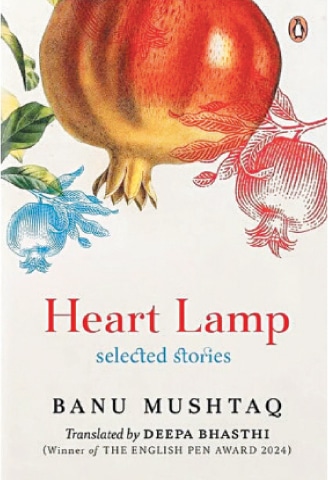
Heart Lamp
By Banu Mushtaq
Translated by Deepa Bhasthi
ISBN: 978-0143464471
Penguin Random House India
224pp.
Banu Mushtaq isn’t a household name in South Asia’s literary circles, but she should be.
A writer, lawyer and activist from Karnataka in India, Mushtaq wrote at a time and place where Muslim women’s voices were rarely heard, let alone amplified. She started writing in the 1970s during the Bandaya Sahitya movement, a protest against caste and communal injustices. Mushtaq’s stories are unapologetically feminist, deeply political and often achingly personal.
The stories in Heart Lamp have been translated from Kannada to English by Deepa Bhasthi, who has done a fine job keeping the emotions and rhythm of the original alive. Bhasthi, also a writer and critic, has translated other Kannada works, but this one is particularly special — it won her the English PEN Translates award in 2024.
The collection features 12 stories, each touching upon themes such as gender, faith, desire, loss, domesticity and power. Mushtaq writes about Muslim women, mothers, daughters, wives and students, through a sharp, empathetic lens. The characters don’t just speak; they confess, confront and resist.
Let’s talk about some of the stand-out stories. ‘Stone Slabs for Shaista Mahal’ starts as a sweet, domestic tale about couples but quickly becomes a gut-punch. Shaista is a vibrant woman, mother of six, with hopes for her daughter Asifa’s future. But Shaista’s husband’s betrayal after her death lands hard. It’s a story about love, and what men do in its name.
The winner of the International Booker Prize this year is a collection of powerful short stories about Muslim women written in Kannada, whose English translation keeps the emotions and rhythms of the original alive
‘Fire Rain’ revolves around property, family rights and inheritance, and how women, even sisters, are forced to fight for what’s already theirs. It shows how men weaponise religion and tradition to hoard power and how women, quietly or not, push back.
‘Black Cobras’ deals with domestic abuse and how women are conditioned to normalise it. The metaphor of cobras slithering into a home isn’t just poetic, it’s chillingly accurate.
‘Red Lungi’ is more humorous, built around rumours and a mysterious man in a red lungi [loincloth] who disrupts a conservative neighbourhood. But it’s also about paranoia and how society polices women’s behaviour under the guise of morality.
‘The Arabic Teacher and Gobi Manchuri’ is hilarious and insightful. It plays on stereotypes of religion, class and food, using humour to make deeper points about human connection.
‘Be a Woman Once, Oh Lord!’ is a cry from the heart. It reads like a prayer, a complaint, and a scream rolled into one. The title says it all. What would happen if God had to live one day as a woman?
Mushtaq’s writing style is deceptively simple. Her characters talk like real people. There are no heavy-handed metaphors or complex monologues. The humour is dry, the sarcasm pointed, and the sadness understated. She slips in social commentary without slowing down the narrative. Her best moments are when you feel like she’s letting you into someone’s home, only to realise the furniture is broken and the roof’s about to collapse.
Two characters really stood out for me. One is Shaista, from the first story. She’s kind, warm, cheeky and full of life. She doesn’t just host guests; she runs her home like a queen — truly what we call a homemaker. When she dies and is quickly replaced, her absence hits you like a slap. The other is Jameela, the sister asking for her rightful property share in ‘Fire Rain.’ Her persistence, despite the discomfort she causes, stays with you.
For women, these stories will hit home. Replace Mysuru with Multan, and many of these houses could be ours. ‘Stone Slabs for Shaista Mahal’, for example, feels eerily familiar: how quickly widows are forgotten, how daughters stop being educated to help their mothers, and how men mask control as affection. Similarly, ‘Fire Rain’ resonates deeply in a country where inheritance battles between brothers and sisters often break families apart.
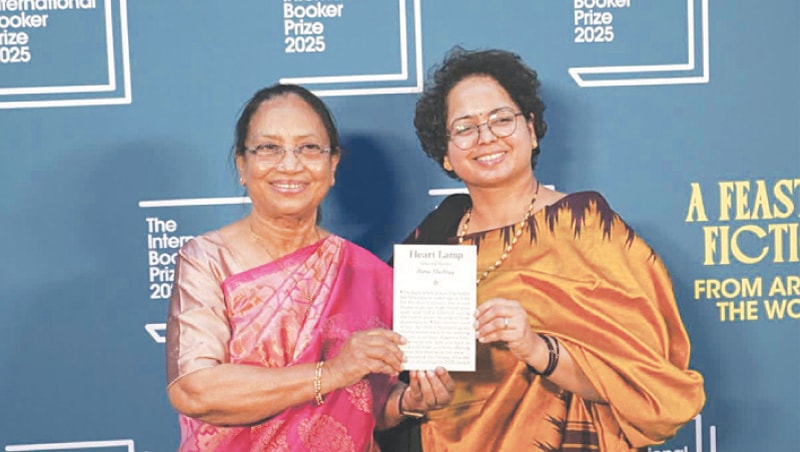
Heart Lamp won the Booker International Prize 2025 and, while awards don’t always reflect readability, this one makes sense. It’s rare to find fiction about South Asian Muslim women that’s not exoticised or simplified. These women aren’t symbols. They are messy, flawed, loving, angry and real.
So how does the translation hold up? Pretty well. Bhasthi resists the temptation to polish things for Western readers. She retains colloquialisms, the essence of the original, and the cultural references. There are moments where one might wish for a glossary, but it’s better this way. Let the reader do some work. If anything, the translation adds a fresh rhythm to the prose and, in parts, the English version feels even more biting than it probably was in Kannada.
That said, the stories do sometimes overlap in tone. A few start to feel similar: young wife, conservative husband, extended family politics. But perhaps that’s the point. These stories aren’t trying to shock. Instead, they’re trying to show how routine this oppression has become.
Still, this isn’t a sad book. It’s a powerful, honest one. It respects its characters, even when it’s angry at their choices. Mushtaq doesn’t offer grand solutions, just a gentle nudge to look again at the lives of the women around us.
Heart Lamp is the kind of book you pass around to friends. Not because it’s trendy, but because it matters. It says what so many women want to say, loudly, clearly and beautifully.
The reviewer is a content lead at a communications agency.
She can be reached at sara.amj@hotmail.co.uk
Published in Dawn, Books & Authors, August 10th, 2025