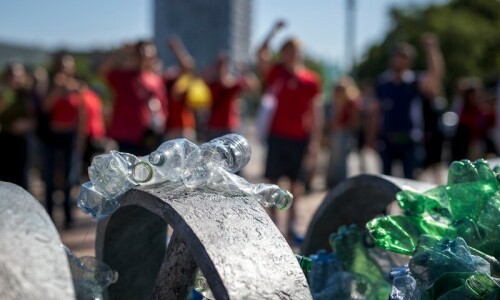
Negotiations on UN plastic pollution treaty floundering


GENEVA: Talks on forging a groundbreaking treaty to combat the scourge of plastic pollution were floundering on Saturday, with progress slow and countries wildly at odds on what the proposed agreement should cover.
The negotiations, which opened on Tuesday, have four working days left to strike a legally-binding instrument that would tackle the growing problem choking the environment. But in a blunt mid-way assessment, the talks chair warned the 184 countries gathered at the United Nations in Geneva that progress so far was well off track.
Some countries called for areas where countries are far from agreement to ditched completely for the sake of expediency. Others slammed the brinkmanship and said insistence on consensus could not be used as justification for sinking the more ambitious elements of the treaty.
“Progress made has not been sufficient,” Ecuadoran diplomat Luis Vayas Valdivieso told delegates in a frank summary as country delegations gathered in the assembly hall to take stock. “We have arrived at a critical stage where a real push to achieve our common goal is needed. “August 14 is not just a deadline for our work: it is a date by which we must deliver.”
‘Little progress’
Countries have reconvened at the UN in Geneva after the failure of the supposedly fifth and final round of talks in Busan, South Korea in 2024. After four days of talks, the draft text has ballooned from 22 to 35 pages — with the number of brackets in the text going up near five-fold to almost 1,500 as countries insert conflicting ideas.
Vayas Valdivieso said states had had two and a half years to make such proposals.
“Some articles still have unresolved issues and show little progress towards reaching a common understanding,” he lamented.
Kuwait spoke up for the so-called Like-Minded Group — a nebulous cluster of mostly oil-producing nations which rejects production limits and wants to focus on treating waste. Kuwait said the scope of the treaty had not been given “an equal and fair chance for discussion”.
“Let us agree on what we can agree… consensus must be the basis of all our decisions.” But Uruguay insisted that doggedly clinging to consensus “cannot be used as a justification to not achieve our objectives”. The talks process is mandated to look at the full life cycle of plastic, from production to pollution. Eirik Lindebjerg, global plastics adviser for the World Wide Fund for Nature, said that Kuwait’s proposal was “another attempt to make it a waste management agreement”, and to stifle talks reducing the amount of plastic and phasing out the most harmful elements.
Saudi Arabia, speaking for the Arab Group, said the responsible way ahead was to start considering what bits of the text “may not make it to the final outcome due to irreconcilable divergence” “We cannot do everything everywhere all at once,” Riyadh said, adding: “Let’s not make the perfect the enemy of the good.”
‘Profits from poisoning’
Panama’s negotiator Juan Monterrey Gomez slammed those countries wanting to stop the treaty from encompassing the entire life cycle of plastic. He said microplastics “are in our blood, in our lungs and in the first cry of a new-born child. Our bodies of living proof of a system that profits from poisoning us”.
Published in Dawn, August 10th, 2025