‘How can you decide on women without them?’
WOMEN’s rights activists and civil society representatives have rejected the National Consensus Commission’s decision on reserved parliamentary seats for women, condemning the decision-making process as exclusionary, undemocratic, and an insult to half the nation’s population.Speaking at an event in the capital, they criticised the complete absence of women’s representation in the consensus commission and its discussions.
They noted that the commission included no women and failed to consult female members of political parties, the interim government’s Women’s Affairs Reform Commission, or any women’s rights organisations.
Titled “Our demand: No decision about women without women”, the event was organised by the Campaign for Popular Education and partner organisations at the BRAC Centre in the capital’s Mohakhali.
During Thursday’s consensus talks, political parties agreed to nominate women in five percent of the constituencies in the next election. They also agreed to retain the existing 50 reserved seats for women, with necessary constitutional amendments to follow. Ali Riaz, vice-president of the commission, said, “Almost all parties agreed in principle to gradually raise the number of women’s seats to 100.” He added that while some parties submitted notes of dissent, “a broad consensus has been established”.
Bangladeshi women demand 50pc representation in all national commissions, boards and committees
At yesterday’s event, speakers pointed out that the 433 detailed recommendations made by the Women’s Affairs Reform Commission were ignored despite repeated follow-ups. They also criticised the consensus commission as an elite-dominated body disconnected from lived realities, especially of women.
Shireen Huq, chief of the Women’s Affairs Reform Commission, said, “We are in 2025, and if we still can’t demand a 50-50 share for women, then when will we? When I raised the issue, someone said that if women get 50 percent representation, there will be a female majority in parliament. But men have led for 50 years; now it’s time to give women a chance.
“We aren’t asking for something permanent. Let women lead for two terms, then judge the results. If a parliament is formed with a female majority, we should evaluate whether the country benefits from it.”
She added, “Our progressive [commission] leaders haven’t accepted this idea. They’ve accepted many things, but not this. That’s the reality, and that’s why we must keep raising the demand.”
Maheen Sultan, a member of the women’s commission, said a letter from the chief adviser and their commission had urged the consensus commission to consider the women’s commission’s report. “But it remained silent. Later, we were told it wasn’t within their ‘terms of reference’, so it couldn’t be included.
“In fact, the consensus commission’s vice president openly said in several forums that it would be an ‘elite body’. We never asked for that. We asked for civil society representation — a genuine citizen’s voice. It appears women’s issues are not a priority.”
She added, “As voters, we were neither given space nor value. From the outset, it seemed the commission assumed women have nothing to contribute to constitutional and electoral reforms — a view that is both ignorant and deeply insulting.”
Shaheen Anam, executive director of Manusher Jonno Foundation, said she was surprised at the commission’s decision to engage only political parties — many of whom, she noted, were barely known to the public.
“Why did the commission only speak to political parties? Do they alone represent us? None of them represent women. No citizen platforms or women’s groups were consulted. Is this an acceptable process?”
Referring to the exclusion of the women’s commission report, she said, “Now we hear it wasn’t in their terms of reference. How is it acceptable to leave out 50 percent of the electorate from discussions about their own political rights?”
She also criticised the consensus commission’s composition. “There was no inclusion of women from the start, as if women’s experience and intellect weren’t enough to be part of a self-proclaimed elite group.
“This club does not represent Bangladesh, a country shaped by class, region, profession, and language. A small committee of six or seven people cannot make such critical decisions. We reject this process outright.”
She also slammed the Cabinet’s inaction, especially that of advisers from the women’s movement, for allowing the recommendations to be shelved — despite the chief adviser calling them practical and worth implementing.
In her opening remarks, Rasheda K Choudhury, former caretaker government adviser and CAMPE executive director, said, “Where are the women representatives in the Consensus Commission? Should we assume those in the commission are anti-women? We waited patiently, enduring in the belief that they would work for women and a non-discriminatory Bangladesh. But they have not only disappointed us, we are also outraged. Women make up 51 percent of the country’s population. We will speak and must be heard.”
Bangladesh Mahila Parishad President Fauzia Moslem said an organised anti-women sentiment has been gaining strength since the political transition began, gradually eroding long-standing gains of the women’s movement.
“Immediately after the uprising, we began to see a shift — starting with the policing of women’s clothing, then harassment, mob violence, women losing jobs, the removal of quotas, and finally the rejection of our commission’s recommendations.
“Even women seeking justice in dowry cases are now told to go through mediation first. These are not isolated incidents. They point to a consistent, growing anti-women agenda. The government may not have formally rejected our demands, perhaps in the face of women’s protests, but now uses polite excuses like ‘It’s not in the terms of reference’.”
Fauzia warned, “This hostility is being nurtured and normalised. If we don’t stop it now, we risk losing everything we’ve fought for.” Naripokkho President Gita Das expressed disappointment over the sidelining of the women’s commission’s report, despite the chief adviser praising it as a document of international standard.
She questioned why the consensus commission’s terms of reference, which are not constitutionally fixed, cannot be amended to reflect women’s needs. Highlighting the persistent gender gap, she said political parties continue to ignore women in both leadership and representation. Dr Khandker Golam Moazzem, research director at the Centre for Policy Dialogue, warned that the post-election scenario could become even more hostile to women’s rights and status. “I fear the future political landscape will become even more challenging for women.”
He suggested drafting a women-centric manifesto to present to all parties ahead of the polls — one that ensures women’s participation beyond election day.
Human rights activist Khushi Kabir said the country has been slowly pushed toward a “moderate Islamic state” since the 1970 election. She warned that women and minority groups are increasingly isolated as Bangladesh moves toward a single-religion, single-ideology model.
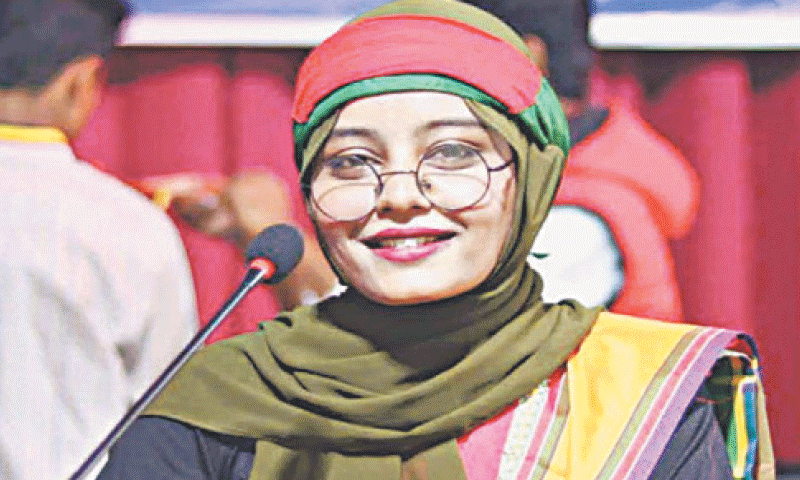
Shahjadi Fananna Kotha, a student leader from East West University, noted that no political party in Bangladesh is led by a woman. She criticised major parties and organisations like Jamaat-e-Islami, Hefazat-e Islam, and BNP for ignoring women’s issues, and said even newer parties like the NCP have little female representation despite their rhetoric.
She also pointed out that many women who played key roles in the July movement remain unacknowledged, facing online harassment, character assassination, and intimidation.
At the end of the discussion, a list of demands was placed. These included a call for the consensus commission to engage women meaningfully; for the July Charter to fully incorporate the women’s commission’s recommendations; and for an urgent review of the Charter with women’s participation.
Published in Dawn, August 4th, 2025