Youth struggle to find jobs in Bangladesh, one year after uprising


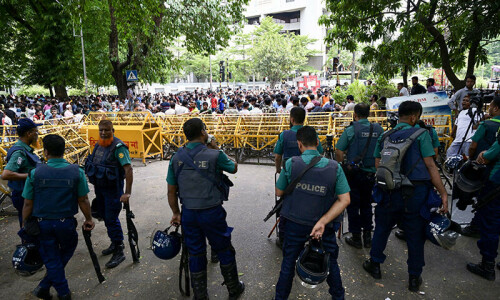
DHAKA: A year after an uprising forced former Bangladesh prime minister Sheikh Hasina out of power, challenges persist to address the severe lack of jobs among youth who took their grievances to the streets.
The uprising, in which some 1,400 people were killed, was sparked by the issue of quota reservations in civil service recruitment tests.
More than half of highly sought-after government jobs were reserved for certain designated groups, including women, disabled people and descendants of veterans of the 1971 war.
The country’s high court has since reduced the quota reservations to seven per cent.
Since the interim government headed by Nobel laureate Muhammad Yunus took over, a broad agenda of reform has been drawn up, but experts say a lack of opportunities for the young workforce remains a problem.
Factory shutdowns and aid cuts have added to job losses
“Amid jobless growth faced by the country’s youth, a fair chance at civil service recruitment tests became a rallying cry,” said Tuhin Khan, a leading activist in the quota reform movement and the July uprising.
“But since then, we have not seen enough meaningful focus from the government on the economic pressures faced by ordinary people as politics took centre stage,” he added.
About 30 per cent of Bangladeshi youth are neither employed nor in school or training, according to the International Labour Organisation (ILO).
Also, about 23pc of young women are unemployed compared with 15pc of young men, and last year’s protests featured the wide participation of young women.
Women in Bangladesh typically have limited opportunities for employment and career growth beyond a few sectors like government, non-governmental organisations and education.
The protesters ranged from graduate students seeking government jobs to garment workers and balloon sellers, as segments of the urban poor demanded better, more dignified lives, said Maha Mirza, a researcher who teaches economics at Jahangirnagar University.
But the creation of decent jobs depends upon jump-starting investment, which may have to wait for an elected government to be sworn in, said Rashed Al Mahmood Titumir, a professor of Development Studies at Dhaka University.
“When we have a stable policy regime, there would be more investment, and that will bring in the much-needed jobs for young people, including graduates and women,” he said.
Job losses
While the protest focused on government jobs, those can provide for only a small slice of the job market.
Last year, about 18,000 government jobs were available, yet more than two million young people enter the job market each year.
One major employer of young people is the garment and textile sector, but a number of factories shut down due to political changeover, including more than a dozen factories owned by Beximco Group that employed 40,000 workers.
Since the political shift, about 10,000 people have been arrested on various charges, including corruption and even murder, and they include a number of business owners linked to the former ruling party. Jasimuddin was a supervisor in a garment factory in the outskirts of Dhaka, but he has been jobless for months.
“I had quit my earlier workplace as they were holding up the payment of wages. Since then, I went from door to door in search of a job,” he said.
Many factory owners affiliated with the earlier government feared arrest and went into hiding, resulting in plant closures, said Arman Hossain, a trade union activist from Gazipur.
Published in Dawn, Aug 2nd, 2025