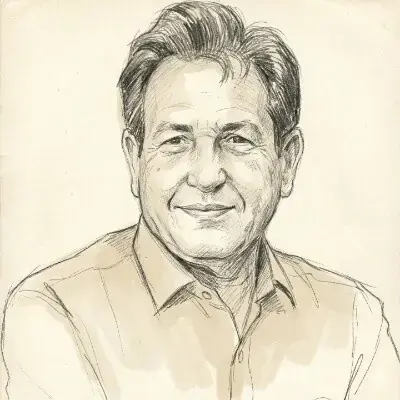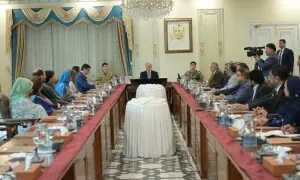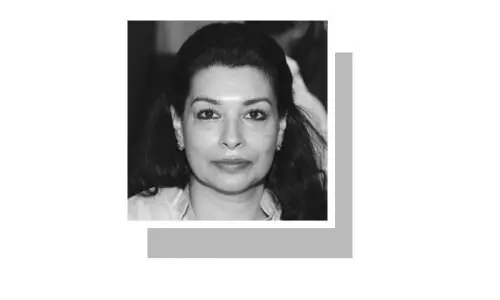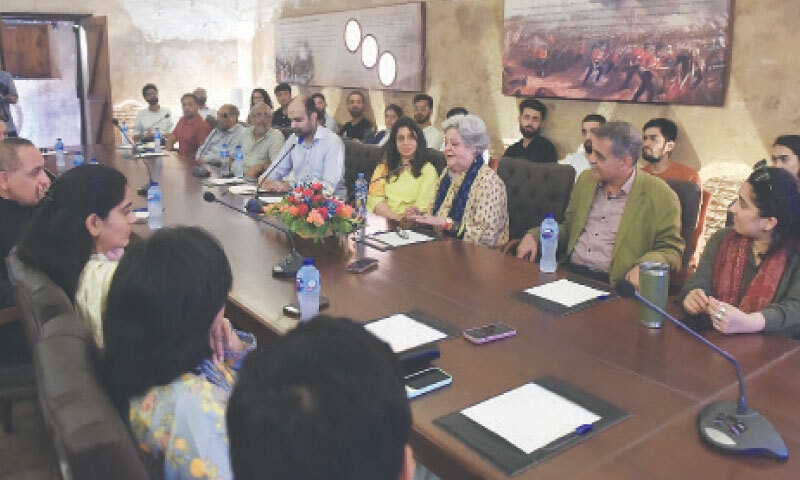
LAHORE: Salima Hashmi, the artist, scholar and activist, led an engaging discussion on the impact of culture on society at the Barood Khana, Lahore Fort.
The event, organised by Aga Khan Cultural-Service Pakistan (AKCS-P), was attended by young artists, archeologists, architects, engineers among others.
Ms Hashmi shared her life journey and presented some of her notable art works as well as private images of herself and her family at different junctures of her life. She had compiled the images and displayed them at a recent event held at Pakistan High Commission London.
“My grandfather was from a small village in Sialkot and managed livestock. He ran away from his village in his youth and came to Lahore where he encountered an Afghan trader. The trader invited him to Kabul. My grandfather’s ability to speak English helped him get a job of a clerk at the court of King Shah Abdur Rehman-II, in Kabul, Afghanistan. Later, he was informed of a conspiracy being plotted to kill him and he fled the city to save his life. Subsequently the king requested him to return to the court but my father stated that he had plans to study at Cambridge University. Fate led him to become an ambassador to Queen Victoria’s Court.”
Salima Hashmi showed images of her father, Faiz Ahmad Faiz, being awarded the Lenin Peace Prize by the Soviet Union in 1962. She said she and her father had travelled to Rome on a train, which was unheard of.
“My father was arrested in 1951 on charges of overthrowing the government. For a long time, we had no idea whether he was dead or alive. We received calls from officials telling us that they were torturing my father and that he needed to speak up. As a child, I remember picking up one of those calls.”
She said Faiz spent 4.5 years in jail under the Rawalpindi conspiracy case and some of his best poetry was written in jail. She said her father’s poem Aaj Bazaar Mein was written about the same period.
Ms Hashmi also showed some of her notable art works in images using a powerpoint presentation. Some of them were displayed in Doha recently and made in 1971 and ironically titled Sohni Dharti in the context of the Civil War that led to the creation of Bangladesh.
She also showed her work that was part of the anti-Zia movement.
I felt it was our collective duty to connect darkness into creative expression.
“During this time dance was banned and Ms Hashmi felt a personal angst as she was a big fan of the celebrated dancer Nahid Siddiqui. “It was my homage to Nahid Siddiqui,” she said.
Some of my work had collages, including clippings of discarded newspapers and magazines. These collages included images of herself and Asma Jahangir.
“I usually don’t do commissioned work but made an exception when the government asked some artists including myself to produce art work on Kashmir. Since I have a deep rooted connection to the area I wanted to share my insights.
“I also produced art work on the environment that showed dead birds due to oil spillage and I wanted to keep them alive through art. I also did art work on Gaza,” she added.
AKCS-P CEO Tausif Khwaja also spoke.
Published in Dawn, July 26th, 2025