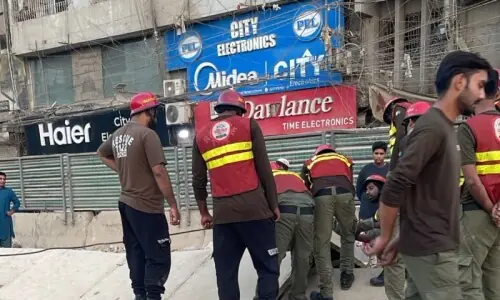
WHAT’S in a name? The civilian paramilitary force hitherto known as the Frontier Constabulary will continue to discharge the same duties it has traditionally undertaken, namely maintaining law and order, supplementing law enforcement agencies, and addressing various security needs, as directed by the federal government. Only, it will henceforth be known as the Federal Constabulary. The change has been executed through an ordinance rather than an act of parliament. Why did the federal government feel the need to do so, and why in such haste? The minister of state for interior had to issue a clarification the very next day. “The Federal Constabulary is the Federal Constabulary. No one should confuse it with the federal police,” he said, explaining that the change “is purely […] to strengthen national defence by providing support to the law enforcement agencies.” According to the minister, the FC had not been accorded the same recognition and benefits as the other security forces despite its many services. “Prime Minister Shehbaz Sharif and Federal Interior Minister Mohsin Naqvi have decided to transform the FC into a federal force with upgraded structure and scope to address this disparity,” the minister explained.
That is all well and good, but questions remain. Many have to do with the minister of state’s defensiveness about the ‘Federal Constabulary being the Federal Constabulary, not a parallel police force’. The FC, it is worth noting, is already deployed in various parts of the country. As are other paramilitary forces, like the Frontier Corps and the Rangers. If the purpose of formalising the FC as a federal force is to allow the Frontier Corps and Rangers to return to the original duties and functions for which they were created, the move would be a welcome one. Such a development could free up vital security resources and allow for them to be returned to border protection duties, especially as cross-border infiltration remains an issue. Meanwhile, this would create opportunities for greater civilian oversight over internal security. However, if the FC is to function as just another entity encroaching on the provinces’ law and order domain, there would be negative consequences for both provincial and police autonomy. This must be avoided at all costs. For now, the government insists that the FC’s role will remain distinct from that of the police. It must be held to its word.
Published in Dawn, July 16th, 2025