The ruling coalition was handed its two-thirds majority in the National Assembly on Wednesday with the Election Commission of Pakistan (ECP) distributing the reserved seats to the PML-N, PPP and the opposition Jamiat Ulema-i-Islam-Fazl (JUI-F) following the Supreme Court’s verdict.
Last week, the Constitutional Bench overturned the Supreme Court’s earlier judgement in the reserved seats case — effectively taking away reserved seats from the PTI and handing them to their rival parties in the national and provincial legislatures. The decision, handed down by a majority of seven judges, supersedes the July 12, 2024 majority judgement by eight judges, which had declared the PTI eligible for reserved seats for women and non-Muslims in the assemblies.
The Constitutional Bench’s decision effectively meant the PTI was no longer a parliamentary party.
Acting on the court’s verdict, the ECP issued an order today withdrawing its July 24 and 29 notifications from last year that had declared returned candidates against general seats of the National Assembly and the Punjab, Sindh and Khyber Pakhtunkhwa assemblies as returned candidates of the PTI.
In another order today, the ECP notified the names of the returned candidates under various categories of reserved seats with immediate effect, distributing 13 seats to the PML-N in the National Assembly, four to the PPP and two to the opposition JUI-F.
After this process, the ruling coalition achieves a two-thirds majority; in a house of 336, the magic number required to attain a two-thirds majority is 224.
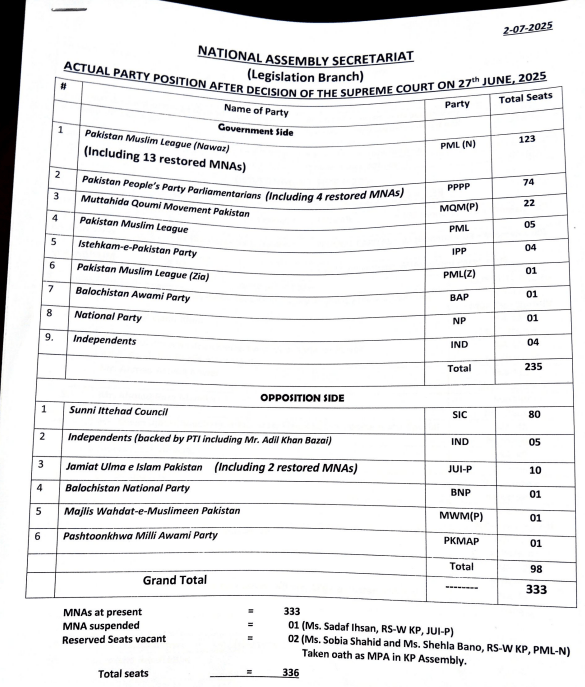
The National Assembly Secretariat’s Legislation Branch later issued the National Assembly composition reflecting the actual party position after the apex court’s verdict and ECP’s distribution. It showed the treasury benches as now having 235 seats to the opposition’s 98 seats, for a total of 333 seats with one MNA suspended and two reserved seats being vacant.
The ECP also distributed reserved seats in the provincial assemblies. In the KP Assembly, 10 seats were given to the JUI-F, seven to the PML-N, six to the PPP and one each to the PTI-Parliamentarians and Awami National Party.
The PML-N was given 23 seats in the Punjab Assembly, two for the PPP and one each to the Pakistan Muslim League-Quaid and Istehkam-i-Pakistan Party.
In the Sindh Assembly, two seats were given to the PPP and one to the Muttahida Qaumi Movement-Pakistan.
Reserved seats case
Through its March 25, 2024 order, the Peshawar High Court (PHC) had deprived the Sunni Ittehad Council (SIC) — the party joined by PTI-backed independents after the Feb 8, 2024, polls — of reserved seats.
In a 4-1 verdict, the electoral watchdog ruled that the SIC was not entitled to claim quota for reserved seats “due to having non-curable legal defects and violation of a mandatory provision of submission of party list for reserved seats, which is the requirement of law”.
The SIC — joined by PTI-backed independents who won the elections sans their electoral symbol — had filed the petition through its chairman, Sahibzada Muhammad Hamid Raza, seeking directives of the court for the ECP to allocate reserved seats to the council based on their strength in the national and provincial assemblies.
The commission had also decided to distribute the seats among other parliamentary parties, with the PML-N and the PPP becoming major beneficiaries. The decision was challenged by the PTI in the top court.
On July 13, the apex court, in a unique majority verdict, declared the PTI eligible to receive reserved seats for women and non-Muslims in the national and provincial assemblies, giving it a new lease of life in the legislature by declaring it to be a parliamentary party.
However, the ruling was not implemented by the National Assembly, while the ECP had raised some objections. The review petitions against the SC order had been filed by the PML-N, the PPP and the ECP.
On the date of the first hearing of this case, Justices Ayesha A. Malik and Aqeel Ahmed Abbasi had rejected outright the review petitions filed by the PML-N, ECP and PPP.
Subsequently, their names were excluded from the strength of the Constitutional Bench, even though they were considered part of the bench.
Meanwhile, Justice Jamal Khan Mandokhail had partly allowed the review petitions and maintained his original order of giving 39 seats to PTI, but reviewed the majority judgment to the extent of 41 seats.
In his July 12 dissenting order, Justice Mandokhail had declared PTI a parliamentary party consisting of 39 members, and thus entitled to reserved seats. Therefore, the ECP should recalculate and reallocate the reserved seats amongst the political parties, including PTI, he held.
The July 12 majority judgement had asked the rest of the 41 independent candidates to file signed and notarised statements before the commission within 15 days — explaining that they contested the Feb 8 general elections as a candidate of a particular political party. Consequently, the ECP had notified them as PTI members, in light of the judgment.
Justice Muhammad Ali Mazhar and Justice Syed Hasan Azhar Rizvi, who were part of the earlier majority judgement, also reviewed their positions and allowed the review petitions.
However, they posited that since the controversy at hand could not be resolved, either by the PHC or the Supreme Court, the ECP should examine and consider afresh the nomination papers/declaration and other relevant documents of all 80 returned candidates, with regard to their affiliation, and take a decision on the allocation of reserved seats within 15 days from receiving a copy of their short order.