0
0
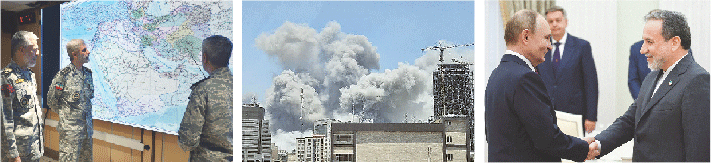
• Iran answers strikes on nuclear sites with ‘Operation Besharat al-Fath’, targets largest US base in Qatar
• US president thanks Iran for ‘advance notice’ ahead of missile strike
• Doha claims intercepting missiles aimed at Al-Udeid Air Base
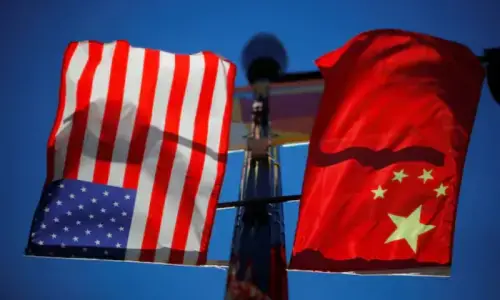
• Russia and China condemn US actions; Putin assures ‘support for Iranian people’
• US urges China to help keep Strait of Hormuz open
TEHRAN / WASHINGTON: Hours after Iran struck the largest US military base in the Middle East, President Donald Trump thanked Tehran for providing advance notice of the missile strike in Qatar.
More significantly, he called on both Israel and Iran to return to diplomatic efforts to bring peace and harmony to the region.
“I am pleased to report that NO Americans were harmed, and hardly any damage was done,” Trump said on Truth Social. “Most importantly, they’ve gotten it all out of their ‘system,’ and there will, hopefully, be no further HATE.”
Trump, who also claimed the US had “obliterated” Iran’s nuclear facilities in airstrikes a day earlier, characterised Tehran’s response as “very weak”, with 13 out of 14 missiles allegedly intercepted.
“Perhaps Iran can now proceed to Peace and Harmony in the Region, and I will enthusiastically encourage Israel to do the same,” he added.
The deft touch was uncharacteristic of Trump, who is known for his bombastic proclamations on social media, leading many observers to believe that diplomatic channels between Iran and the US had, indeed, been activated.
Iran gave advance notice to the US via diplomatic channels hours ahead of the attack, as well as to Qatari authorities. Trump seized on that as a positive sign. The actions appeared well-choreographed, allowing Iran to hit back to placate domestic pressure, while not causing American casualties that would be sure to trigger US entanglement.
Iran acted similarly in 2020 when Trump ordered the killing of top general Qasem Soleimani, hitting back at a base in Iraq housing US troops without killing any - after which tensions subsided.
The heightened tensions and subsequent exchanges occurred amidst a backdrop of recent diplomatic activity involving Iran, including engagements with Russia and China, both of which had condemned the initial US strikes.
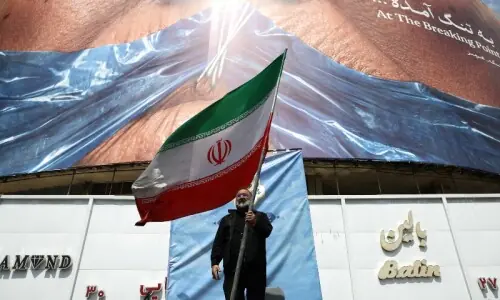
The Iranian operation, named ‘Besharat al-Fath’ (Annunciation of Victory) according to Iranian state TV, was a declared reprisal for a US action days prior that Washington said targeted Iran’s nuclear facilities.
The US Department of Defence has described Iran’s response as a retaliatory, but mostly “symbolic action”.
Operation Besharat al-Fath
A day after Washington targeted its nuclear facilities, Iran on Monday retaliated against US military bases in its neighbourhood, including Al-Udeid Air Base — the largest American military installation in the Middle East.
In a statement, the Revolutionary Guard Corps said Iran “will never leave any aggression against its territorial integrity, sovereignty, or national security unanswered”.
Two US officials confirmed they was tracking multiple missiles fired from Iran toward US military installations in Qatar and Iraq.
Although defences at the Ain al-Asad airbase in Iraq had also been activated, no Iranian attack detected at any US military base other than in Qatar, a US military official told Reuters.
The official also said that there was no direct impact on the Al-Udeid airbase in Qatar.
Qatari response
Although Qatari authorities condemned the attack and said they reserved the right to respond, they noted that there were no casualties in the attack.
Doha called the move “a flagrant violation of Qatar’s sovereignty and airspace,” but foreign ministry spokesperson Majed Al Ansari struck a reconciliatory tone, saying: “There are deep ties between the two states and the two nations, but the attack undoubtedly calls for a genuine meeting and a clear stance.”
Russian condemnation
Earlier, Russian President Vladimir Putin met with Iranian Foreign Minister Abbas Araghchi in Moscow, condemning US and Israeli attacks on Iran as “absolutely unprovoked” and “unjustified”.
Putin told Araghchi, “For our part, we are making efforts to assist the Iranian people.”
Kremlin spokesman Dmitry Peskov said Russia “deeply regrets and condemns” the US strikes, adding they ushered in a “new spiral of escalation.”
Asked if Russia would offer arms, Peskov focused on diplomacy: “It depends on what Iran needs. We have offered our mediation efforts.”
China’s criticism
China also strongly condemned the US airstrikes on Iranian nuclear facilities.
Fu Cong, China’s ambassador to the United Nations, said, “Iran is harmed, but also harmed is US credibility — as a country and as a party to any international negotiations.” He stated Beijing was “deeply concerned about the risk of the situation getting out of control.”
A Chinese foreign ministry statement accused Washington of intensifying tensions:
“The US move seriously violates the purposes and principles of the UN Charter and international law and exacerbates tensions in the Middle East. China calls on all parties to the conflict, especially Israel, to cease fire as soon as possible.”
Regarding Iran’s threats to close the Strait of Hormuz, Lin called the waterway “an important route for international trade in goods and energy,” urging efforts to prevent wider economic impact.
White House posture
On Monday, President Trump also appeared open to the idea of regime change, posting on Truth Social: “if the current Iranian Regime is unable to MAKE IRAN GREAT AGAIN, why wouldn’t there be a Regime change???”
White House press secretary Karoline Leavitt clarified that the US posture “has not changed” and that Trump “believes the Iranian people can control their own destiny.”
Meanwhile, US Secretary of State Marco Rubio has encouraged China to use its influence to prevent Iran from closing the Strait of Hormuz, a critical oil transit choke point.
Published in Dawn, June 24th, 2025