Today is Eidul Azha, or in local parlance ‘Bakra Eid’, and a whole set of celebrations unfold. These celebrations are mostly ‘meat based’ as almost every Pakistani Muslim sacrifices goats and cows and sheep, with camels also sparingly.
The statistical numbers are staggering. Officially last year in 2024 over 6.8 million animals were sacrificed in Pakistan alone. If the average meat recovered is 15kg per animal, that brings the meat total to an unbelievable 102 million kilos. Officially the population of Pakistan in 2024 was 251.2 million persons. This makes the meat available for consumption to over 400 grams per person. The average family of seven persons has almost three kilos to cook in the house. Amazing.
But we will return to such staggering statistics later. First a bit of history might make sense of these sacrifices. Humans thousands of years ago even sacrificed humans, mostly babies, to satisfy the ‘gods’ or deities they thought existed. Then came animals as a substitute. But human sacrifice is what is the beginning of Eidul Azha.
The story of Ebrahim and his son Ismail in Judaism are claimed to have had a dream in which the Allah Almighty commanded Ebrahim to sacrifice his son as a test of his ‘unwavering’ faith. Both father and son agreed and just as Ebrahim was about to cut his son’s throat, the Almighty intervened and replaced the son with a ram.
Here the story takes a twist, and the devil tried to stop them from sacrificing the ram and to return to the humans. At this stage, Ebrahim rejected the devil and threw stones at ‘him’. This stone-throwing is today part of that very ritual, just as sacrificing is.
In ancient Judaism animal sacrifice, known in Hebrew as ‘Korbanat’, was an important part of their faith, as long as it was carried out in the Temple of Jerusalem. This ritual included ancient burning of offerings of the animals to connect to God. In 586 BC, the Babylonians destroyed the temple, but it was rebuilt and the sacrifices continued within the temple.
Then in 70 CE the Romans destroyed the Temple of Jerusalem. That is when the Jews stopped animal sacrifice and instead concentrated on studying the Torah and mourning in front of the ancient wall that remains. But come Christ and his followers rejected animal sacrifice, claiming that the sacrifice of Hazrat Esa himself was more than enough.
But then when Islam came and as the Holy Quran narrates in Surah 22:36 that animal sacrifice is there to please Allah, and to remember the faith Hazrat Ebrahim had in the Almighty. The verse goes on to remind “every sane adult Muslim to sacrifice an animal from his excess wealth”.
The distribution of the meat so obtained must be in three equal parts. One third for the home of those sacrificing, another third to relatives and friends, and one third to the poor and needy. So it is that our faith starting from thousands of years ago recommends animal sacrifices.
Another point needs to be clarified. An animal cannot be sacrificed before Eid prayers in a collectively manner. The Hadith says that otherwise the sacrifice is null and void.
Now let us return to see what actually happens to the meat in Lahore. The first item available is the goat’s brain – ‘maghaz’ – and this is immediately cooked and served for breakfast. At least this is what our family did. Then the cooking starts. The bones are set aside and cooked for hours to get an amazing set of dishes.
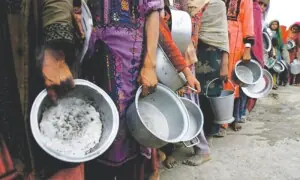
In Lahore we see groups of people going from house to house wanting meat. Some of them could collect as much as 15 to 20kg and store them away. If you observe the ‘katchi abadis’ along the railway lines, you might see meat strips hanging from ropes to dry. These are used over the next few months. The positive point is that they are not wasted. But at least these poor under-paid people get to consume meat which they seldom can afford, especially in this age of inflation.
Talking of inflation the prices this year are shocking. On various TV channels they are claiming that a healthy lamb or goat can cost over Rs100,000 or even higher. One champion goat was purchased for Rs1.5 million. Staggering. As I write these unbelievable lines and prices, the internet informs me that in England a 45kg lamb costs from £145 to £160.
That means a lamb that in England costs a maximum of Pak Rs60,000 costs three to five times more in Pakistan. To cover this the sellers are seen on TV claiming that they feed their animals with milk and almonds. Sounds like ‘hogwash’ to me. But then it is Bakra Eid, and we have to believe ‘traders’.
The negative side of the celebration is the waste heaps that collect. The offal’s can stink if not quickly disposed off. The skins are sold to leather traders and companies. The export of raw leather was always banned, and finished leather was preferred. One understands this policy has been changed.
But once all is under control visiting starts. Lunches and dinners for relatives and friends start. Amazingly, after day two people prefer vegetables to meat. Too much of meat can also be overwhelming.
Unlike Eidul Fitr where after a month of fasting, people wear their finest clothes and enjoy sweets and gifts. Youngsters prefer getting gifts and eating loads of sweets and snacks. Plus, visiting family and friends is also exciting. But Eidul Azha is a much more sedate affair.
My personal recollection of my youth was that our father took us five brothers walking all the way from our Rattigan Road house to the Badshahi mosque. We loved walking through the old walled city and listening to the commentary of our father.
But on Bakra Eid all of us were more concerned about the decorated ‘bakra’ tied at home. Sometimes the butcher came before we returned, and our English mother invariably asked: “
Namaz parr leeya”. We then sat around and watched as the meat was cut into pieces.
As a journalist we had a number of assignments to cover. So, life remained busy. At every place we were offered meat, which we refused. Naturally, one was sick of it by the time the day ended. But on a positive note, the best part was the ‘magaz’ breakfast. Eid Mubarak to all those who read this column.
Published in Dawn, June 7th, 2025